
When Stars Eat Planets: A Real-Life Cosmic Drama Unfolded by NASA’s Webb Telescope
NASA’s James Webb Telescope reveals a star slowly engulfing its planet—not in a violent flash, but in a quiet, fiery spiral. Learn what this means for Earth’s future.

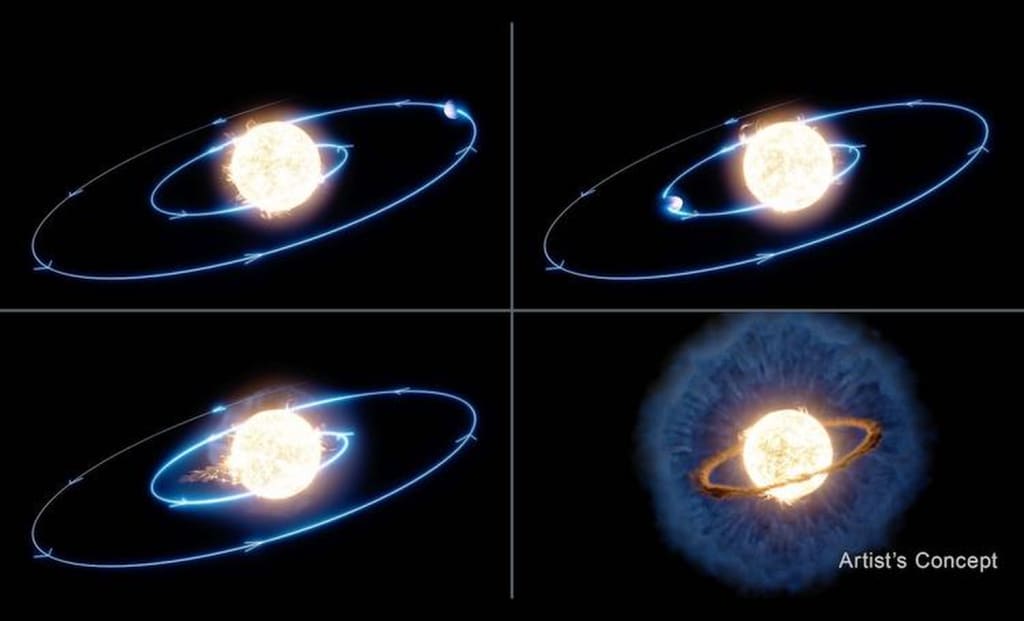
It was once thought that when an aging star engulfed a planet it would be a dramatic swelling and devouring event akin to a predator eating its prey. New observations however tell a very different story
Data from NASA’s James Webb Space Telescope JWST reveals that the planet’s orbit didn’t terminate with a sudden engulfment. Instead, the planet slowly moved inward over time until it was consumed by fire. The scientists behind this surprising update are from NSF’s NOIRLab and they worked with data collected by Webb’s powerful mid and near infrared instruments
Their observations challenge earlier theories and offer a clearer picture of what may await planetary systems like our own
Disappearing planet grabbed attention
The star at the center of this event sits about 12000 light years from Earth in our Milky Way galaxy. A flash of visible light first spotted in 2020 and labeled ZTF SLRN 2020 originally caught astronomers’ attention
However, earlier infrared data from the NASA NEOWISE mission had detected a brightening signal that suggested dust accumulation. A deeper investigation in 2023 led researchers to think the star was becoming a red giant
The narrative was altered by Webb's MIRI (Mid Infrared Instrument). Its ability to isolate faint emissions in crowded star fields showed that the star wasn’t as bright as a red giant should be
In fact, it never grew large enough to completely engulf a planet. Because this is such a novel event we didn’t quite know what to expect when we decided to point this telescope in its direction said Ryan Lau
With its high resolution look in the infrared we are learning valuable insights about the final fates of planetary systems possibly including our own.
Engulfed planet’s final orbit
The planet came to an abrupt end in slow motion, not in a flash. Researchers now believe the planet was roughly the size of Jupiter and orbited its host star much closer than Mercury orbits the Sun
It spiraled inward over millions of years. Eventually it began brushing the star’s outer atmosphere. That contact triggered a runaway effect the closer the planet got the faster it fell in
The planet as it’s falling in started to sort of smear around the star said Morgan MacLeod
Gas would have been blown outward from the star's surface as a result of this violent encounter. That gas then cooled and formed dust creating a faint halo that continued to glow in the infrared long after the planet Demise
Engulfed planet leaves gas disk behind
Webb’s Near Infrared Spectrograph NIRSpec offered an even closer look
Along with the expected cool dust cloud it revealed something much more surprising a hot molecular gas disk surrounding the star
This accretion disk contained carbon monoxide and other compounds the kind often found in regions where planets are born
With such a transformative telescope like Webb it was hard for me to have any expectations of what we’d find in the immediate surroundings of the star said Colette Salyk
This illustration depicts the sequence of events that took place over millions of years based on observations from Webb’s MIRI Mid Infrared Instrument and NIRSpec Near Infrared Spectrograph. Panel 1 The planet was about Jupiter sized and orbited very close to the star even closer than Mercury’s orbit around our Sun. Panel 2 The planet’s orbit slowly shrank or decayed over time and the planet approached the star. It eventually started to graze the star’s atmosphere. As the planet was falling in it smeared around the star. Panel 3 The planet was engulfed by the star completely and blasted gas away from the outer layers of the star. Panel 4 As that gas expanded and cooled off the heavy elements in this gas condensed into cold dust over the next year. There is a hot circumstellar disk of molecular gas closer to the star
I will say I could not have expected seeing what has the characteristics of a planet forming region even though planets are not forming here in the aftermath of an engulfment
This leftover material provides fresh clues about what happens after a planet disappears into a star
Researchers are now questioning how the interaction may have altered the star’s outer layers or affected nearby planetary debris.
Why does any of this matter
The event was observed under Webb’s Guaranteed Time Observation program 1240 one of the first Target of Opportunity programs ever conducted by the telescope
Even though scientists are unable to precisely predict when or where these rare events will occur, these programs are designed to capture them. Examples include stellar explosions and dramatic system changes. This is truly the precipice of studying these events. This is the only one we’ve observed in action and this is the best detection of the aftermath after things have settled back down enthused Lau. We hope this is just the start of our sample.
Will planet Earth be engulfed by the Sun
The Sun like all stars won’t shine forever. In about five to seven billion years it’ll run out of hydrogen the fuel that’s kept it stable and warm all this time
When that happens its core will contract and heat up while the outer layers expand. The Sun will swell into a red giant growing so massive that it might swallow Mercury and Venus
Earth sits right on the edge of that danger zone. It may be completely enveloped by the Sun, according to some scientists. Others believe Earth might just escape pushed outward as the Sun loses mass. Either way the outcome isn’t good
Even if Earth avoids getting swallowed it won’t survive the heat. The oceans will boil away. The atmosphere will vanish. The surface will burn
Eventually the Sun will shed its outer layers and collapse into a tiny dense white dwarf. What’s left of Earth if anything will be a frozen lifeless husk orbiting a dim burnt out star. No fire no light no life. Just silence
What happens next
With the help of observatories like NASA's Nancy Grace Roman Space Telescope and the upcoming Vera C. Rubin Observatory, more events like ZTF SLRN 2020 are expected to be discovered in the future. These tools will scan the sky repeatedly helping scientists to track sudden changes and expand our understanding of how stars and planets interact in their final acts
About the Creator
MD Habib
"Exploring health, science, history, and lifestyle through writing that inspires, informs, and transforms, offering fresh perspectives on life's mysteries and human journeys."
Environmental Volunteering in Sri Lanka
Reforestation and tree planting is one of the best ways to give back to nature. When you travel, you contribute to air pollution in a very big way. Emissions from air travel being one of the main contributors of global warming, everyone who travel should find a way to at least compensate for some of the pollution they are responsible for.
By Jayantha Wijesinghaabout 6 hours ago in Earth
A Transparent Look at Vocal Challenges and Top Stories
Almost three years ago, we shared a resource article that served as a place for people to suggest new challenge prompts. We thought it would be a good idea to refresh that thread, and take the opportunity to answer a few common questions about top stories, how challenges are judged and how submissions are reviewed.
By Vocal Curation Team4 days ago in Resources


Comments (2)
It inspired me thank you for publishing for us all♦️♦️♦️ps I subscribed to you please add me too 🙏💙
Hey, I'm MD Habib! Thanks for reading. I hope you read something that inspires you. Or something that you find relevant. I write a lot about lifestyle, history, science, world identity. Sometimes I try to answer other people's questions.