
When Behavior Walks Away:
Modern Animal Shifts and the Universe 25 Pattern

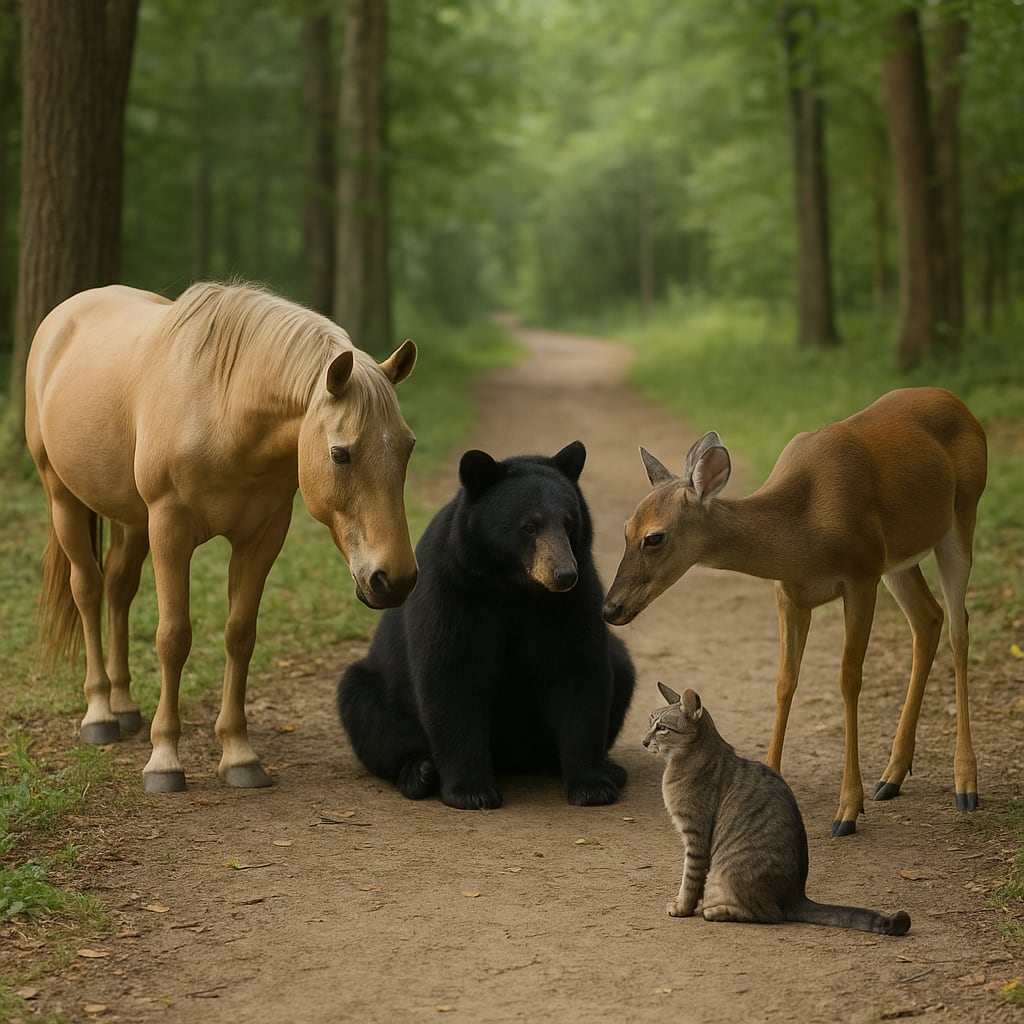
I have spent decades watching how behavior changes when the environment stops making sense. That skill came from forensics, trauma science, and animal work in the field. Patterns never break cleanly. They stretch first. They warp. Then the organism abandons the behavior that once kept it stable. I see that pattern now across animals that have nothing in common except the world they live in.
- Horses refuse tasks they performed for years without resistance.
- Deer and bears stand their ground instead of fleeing.
- Domestic animals pause before carrying out commands they never questioned.
None of these shifts are random. They follow rules that show up in neuroscience, ethology, and behavioral collapse models.
I've written before about how animals are warning us. However, Calhoun’s Universe 25 experiment is one of the clearest laboratory examples of what happens when a social species loses environmental coherence. The mice were not deprived. They had abundant food, clean water, and more physical room than they needed. The collapse began when their social structure lost meaning. Roles blurred. Hierarchies grew unstable. Purpose drifted. Females stopped protecting their young. Males withdrew or turned aggressive without clear reason. The group fragmented long before the population failed. By the time reproduction halted, the collapse had already taken hold. The animals lived in a world that looked “perfect” on paper but offered no stable behavioral anchors. Once purpose vanished, survival instincts became confused. The colony died even though the resources remained intact.
I see this same architecture in modern animal behavior. Horses react first because their survival depends on accurate reading of pressure and intent. They sense when a handler is uncertain or emotionally loud. They sense when the environment carries contradictions.
- A horse that stops, refuses, or checks out is not being difficult. It is responding to a world that feels untrustworthy. That reaction aligns with trauma responses in prey mammals. Freeze, refuse, or disengage. When the signals no longer match the expected pattern, the horse chooses safety over compliance.
- Deer and bears adapt in a different direction. When their environment becomes unpredictable, they reassess threat. Hunters now describe deer that lock eyes instead of fleeing. Bears test boundaries instead of retreating. These actions are not signs of boldness. They are calculations.
In unstable ecosystems, automatic flight becomes a waste of energy. The animal gathers information by standing still. If the human behaves inconsistently, the animal escalates. This is evolution in motion. It is also a sign of environmental noise pushing species into new decision pathways.
Domestic animals read emotional instability with a precision most people underestimate.
- A dog detects stress through scent, tone, and micro-movement.
- A cat shifts territory when tension saturates a living space.
- Even livestock adjust to human emotional patterns faster than the humans tracking them.
This is built into mammalian neurobiology. Stress contagion travels through sound and posture long before it becomes visible to people who are not trained to read it.
The fusion point between these field observations and Universe 25 is not metaphorical. It is behavioral. Collapse begins when meaning breaks. In Universe 25, the mice showed that survival needs are not enough. A social species requires structure, predictability, and purpose. When those elements fail, behavior frays. Aggression rises in some individuals. Withdrawal takes over in others. Care for young disintegrates. Self-maintenance becomes compulsive. Reproduction stops. These behaviors match the dysfunction seen in captive animals, chronically stressed humans, and trauma survivors whose environments no longer support coherent action.
Modern animals are reporting the same fracture. They respond to emotional and environmental instability with shifts that match early collapse patterns. They are not confused. They are accurate. They sense the pressure change before humans admit it exists. Their hesitation, refusal, or recalibration is information. It tells us that the environment they inhabit carries signals that no longer align with predictable behavior. When animals stop playing along, the world has already changed.
I treat these changes as evidence, not anecdotes. They reveal the same structure Calhoun documented: behavioral patterns collapse when the environment loses meaning. In Universe 25, the collapse was contained inside a laboratory. Outside those walls, the same rules apply. The only difference is scale.
Readers who are drawn to this line of analysis will find a deeper expansion of it in my book When the Earth Says Enough.
---------------------------------
Sources That Don’t Suck
Calhoun, J. B. (1973). Death squared: The explosive growth and demise of a mouse population. Royal Society of Medicine Press.
McEwen, B. S. (2007). Physiology and neurobiology of stress and adaptation. McGraw-Hill.
Panksepp, J. (1998). Affective neuroscience: The foundations of human and animal emotions. Oxford University Press.
Siegel, A., & Victoroff, J. (2009). Understanding human aggression: New insights from neuroscience. Academic Press.
Tinbergen, N. (1963). On aims and methods of ethology. Oxford University Press.
About the Creator
Dr. Mozelle Martin
Behavioral analyst and investigative writer examining how people, institutions, and narratives behave under pressure—and what remains when systems fail.
Keep reading
More stories from Dr. Mozelle Martin and writers in Earth and other communities.
Animals Are Warning Us
Wildlife is not getting meaner. Animals are not “turning on us.” What is changing is something larger and far less comfortable for people to admit: the energetic field we share with them. For months now I’ve been hearing real accounts from the field and reading incident logs that all point in the same direction.
By Dr. Mozelle Martin3 months ago in Earth
Donald Trump warned that the world has just ten days to find out whether Iran will accept a new agreement, cautioning that serious consequences could follow if no deal is reached.
US President Donald Trump says that the world will find out over the ten days if the United States will make a deal with Iran or take military action.
By The Academy Awards33 minutes ago in Earth



Comments
There are no comments for this story
Be the first to respond and start the conversation.