
What You Should Know About California Proposition 65 and Product Compliance
Prop. 65
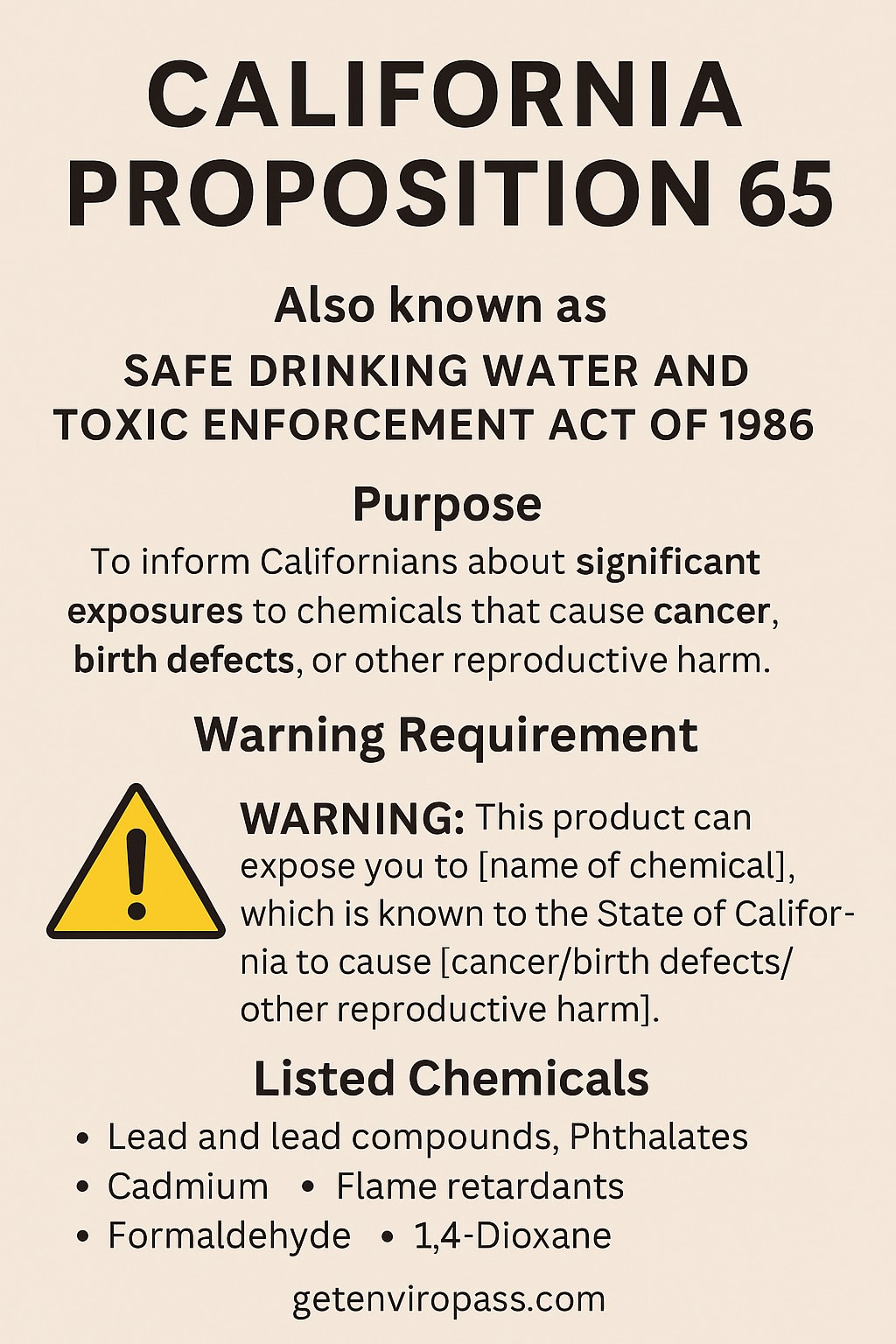
California is known not only for its innovation and environmental leadership but also for its strict safety regulations. One of the most impactful and far-reaching among them is California Proposition 65—officially titled the Safe Drinking Water and Toxic Enforcement Act of 1986.
If your company sells products in California—whether directly or online—understanding and complying with Proposition 65 (Prop 65) is not just wise; it’s legally essential.
What Is California Proposition 65?
Proposition 65 is a right-to-know law. It requires businesses to warn Californians about significant exposures to chemicals that cause cancer, birth defects, or other reproductive harm. The state maintains a list of chemicals—updated at least once a year—that are known to cause these health effects. As of today, the list includes over 900 substances.
But the purpose isn’t necessarily to ban those chemicals. Rather, it’s to ensure that consumers and workers are informed of their presence in the products or environments they encounter.
Who Needs to Comply?
The rule applies to any company with 10 or more employees that sells products in California, regardless of whether the business is located in or outside the state. This includes:
- Manufacturers
- Distributors
- Retailers
- Importers
If your product contains any listed substance above the defined safe harbor limits (or no limit is established), then you must provide a clear and reasonable warning.
This obligation can seem daunting, especially given the growing list of substances and the complexity of exposure scenarios. That’s where working with a compliance expert can make all the difference.
What Are Safe Harbor Levels?
To help businesses determine whether a warning is needed, California established safe harbor levels. These include:
- No Significant Risk Levels (NSRLs) for carcinogens
- Maximum Allowable Dose Levels (MADLs) for reproductive toxins
If exposure to a chemical stays below these thresholds, no warning is required. However, if no safe harbor level has been established for a listed chemical, you must either:
Provide a warning, or
Perform a qualified risk assessment to demonstrate the product’s safety.
How Should You Label Products?
The most recognized aspect of Prop 65 compliance is the warning label. This can be applied to the product, packaging, website, or catalog. Since 2018, Proposition 65 warnings have had stricter formatting requirements:
A yellow triangle with an exclamation mark
A standard warning phrase such as:
“⚠ WARNING: This product can expose you to [name of chemical], which is known to the State of California to cause [cancer/birth defects/other reproductive harm].”
A link to the California Proposition 65 website for more information.
Failing to follow these requirements can lead to penalties of up to $2,500 per day, per violation. Lawsuits can also be filed by the state or private parties.
What Are the Most Common Chemicals Listed?
Some chemicals frequently flagged in electronics, packaging, and consumer products include:
- Lead and lead compounds
- Phthalates (such as DEHP, DBP, and BBP)
- Cadmium
- Flame retardants
- Formaldehyde
- 1,4-Dioxane
Products like cables, solder, batteries, plastic casings, and coatings may contain these substances—even in trace amounts. Therefore, supply chain communication becomes critical.
How Enviropass Can Help
At Enviropass, we specialize in helping businesses navigate Proposition 65 compliance. Our team:
- Identifies listed substances in your products
- Evaluates safe harbor levels and exposure scenarios
- Develops appropriate warnings and labeling strategies
- Supports supply chain documentation and communication
- Assists with product testing and risk assessments
We recognize that small and medium-sized businesses may find this law overwhelming, especially when products are sold across different jurisdictions. That’s why Enviropass offers a free initial consultation to assess your needs and help you move toward compliance confidently.
Why Should You Act Now?
Even if you’re not based in California, the state’s laws can still apply to you. Online marketplaces like Amazon often require Prop 65 warnings to be in place for listed products. Moreover, failure to comply can damage your reputation, interrupt sales, or result in costly litigation.
Being proactive not only protects your brand—it demonstrates your commitment to health, transparency, and environmental responsibility.
Final Thought
Whether you're a manufacturer, importer, or retailer, understanding Proposition 65 is vital for anyone selling in the California market. And you don’t have to do it alone. Let Enviropass guide you through the process—so you can focus on delivering safe, compliant, and trustworthy products.
About the Creator
Keep reading
More stories from Mahgol Nikpayam and writers in Earth and other communities.
REACH with 251 SVHC
The European Chemicals Agency (ECHA) continues to strengthen chemical safety across the European Union through its regulatory framework, REACH (Registration, Evaluation, Authorisation, and Restriction of Chemicals). One of the essential tools under REACH is the Candidate List of Substances of Very High Concern (SVHCs), which identifies chemicals that pose serious risks to human health and the environment.
By Mahgol Nikpayam6 months ago in Earth
US Warns Airlines About Military Activity in Parts of Latin America
Commercial aviation is built on predictability—clearly defined airspace, coordinated air traffic control, and shared international rules. When that predictability is disrupted, even subtly, the ripple effects can stretch far beyond the cockpit. That is exactly why a recent warning from the United States has caught the attention of airlines, governments, and travelers alike. In early 2026, US aviation authorities issued an advisory warning airlines about military activity in parts of Latin America, urging pilots to exercise heightened caution when flying over certain regions. While no immediate restrictions or flight bans were imposed, the message itself was clear: something in the skies has changed, and the risks—however limited—can no longer be ignored. This development is not just about aviation safety. It reflects a growing intersection between geopolitics, military operations, and civilian infrastructure in a region that has long balanced cooperation with tension. What Exactly Did the US Warn About? The advisory, released through official aviation safety channels, highlighted concerns over potential military activity affecting airspace across parts of Mexico, Central America, South America, and nearby oceanic regions. Airlines were advised to remain vigilant during all phases of flight, including cruising at high altitudes, takeoff, and landing. Unlike routine notices related to weather systems or airport congestion, this warning explicitly referenced security-related risks. These include the possibility of unexpected military movements, temporary airspace disruptions, and interference with navigation systems that modern aircraft rely on for safe operations. Importantly, the warning did not accuse any specific country of wrongdoing, nor did it suggest an immediate danger to passengers. Instead, it served as a precaution—one designed to ensure airlines adjust flight planning, monitoring, and communication protocols accordingly. Why Military Activity Matters to Civil Aviation To the average traveler, military exercises or operations may seem distant from the experience of flying on a commercial jet. In reality, the two worlds often share the same skies. Civilian aircraft depend heavily on satellite navigation, coordinated air traffic control, and stable airspace rules. Military operations—especially those involving fast-moving aircraft, surveillance systems, or electronic equipment—can introduce uncertainty into that environment. Some of the key risks aviation authorities monitor include: Unplanned military aircraft movements that may not follow civilian flight patterns Temporary airspace closures or restrictions that require last-minute rerouting Navigation signal disruptions, whether accidental or intentional Increased congestion in strategic corridors used by both civilian and military flights While these risks are typically managed through coordination and communication, heightened military activity raises the stakes. The FAA’s advisory suggests that such activity has reached a level where additional caution is warranted. The Geopolitical Context Behind the Warning The timing of the advisory is not accidental. Latin America has seen a noticeable rise in security operations and military coordination involving the United States over the past year. These efforts are largely focused on counter-narcotics missions, maritime security, and regional stability, particularly in areas with strategic shipping routes or ongoing political tension. At the same time, broader global dynamics—ranging from great-power competition to shifting alliances—have increased the strategic importance of air and sea routes across the Western Hemisphere. From Washington’s perspective, issuing an aviation warning is not about alarmism. It is about acknowledging that military and security activities in the region may temporarily affect civilian systems, including aviation. How Airlines Are Responding For airlines, advisories like this are not unusual—but they are taken seriously. Most major carriers already operate with layered safety systems that allow them to respond quickly to changing conditions. In practical terms, this warning may lead to: Slight route adjustments to avoid specific airspace Enhanced pilot briefings before flights Increased coordination with air traffic controllers Closer monitoring of navigation and communication systems So far, there have been no widespread flight cancellations or suspensions linked directly to the warning. That suggests airlines view the risk as manageable, provided proper precautions are followed. Reactions from Latin American Governments Some governments in the region have been quick to reassure the public. Officials have emphasized that their national airspace remains safe and fully operational, and that civilian flights continue without disruption. This response highlights an important tension: while the US warning is precautionary, it can still affect public perception. Tourism, business travel, and investor confidence are all sensitive to suggestions of instability—even when no immediate danger exists. As a result, many countries are walking a careful line between cooperating on aviation safety and defending their reputation for stability. What This Means for Passengers For travelers, the key takeaway is simple: commercial aviation remains safe. Warnings like this are designed to prevent incidents, not predict them. Passengers flying through or over affected regions may experience slightly longer flight times or minor schedule adjustments, but there is no indication of increased danger to civilian aircraft. In fact, the existence of such advisories demonstrates how seriously aviation authorities take even low-probability risks. A Sign of a More Complex World The US warning to airlines is a reminder that modern air travel does not exist in a vacuum. As military operations, security concerns, and geopolitical rivalries evolve, civilian systems—from shipping lanes to flight paths—are increasingly affected. This moment underscores a broader reality: the skies are becoming more crowded, more contested, and more interconnected with global politics. Managing that complexity will require continued transparency, cooperation, and vigilance from governments, regulators, and airlines alike. For now, planes continue to fly, passengers continue to travel, and the system continues to work. But behind the scenes, aviation authorities are quietly adjusting to a world where safety is shaped not just by weather and mechanics—but by geopolitics as well.
By Muhammad Hassanabout 20 hours ago in Earth




Comments
There are no comments for this story
Be the first to respond and start the conversation.