
What You Need to Know About the Annular Solar Eclipse of 2023
A comprehensive overview of the science, history, and significance of the annular solar eclipse that will occur on October 14, 2023, and how it differs from other types of solar eclipses.


An annular solar eclipse, which is extremely rare and spectacular, will take place on October 14, 2023. It will be possible to see this phenomenon, also referred to as a "ring of fire" eclipse, from North America, Central America, and South America as well as some regions of Europe and Africa. This blog post will define annular solar eclipses, describe how they differ from other types of solar eclipses, outline viewing locations and times, and discuss the significance of annular eclipses for science and culture. As well as discussing annular solar eclipses and how to get ready for this once-in-a-lifetime event, we'll also share some fascinating and unexpected facts and figures.
What is an Annular Solar Eclipse?
When the moon moves in front of the sun, it obscures our planet from some or all of the sun's light, causing a solar eclipse. There are four types of solar eclipses: total, partial, annular, and hybrid, depending on the distances and positions of the sun, moon, and Earth.
A total solar eclipse occurs when the moon completely blocks the disk of the sun, casting a shadowy area on Earth. When the moon only partially blocks the sun's disk, a partial solar eclipse occurs, casting a crescent-shaped shadow on Earth. An annular eclipse that transitions to a total eclipse along its path is known as a hybrid eclipse.
When the moon is unable to completely block the sun's disk because it is slightly smaller than the sun in the sky, an annular solar eclipse occurs. This creates a stunning "ring of fire" effect around the moon's silhouette. The moon is smaller than usual because it is in its slightly elliptical orbit's furthest point from Earth. It is known as the apogee. Perigee refers to the opposite point, which is when the moon is closest to Earth.
There may be a big difference between apogee and perigee. For instance, the new moon will be approximately 406,000 kilometers (252,000 miles) from Earth on October 14, 2023, when it is at its apogee. The full moon will be at perigee on October 28, 2023, when it will be about 357,000 kilometers (222,000 miles) from Earth. This represents a discrepancy of roughly 49,000 kilometers (30,000 miles), or about 12% of the typical distance between Earth and the moon.
When and Where Can You See the Annular Solar Eclipse of 2023?
The 2023 annular solar eclipse will take place on October 14th, a Saturday. At 16:38 UTC (11:38 ADT), the eclipse will begin. It will end at 20:46 UTC (3:46 ADT). Depending on where you are, the eclipse will last a different amount of time. When the ring of fire is visible, annularity can last for up to 4 minutes and 28 seconds.
The region of North America where the ring of fire is visible will be along the path of annularity, which runs from Texas to beyond. It will also travel through parts of South and Central America. The path will be roughly 200 kilometers (125 miles) wide. Below is a map that highlights the annularity's path in red and the areas that will experience a partial solar eclipse in blue.
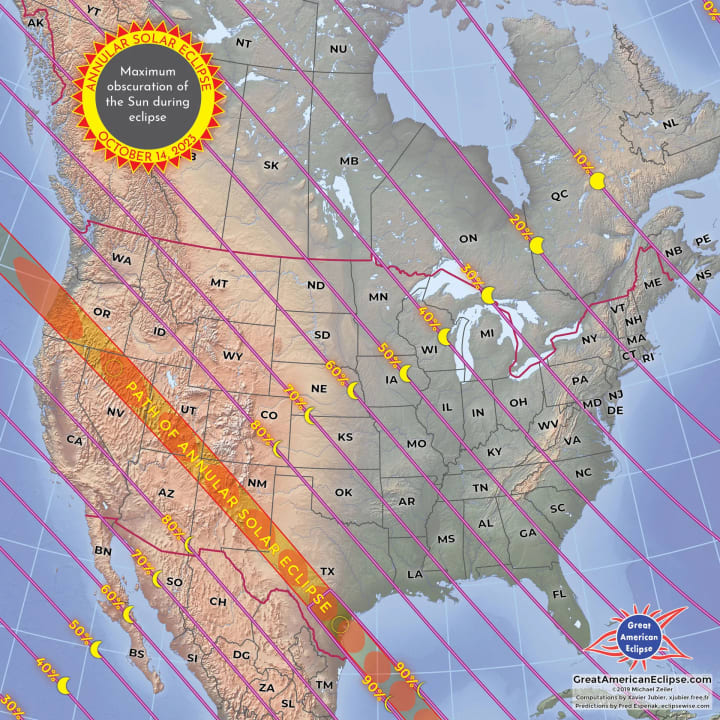
If you're fortunate enough to be in or close to the annularity's path, you'll get to see a breathtaking sight. The sun will appear as a brilliant ring with a hole in the center. Although not as much as during a total solar eclipse, the sky will become slightly darker. Additionally, the temperature and wind speed may have changed.
You will see the sun partially obscured by the moon if you are inside the region of a partial solar eclipse but outside the path of annularity. Depending on where you are and when it is, there will be varying degrees of obscuration (how much of the sun is blocked). The sun will be more obscured the closer you are to the path of annularity.
How to View the Annular Solar Eclipse Safely and Clearly?
There are specific safety measures and tools needed to view an annular solar eclipse. An annular solar eclipse never reaches totality, the point at which it is safe to look directly at the sun (when it is entirely obscured by the moon). In light of this, permanent eye damage or blindness can result from looking at the sun directly, through regular sunglasses, or through binoculars.
The use of appropriate eye protection or indirect viewing techniques is the only safe way to view an annular solar eclipse. Here are a few possibilities:
- Eclipse glasses: These unique eyewear block out the majority of the sun's harmful rays. They are inexpensive and widely accessible online, at astronomy clubs near you, or museums. Ensure that they have ISO 12312-2 as their certification from the International Organization for Standardization (ISO). Use only working glasses; do not use old or scratched ones. Avoid using 3D glasses, regular sunglasses, or homemade filters. They are insufficiently secure.
- Pinhole projector: A straightforward tool that uses a tiny hole to cast the image of the sun onto a screen. One is simple to make with a cardboard box, some tape, paper, and a pin. Make a tiny hole in the box's side and tape the paper to the other. Hold the box over your head while standing with your back to the sun. When the sun appears clearly on the paper, adjust the distance between the hole and the paper. Do not peer through the sun's hole.
- Solar filter: With the aid of this specialized filter, you can view the eclipse through a telescope, pair of binoculars, or camera while blocking the majority of the sun's light. Although they cost more and are more difficult to find than eclipse glasses, they provide a better view of the sun's finer details. Make sure they fit securely and are built for your particular device. Avoid utilizing common filters, such as neutral density or polarizers. They are insufficiently secure.
When viewing a solar eclipse, it is essential to prioritize safety. Regardless of the method you choose, please follow these safety tips:
- Never look directly at the sun or use any optical device without a proper solar filter.
- Avoid looking through a camera, telescope, binoculars, or any other optical device while wearing eclipse glasses as concentrated solar rays can harm your eyes and the device.
- Do not leave your device unattended, and always supervise children when they are using it.
- Take frequent breaks and avoid staring at the sun for extended periods.
- If you experience discomfort or pain in your eyes, stop viewing the eclipse immediately and seek medical attention.
Why is the Annular Solar Eclipse of 2023 Important for Science and Culture?
Not only is an annular solar eclipse a stunning sight to behold, but it also offers important opportunities for science and culture. Some of the explanations are as follows:
- Science: Since the sun's brightness normally obscures the corona, the outer atmosphere of the sun, an annular solar eclipse enables researchers to study it. Most of the sun's activity, including flares and coronal mass ejections, takes place in the corona. Satellites, power grids, communication systems, and climate on Earth are all susceptible to these phenomena. Scientists can gain more insight into the corona's structure, temperature, magnetic field, and dynamics by watching it during an annular solar eclipse.
- Culture: Throughout history and all over the world, an annular solar eclipse has inspired and influenced numerous cultures and traditions. Others believe it to be a sign of good or bad fortune, a sign of impending change or disaster, or a sign of divine power or wrath. Some individuals observe it through festivals, rites, prayers, or gifts. Some people make use of it as a chance for introspection, meditation, or education. Artists, writers, musicians, and filmmakers may become curious and inventive as a result of an annular solar eclipse.
What are Some Interesting and Surprising Facts and Figures About Annular Solar Eclipses?
A rare and amazing occurrence, annular solar eclipses provide a wealth of information about our solar system and planet. Here are a few instances:
- There are annular solar eclipses more frequently in some years than others. There are roughly 0.75 annular solar eclipses annually on average, or one every 16 months. There may be one or two annular solar eclipses in some years, though.
- An annularity can last for a maximum of 12 minutes and 24 seconds. This occurs when the sun is directly overhead at the equator, the Earth is at its closest point to the sun (perihelion), and the moon is at its furthest point from Earth (apogee). The shortest time that annularity can last is less than a second. This occurs when the sun is near the horizon at high latitudes, the Earth is slightly farther from the sun than perihelion, and the moon is slightly closer to Earth than apogee.
- The next annular solar eclipse will take place on October 2, 2024, after the one on October 14, 2023. This eclipse will be visible from the Pacific Ocean, southern Chile, and southern Argentina. Another annular solar eclipse that will cross North America will take place on June 11, 2048, after October 14, 2023. This eclipse will be seen from Northern Canada, Greenland, Iceland, northern Europe, and northern Asia.
- The last annular solar eclipse visible from Asia and Australia occurred on October 14, 1957.
We hope this blog post was interesting to you and that you learned something new about the annular solar eclipse of 2023. This is an exceptional chance to see one of nature's most breathtaking displays. You can still enjoy the beauty and wonder of this celestial event whether you are in the path of annularity or not. Use the right tools and keep in mind the safety precautions when viewing the eclipse. Happy eclipsing, and thanks for reading!
About the Creator
Keep reading
More stories from Farzan Ahmed and writers in Earth and other communities.
10 Steps to Develop a Better Sense of Humor and Make People Laugh
Are you tired of being the only one in the room who doesn't get the joke? Do you wish you could effortlessly come up with witty comebacks and hilarious stories? Well, you're in luck! In this article, we're going to take you on a laughter-filled journey and share 10 practical steps to help you develop a sense of humor that will make you the life of the party. Get ready to unleash your inner comedian and leave everyone in stitches!
By Farzan Ahmed3 years ago in Humor
Scientists Probe How Long-Term Spaceflight Alters Immunity
On Earth, a human body with a properly functioning immune system will work to overcome an infection. But in space, that same immune system will have to work a bit harder to overcome the same infection. In the isolated environment of the International Space Station, many factors — physiological stress, disrupted circadian rhythms, radiation, microgravity, and other spaceflight factors — can alter an astronaut’s immune response.
By Voice of Reality6 days ago in Earth
Guard Your Battery
Why are some people so attractive just by standing there? It’s not because they are "likable," but because they don’t need everyone to like them. I realized later that truly charismatic people allow themselves to be criticized, but they never criticize themselves. They never try to please the world; instead, the world stops to watch them.
By Emily Chan - Life and love sharing2 days ago in Poets




Comments
There are no comments for this story
Be the first to respond and start the conversation.