
What Would Happen If Earth Fell into a Black Hole
Lets Dive In

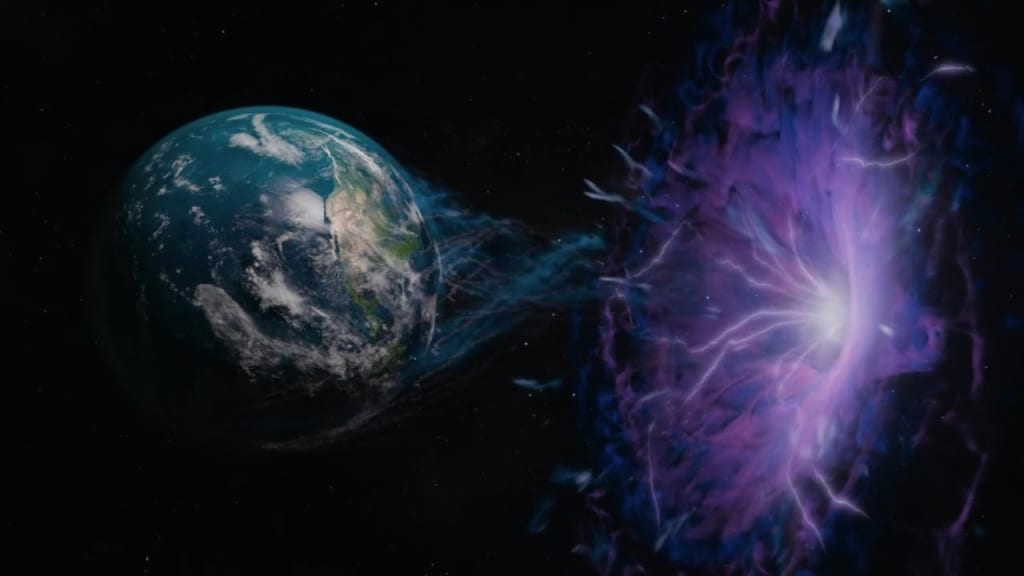
Black holes are some of the most mysterious and intriguing phenomena in the universe. They possess a sinister quality, capable of devouring entire stars and planets while distorting the fabric of space and time. But what if our home planet, Earth, were to fall under the grip of a black hole's event horizon? What would we witness before the inevitable end? Let's explore this scenario.
Black holes can be likened to playground bullies, intimidating and best avoided at all costs. They are regions of space where gravity is so incredibly strong that even light cannot escape their clutches. It's like witnessing a reverse Houdini act.
Just as no two snowflakes are alike, each black hole possesses its own unique characteristics, including mass, spin, and charge. They come in various sizes, similar to different types of jeans—petite, slim, regular, and husky. In the realm of black holes, we have four sizes. The smallest are the stellar-mass black holes, born from massive stars that collapse in on themselves. They resemble the chihuahuas of the black hole world, tiny yet feisty. Even the smallest stellar-mass black hole is three times more massive than our sun.
Next, we have the intermediate-mass black holes, the middle children of this cosmic family. These black holes are too large to be born from collapsed stars. Scientists theorize that they may form when multiple black holes merge into one. While they may not dominate galaxies, they can still consume nearby stars, which is quite an accomplishment for them.
Now, if we're talking about galaxy dominators, we have the supermassive black holes, the enormous monsters of our universe. These giants have masses ranging from millions to billions of times that of our sun. They play a crucial role in the growth and formation of their host galaxies. And lastly, there are the ultra-massive black holes, the cosmic eldritch horrors that are extremely rare. The ones we know of can engulf entire galaxies, much like Pac-Man devouring dots.
So, what would happen if you got too close to a black hole? What would your last moments be like? As you approach the event horizon, an invisible boundary marking the edge of a black hole, strange things begin to occur. Time starts to slow down, but only from the perspective of an outside observer watching you fall into the black hole. From your perspective, you wouldn't feel any different. However, the observer would see you gradually slow down and eventually freeze in time, as if paused in a video.
As you get closer, mind-bending phenomena come into view. The intense gravity of the black hole causes light to bend and distort, creating a fun-house mirror effect. You might witness a halo of light known as the photon ring or jets of high-energy particles emanating from the black hole's poles. Surprisingly, you can approach a black hole quite closely without experiencing significant effects. It's only when you cross the event horizon that there's no turning back—the point of no return.
Once inside a black hole, you're on a collision course with the singularity, a point of infinite density at its center where all matter is compressed to a single point. It's like attempting to fit an elephant into a tiny matchbox—everything is crushed down to its smallest possible size. And with that, it's time to bid farewell.
Now, if all these aspects of black holes sound terrifying, here's a comforting fact: black holes are actually quite common. In fact, there's one in the center of each galaxy, including our very own Milky Way. However, this doesn't mean we'll eventually be swallowed by one. The nearest known black hole to our solar system, Gaia bh1, is located about 1,600 light years away in our own Milky Way galaxy. Black holes move slowly and will never come close enough to pose a threat to our system.
The black hole at the center of our galaxy, Sagittarius A*, is indeed massive and exerts a strong gravitational pull. However, it only affects objects in close proximity. The objects within the galaxy, including planets, are too large and move too fast to be pulled into a black hole. Nevertheless, black holes remain captivating objects of study, and scientists continue to unlock their mysteries.
So, while the idea of Earth falling into a black hole may be fascinating to contemplate, rest assured it will never happen. The chances of such an event are infinitesimally small, even more unlikely than winning the lottery. Black holes serve as reminders of the awe-inspiring power of our universe. Now, let's redirect our attention to the incredible power of chocolate.
That concludes today's exploration. If you found this intriguing, please like and share the video with your friends. And for more fascinating content, click on the suggested videos and stay on the bright side.
About the Creator
Random Facts
hope you guys enjoy the stories i publish, please support and like
thank you
Keep reading
More stories from Random Facts and writers in Earth and other communities.
Scientists Found Black Holes on Earth, Here's Where They Are
Let me transport you to a realm that appears to be beyond our world. The life thriving within this cavern has been secluded from the outside realm for approximately 5.5 million years, and the evidence is striking. Witness it firsthand. Due to this prolonged isolation, the conditions within this mobile cave are unparalleled anywhere else on Earth. A distinctive ecosystem flourishes despite the scarcity of sunlight and the presence of toxic air. Situated a few miles west of the Black Sea in Romania, this cave was initially discovered in 1986. Nowadays, access is restricted to those with special permission. Furthermore, the central caverns are naturally safeguarded by narrow limestone tunnels and vertical shafts. If you are prone to claustrophobia, it is advisable to avoid venturing into this place. The cave's depth harbors air with half the oxygen content compared to the outside atmosphere, instead comprising significant amounts of carbon dioxide and hydrogen sulfide—far from the freshest air one can breathe. Additionally, the cavern is pitch black. Despite, or perhaps owing to, these extremely harsh conditions, the site proves to be a veritable treasure trove for biologists. Astonishingly, life thrives within. In a 1996 study, scientists identified 48 species, 33 of which were unique to this cave. Most of the creatures residing within this environment are diminutive, equipped with long limbs and antennae to navigate the darkness. They lack vision and pigmentation, for what purpose is there to see or display vibrant colors when dwelling in perpetual darkness, unseen by any observer?
By Random Facts3 years ago in Earth
Birds with Wild Hairdos
Cockatoos are known for their expressive crests, which they raise or lower depending on their mood. The crests can be white, yellow, or pink. These charismatic birds are native to the Australian continent, the islands of the Indo-Australian archipelago, and parts of New Guinea. There are 21 different species of cockatoo, varying in size from the diminutive Galah to the imposing Sulphur-crested Cockatoo. Most cockatoo species are highly social birds, forming strong pair bonds that often last a lifetime. Cockatoos are primarily herbivores, with a diet consisting of seeds, nuts, fruits, roots, and occasionally insects and larvae.
By Rasma Raistersabout 13 hours ago in Earth




Comments
There are no comments for this story
Be the first to respond and start the conversation.