
Scientists Found Black Holes on Earth, Here's Where They Are
Lets Dive in

Let me transport you to a realm that appears to be beyond our world. The life thriving within this cavern has been secluded from the outside realm for approximately 5.5 million years, and the evidence is striking. Witness it firsthand. Due to this prolonged isolation, the conditions within this mobile cave are unparalleled anywhere else on Earth. A distinctive ecosystem flourishes despite the scarcity of sunlight and the presence of toxic air. Situated a few miles west of the Black Sea in Romania, this cave was initially discovered in 1986. Nowadays, access is restricted to those with special permission. Furthermore, the central caverns are naturally safeguarded by narrow limestone tunnels and vertical shafts. If you are prone to claustrophobia, it is advisable to avoid venturing into this place. The cave's depth harbors air with half the oxygen content compared to the outside atmosphere, instead comprising significant amounts of carbon dioxide and hydrogen sulfide—far from the freshest air one can breathe. Additionally, the cavern is pitch black. Despite, or perhaps owing to, these extremely harsh conditions, the site proves to be a veritable treasure trove for biologists. Astonishingly, life thrives within. In a 1996 study, scientists identified 48 species, 33 of which were unique to this cave. Most of the creatures residing within this environment are diminutive, equipped with long limbs and antennae to navigate the darkness. They lack vision and pigmentation, for what purpose is there to see or display vibrant colors when dwelling in perpetual darkness, unseen by any observer?
Now, let us embark on a journey to another remarkable cave, one that differs greatly in appearance. Welcome to the Giant Crystal Cave, also known as the Cave of the Crystals, located in Mexico. These colossal crystals were unearthed in the year 2000 by a mining company after the water had been pumped out of the cave. Two miners stumbled upon this awe-inspiring sight while traversing the desiccated cavern on foot. These breathtaking crystals are, in fact, massive gypsum pillars concealed 984 feet beneath the surface. Firmly anchored to the cave's walls and floor, scientists estimate that these crystals have been growing for approximately half a million years, which explains their immense size—some are long and wide enough to walk across. Unfortunately, visiting this natural wonder is presently impossible. Perhaps it is for the best, as the Giant Crystal Cave is a hazardous place that could easily become inaccessible for tens of thousands of years. Initially, it was filled with groundwater, propelled upward into the cavity by a magma chamber located deep within our planet. The magma beneath the cave maintained the water's high temperature. Eventually, the water cooled below 136 degrees Fahrenheit, causing calcium and sulfate particles to combine and form gypsum. These white-tinted crystals gradually dominated the cave as they continued to grow, submerged beneath the water.
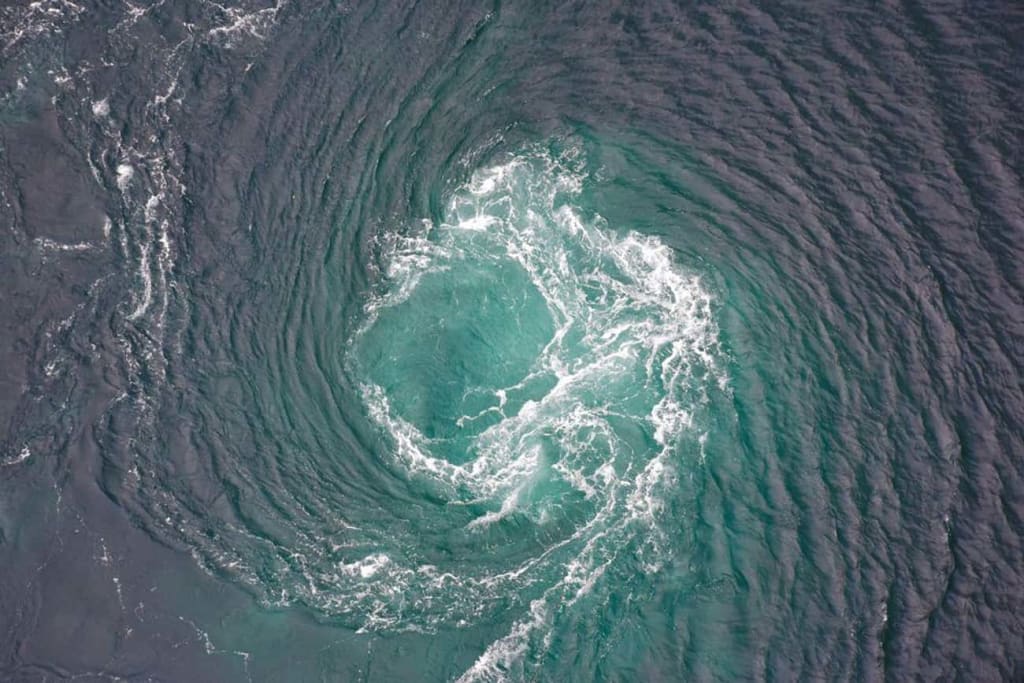
Exploring a black hole doesn't require a journey to space. Scientists have discovered something remarkably similar to black holes right here in the southern Atlantic Ocean. Black holes possess an immense gravitational force that ensnares anything within their grasp, leaving no chance of escape—not even light can flee their grasp. Astonishingly, oceanic black holes exhibit comparable power to their celestial counterparts. However, instead of capturing light, they ensnare water. Ocean eddies, colossal whirlpools that spin counter to the main current, often churn billions of tons of water. Most of these eddies surpass the size of a city. Their strength is such that nothing trapped within them can escape. The terrifying aspect is that you might not even realize you are heading into one of these powerful whirlpools. They are so vast that their boundaries remain imperceptible until it is too late. Scientists used satellite technology to explore oceanic vortices, which led to the identification of several eddies and the revelation that they possess the same mathematical properties as enigmatic black holes in space. These massive eddies are encased within incredibly tight barriers, where fluid circulates in closed loops. Even water cannot escape from within these loops. Thus, these formidable oceanic vortices serve as immense containers, containing water that can differ significantly from the surrounding ocean, not only in temperature but also in salt content.
On the narrow spit of land known as the Curonian Spit, which divides the Baltic Sea from the Curonian Lagoon, lies one of Earth's most peculiar places. Locals refer to this area as the Dancing Forest, for the pine trees that inhabit it possess astonishingly peculiar shapes—they twist and contort in spirals and circles along the ground. Various theories attempt to explain this phenomenon. Some attribute it to a clash of immense positive and negative energies within the area, while others propose that the sandy soil in the region is too unstable to support vertically growing trees. Another popular hypothesis suggests that strong winds blowing from the water influence the tree shapes. However, experts have yet to reach a definitive conclusion.
Behold these underwater crop circles. Initially discovered in 1995 near the coast of southern Japan, these seven-feet-wide formations earned the moniker "mystery circles" from local divers. For almost 16 years, these enigmatic structures puzzled researchers until the culprit was finally revealed—a male pufferfish. These fish require a little over a week to construct a single circle, and aesthetics evidently play a crucial role. The male swims within the circle, using its fins to create valleys in the sand. Additionally, the fish employs shells and corals to decorate specific portions of the circle. This circle-building behavior serves a practical purpose as well. As the male fish swims, it pushes the sand toward the center of the circle, creating a mound that later serves as a nest.
Our next mystery takes us to the Caribbean, just off the coast of Belize, where a colossal sinkhole known as the Great Blue Hole resides. Spanning approximately one thousand feet in width and plunging over 400 feet into the depths, this hole was once an ancient cave. Over time, rising waters filled the cave, causing it to collapse inward. As you descend further into the crystalline waters of the Great Blue Hole, darkness envelops you, revealing numerous caves adorned with stalactites. However, entering these caves is highly perilous unless you wish to become hopelessly lost. Once you reach a depth of 50 feet, you will notice a shimmering line—a boundary separating the saltwater above from the freshwater abyss below. It might be wise to reconsider venturing deeper, for who knows what secrets lie within the murky depths.
Legend once spoke of an Amazonian river that boiled, but it was dismissed as mere folklore. However, Peruvian geoscientist Andres Ruzo questioned the possibility of such a river's existence. Initially, experts dismissed the notion, as hot rivers are typically found near volcanic areas. However, the region mentioned in the legend lacked any active volcanoes. Undeterred, Ruzo persisted in his quest. In 2011, he finally located the fabled river. True to the legend, the water in this river is steaming hot, measuring 186 degrees Fahrenheit—almost boiling. Yet, what shocked the researcher most was the river's vast size. While thermal pools are usually small, this river stretches 20 feet deep and flows for almost four miles, making it the only one of its kind on our planet.
That concludes our journey for today. If this has satisfied your curiosity, please show your appreciation by liking and sharing this video with your friends. For more fascinating content, click on the
About the Creator
Random Facts
hope you guys enjoy the stories i publish, please support and like
thank you
Keep reading
More stories from Random Facts and writers in Earth and other communities.
Eerie Sounds from Mount Everest: What's Really Happening?
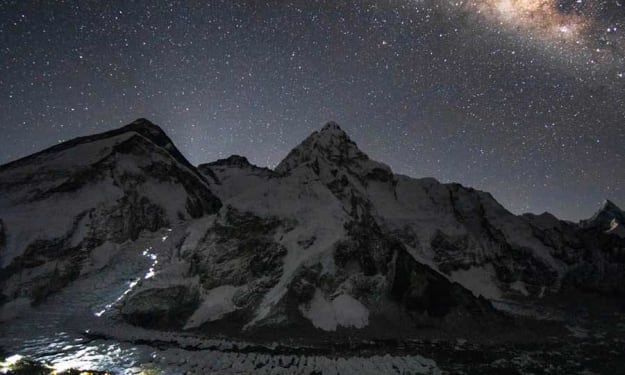
Have you ever contemplated why mountains exude such tranquility and silence? Prepare to be astonished because these majestic landforms possess hidden talents. Mountains are, in fact, performers in their own right, with unique songs and dance routines. What does this mean and how does it work? Let's delve into this chilling revelation.
By Random Facts3 years ago in Earth
Without Democracy, Donald Trump’s Venezuelan Oil Quest Will Fail
Donald Trump’s renewed interest in Venezuelan oil may seem, on the surface, like a hard-nosed geopolitical calculation. Venezuela holds the world’s largest proven oil reserves, and amid global energy uncertainty, access to those resources is undeniably tempting. But history, economics, and politics all point to the same conclusion: without democratic reform in Venezuela, any attempt by a Trump-led US administration to secure reliable Venezuelan oil will ultimately fail.
By Aarif Lashari3 days ago in Earth



Comments
There are no comments for this story
Be the first to respond and start the conversation.