
What’s Really in Your Soup Bowl? The Truth About Biodegradable Options
Why Not All Eco-Friendly Soup Packaging Is What It Claims to Be—and What You Should Choose Instead
🥣 Introduction: A Warm Meal in the Wrong Bowl?
Whether it’s miso ramen, lentil stew, or chicken noodle, soup has become a year-round favorite in the fast-casual and takeaway world. But here's the real question: Is your soup bowl as clean and sustainable as your ingredients?
You may think your packaging is eco-friendly. After all, it says “biodegradable” or “compostable” on the label. But what if we told you most disposable soup bowls contain hidden plastics, misleading certifications, and don’t degrade the way they promise?
This blog dives into the material science, certifications, and market reality behind common paper soup bowls, especially those labeled as “biodegradable soup bowls.” We'll explore:
- What’s really in your takeaway soup container
- The difference between biodegradable and compostable
- How to choose the best disposable bowls for hot soup
- And the right questions to ask your supplier
🧪 The Problem: Greenwashed Packaging Is Everywhere
The rise in environmental awareness has driven many food businesses to replace plastic with paper soup bowls and compostable alternatives.
But here’s the reality:
A 2022 study by the Environmental Packaging Alliance tested 100 products labeled as biodegradable or compostable in the U.S. and EU markets. The findings?
- 72% had plastic linings (PE or PLA)
- Only 28% met full compostability standards (EN 13432, ASTM D6400)
- Most paper soup bowls with lids used dual materials (fiber + plastic), making them non-compostable and non-recyclable
So while the product might look sustainable—it may not break down in compost or landfill conditions at all.
♻️ Biodegradable vs. Compostable: A Critical Difference
Before we look at materials, let’s clarify terminology:
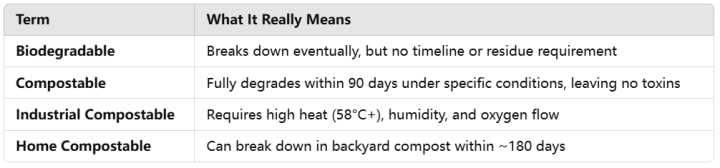
So your biodegradable soup bowls? Unless they’re certified compostable, they might take decades to break down—or worse, leave microplastic behind.
🧱 What’s Really in “Paper” Soup Bowls?
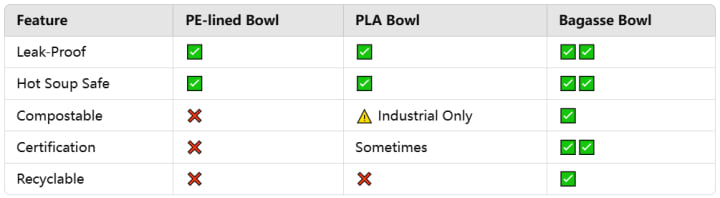
Most disposable soup bowls sold today fall into 3 categories:
- PE-lined Paper Bowls
Plastic lining prevents leaks
Not compostable or recyclable
Common in low-cost takeaway soup bowls
- PLA-lined Bioplastic Bowls
Marketed as “eco-friendly”
Compostable only in industrial composters
Decomposes poorly in natural settings
- Natural Fiber Compostable Bowls (Bagasse, Bamboo, Wheat Straw)
No plastic liners
Fully compostable (home & industrial)
Heat-resistant up to 120°C
Often the best disposable bowls for hot soup
🔥 Performance: Not Just About Sustainability
Even the greenest packaging must perform under pressure—especially with hot, oily liquids.
A 2023 product test by Global Packaging Watch compared bowl types:

💡 Bagasse (sugarcane fiber) came out on top across all categories.
🔍 What to Look for in a Truly Eco-Friendly Soup Bowl
When sourcing takeaway soup bowls, check for:
Certified compostable materials (bagasse, bamboo, water-based coated paper)
Matching compostable lids—plastic lids disqualify the whole product
Certifications like:
- EN 13432 (EU)
- ASTM D6400 (USA)
- BPI Certified
- OK Compost / OK Compost HOME
If your paper soup bowl with lid lacks these—assume it’s not compostable.
📦 Real-World Example: A Brand That Switched
A California-based soup meal subscription brand switched from PLA-lined “biodegradable” bowls to bagasse compostable soup bowls in 2023.
After 90 Days:
- Customer satisfaction rose by 23% (due to better lid performance & leak resistance)
- Reduced packaging-related complaints by 84%
- Achieved zero-waste certification in 2 states
- Switched to a certified supplier with EN 13432 and BPI compliance
🏭 Recommended Supplier: Xiamen Bioleaderpack Co., Ltd.
If you’re serious about switching to compostable soup packaging, partner with a verified manufacturer:
✅ Xiamen Bioleaderpack Co., Ltd.
- Specializes in compostable soup bowls from bagasse and bamboo
- Offers paper soup bowls with lids in all standard takeaway sizes
- Certified under EN 13432, ASTM D6400, OK Compost, and BPI
- Heat-resistant (up to 120°C), leak-proof, and stackable
- Full OEM/ODM customization and private label support
- Ships globally to North America, EU, Middle East, Asia-Pacific
📊 Comparing Options at a Glance
❓ FAQ: Top 5 Google Questions About Biodegradable Soup Bowls
1. Are paper soup bowls really compostable?
Only if they have no plastic lining and carry valid certifications like EN 13432 or BPI. Most “paper” bowls have PE or PLA linings.
2. Can I microwave biodegradable soup bowls?
Yes, but only those made from natural fibers like bagasse or bamboo. PLA-based bowls may not withstand microwave heat safely.
3. What are the best disposable bowls for hot soup?
Certified compostable soup bowls made from bagasse are the best—they’re leak-proof, heat-safe, and fully compostable.
4. Do compostable soup bowls degrade in home compost?
Some do. Look for OK Compost HOME certification. Many require industrial composting conditions to fully break down.
5. Where can I buy compostable soup bowls in bulk?
Xiamen Bioleaderpack offers certified paper soup bowls with lids, available in wholesale quantities for international foodservice brands.
💡 Final Takeaway: Your Bowl Is More Than a Container
If your food is clean, nourishing, and thoughtfully prepared—your packaging should be too.
Choosing the wrong disposable soup bowl not only compromises the eating experience but also undermines your brand’s sustainability message.
✅ Choose materials that are certified, safe, and perform under pressure
✅ Avoid hidden plastics and vague “biodegradable” claims
✅ Work with suppliers who provide documentation and transparency
Because what’s really in your soup bowl isn’t just the ingredients—it’s your values.
About the Creator
Without Democracy, Donald Trump’s Venezuelan Oil Quest Will Fail
Donald Trump’s renewed interest in Venezuelan oil may seem, on the surface, like a hard-nosed geopolitical calculation. Venezuela holds the world’s largest proven oil reserves, and amid global energy uncertainty, access to those resources is undeniably tempting. But history, economics, and politics all point to the same conclusion: without democratic reform in Venezuela, any attempt by a Trump-led US administration to secure reliable Venezuelan oil will ultimately fail.
By Aarif Lashari4 days ago in Earth
So You Decided To Become a Nurse Practitioner:
So you decided to become an "Advanced Practice" nurse. Congratulations!... is what I would say if this was a good idea. Grad school? In this economy? What were you thinking? Likely it was something along the lines of either 1) “I've seen these other chucklefucks do it— Why can't I?” or even 2) “I've got a nice career, I should shake it up. I miss feeling like I have no clue what I'm doing.”
By Sandor Szaboa day ago in Fiction



Comments
There are no comments for this story
Be the first to respond and start the conversation.