
What is Happening to the Earth’s Core?
The Earth roughly leaks about 90 tons of material each day. Should we be nervous about these leaks?
A hydrogen molecule soars high within the Earth’s peripheral atmosphere. This particular molecule had previously entered the exosphere a long time ago, and during its stay on Earth, it has spent time in the waves of the Atlantic Ocean, the soil of the Amazon, and even in the steam rising from a boiling pot of spaghetti. However, today, traveling at speeds multiple times faster than the speed of sound, it overcomes Earth’s gravitational pull and escapes, joining the approximately 90 tons of material that break free from our atmosphere every day. This daily, whale-sized atmospheric loss is just one example of how Earth is leaking. Atoms, energy, and particles leak from one layer of the planet to another. And for Earth, whose protection is vital for sustaining life, these leaks can be concerning.
To better understand the extent of the planet’s flawed systems and when they become problematic, we should explore two more leak sites. Our next stop takes us to the Earth’s surface, specifically to a field in Central Appalachia. Here, a 1,500-meter well connects an oil reservoir to the Earth’s surface. The oil reservoir has dried up, leaving the site abandoned. However, this underground reservoir also contains the potent greenhouse gas methane, which continues to rise up the well and escape through cracks and faulty lines. This leaking well joins the millions of abandoned wells scattered throughout the US, collectively emitting, by conservative estimates, 280,000 metric tons of methane annually.
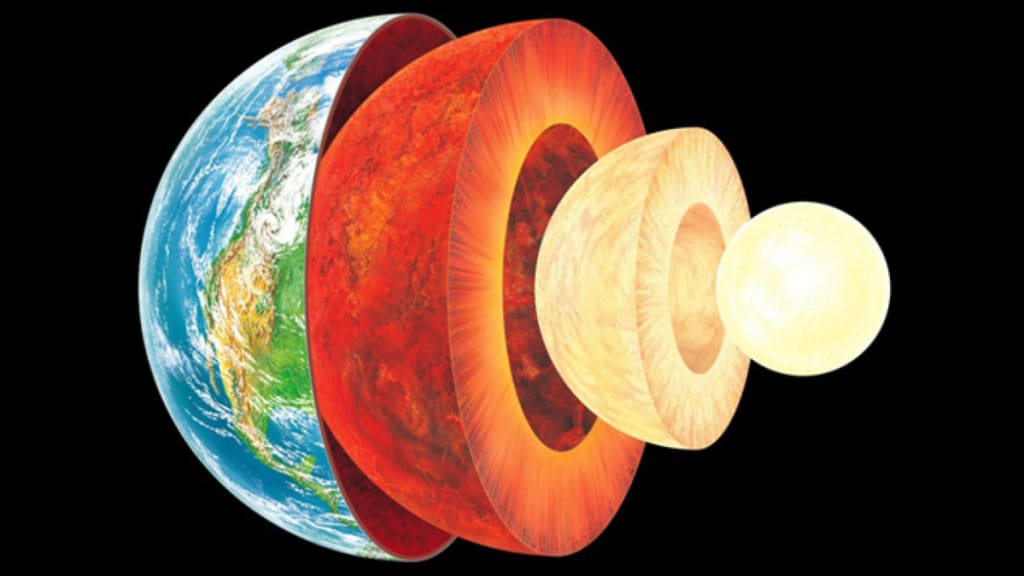
Our final leak point takes us deep within Earth’s innermost boundary, the core. Heat, originating from the formation of our local planetary system, propels the movement of liquid metal around the solid inner core. This movement, in turn, generates the planet’s magnetic field, a shield that protects us from cosmic radiation and solar wind. Yet, the core is not perfectly sealed, so heat continually escapes, flowing into the surrounding mantle and driving plate tectonics and volcanic activity. Consequently, the outer liquid metal of the core is slowly solidifying. When fully cooled, the magnetic field will vanish, leaving us exposed to the Sun’s harshest rays.
Earth clearly exhibits several leaks and flaws. Should we be concerned? Fortunately, the immediate risks of our hydrogen leak are minimal. At its current rate, it would take over 150 billion years to lose all our hydrogen to space. The same applies to our core leak. Scientists estimate that the core won’t completely cool for another 700 million to several billion years. Methane emissions, however, have the potential to alter our Earth’s atmosphere within the next decade. Methane’s unique structure efficiently traps outgoing heat from Earth, capturing it in the atmosphere as energy. This gives methane incredible warming potential, exceeding that of carbon dioxide by a factor of twenty-five. The impact of methane escaping from abandoned wells in the US is equivalent to burning 10 billion pounds of coal annually. As most of the world’s top oil producers have yet to comprehensively assess or survey their abandoned wells, the global emissions from all neglected wells are likely significantly higher. Furthermore, they add to the estimated 570 million tons of methane emitted by other anthropogenic and natural sources annually. Beyond their climate impact, these uncapped wells can leak methane and other toxic gases into nearby groundwater, contaminating drinking water and affecting local ecosystems.
Fortunately, non-producing oil wells can be sealed by injecting cement into their depths. While many state and federal governments require oil and gas companies to plug inactive wells, the cost of plugging has historically led companies to avoid such measures. For decades, these faulty, low-producing, and economically unviable wells were sold off and abandoned. Clearly, oil and gas companies won’t solve this problem on their own. It will take concerted governmental efforts, such as imposing substantial taxes on methane emissions and organized oversight of plugging, to hold companies accountable. However, the issue starts even before these wells are abandoned. Within the US, active oil and gas production emits massive amounts of methane, ten times that of abandoned wells. The most effective way to eliminate this leak is to stop drilling oil and gas wells altogether.
About the Creator
Keep reading
More stories from Regina Joseph and writers in Earth and other communities.
The One Thing Stopping Jellyfish from Taking Over
Over the past few decades, jellyfish have begun to dominate our oceans. In New Zealand, divers encounter thousands of stinging jellyfish, each no larger than a grain of pepper. In Sweden, a massive swarm of moon jellyfish shut down one of the world’s largest nuclear reactors by clogging the plant’s main intake pipes. And in the Sea of Japan, thousands of 200-kilogram Nomura’s jellyfish with bells two meters in diameter swarm fishermen, snapping nets and devouring local fish. All around the world, these creatures voraciously consume fish eggs and larvae, often undermining marine farming efforts, and outcompeting adult fish by consuming the resources they need to survive. If things continue on their current trajectory, we could be headed for a future where the entire ocean is teeming with jellyfish.
By Regina Joseph3 years ago in Earth
The Day the Forest Spoke
A Walk Into the Unknown It began as an ordinary hike, a chance to escape the chaos of the city and immerse myself in the green stillness of the old Redwood Forest at the edge of my town. The sun filtered through the towering trees in long golden beams, the leaves rustling faintly with a whisper of wind, and for a moment, I felt at peace — detached from deadlines, notifications, and the endless noise of human life. I hadn’t planned for anything extraordinary, just a few hours of solitude surrounded by the ancient giants that had stood for centuries, quietly observing the world.
By The Curious Writer2 days ago in Earth


Comments
There are no comments for this story
Be the first to respond and start the conversation.