
What If the Moon Disappeared?
What Would Happen to Earth?

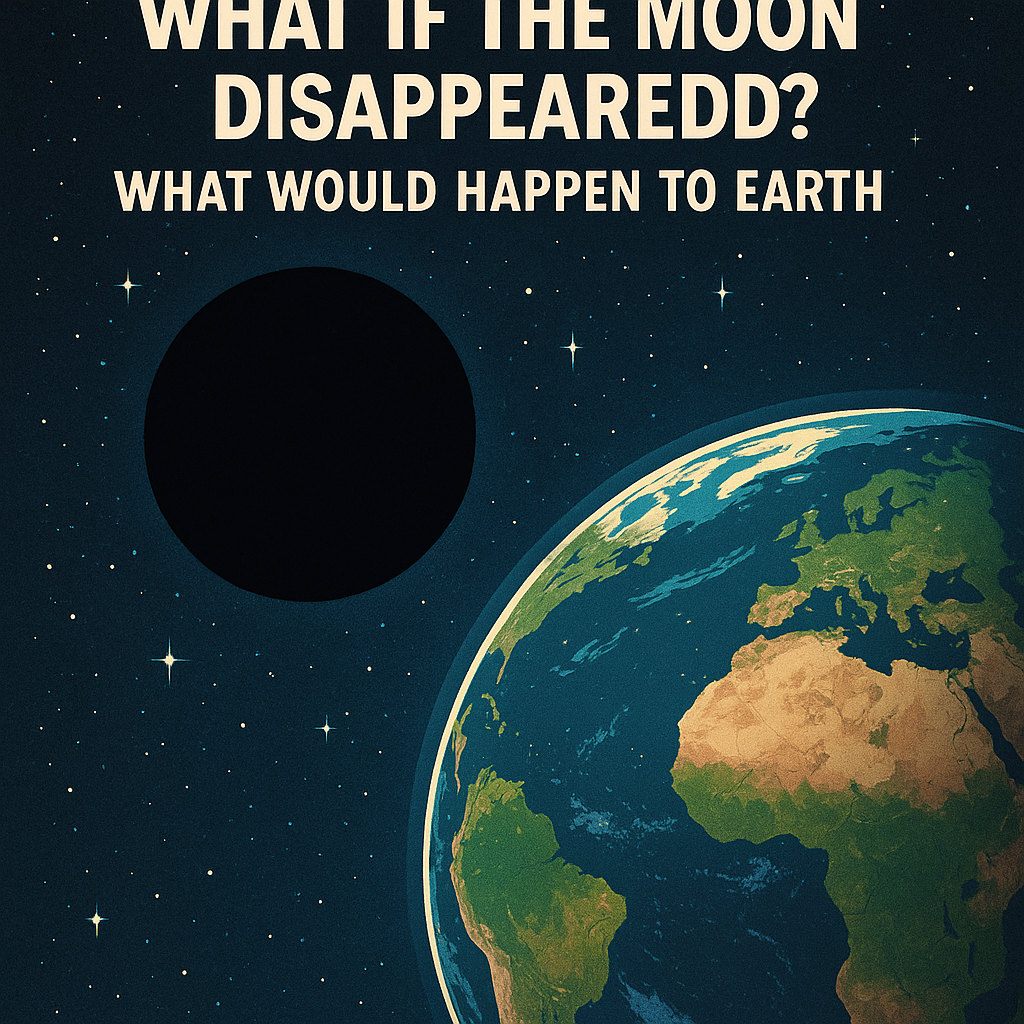
Imagine the night sky being empty when you look up at it. No silver crescent to evoke poetry or dreams, no bright moon to illuminate the night. Doesn't that sound dramatic? However, the effects of a sudden Moon disappearance would extend well beyond a darker sky. The Moon is more than just a pretty face; it is essential to the stability, life, and rhythms of Earth.
Let's examine what would happen if our cherished lunar companion abruptly vanished. It's an intriguing (and a little scary) thought.
🌊 Tides Would Fall—But Not Disappear
Ocean tides are caused by the Moon's gravity. Without it, the Sun alone would still exert some pull, causing tides to drastically decrease to around one-third of their current size. While beachgoers may find this to be a relief, marine ecosystems would be devastated. Strong tidal flows are essential for the feeding and breeding of many coastal species. No tides? That is an impending catastrophe for the food chain.
🌍 Earth’s Spin Would Go Wild
The Moon's role as a cosmic stabilizer for Earth's axis is one of its most important functions. Earth would gradually begin to wobble more in its absence. Our planet's tilt could change from the 23.5° it is now to anywhere between 10° and 85°. That means seasons would become extreme or disappear altogether. Imagine snow in the Sahara or boiling summers in Antarctica—it’s climate roulette on a planetary scale.
🌒 Say Goodbye to the Lunar Night Light
Nights would get much darker without the moon—up to 100 times darker, actually. It may sound romantic, but nocturnal animals will not like that. Many of them depend on moonlight for hunting, navigation, or avoiding predators. Human culture, from ancient calendars to nighttime rituals, would lose an iconic anchor. And let's not forget: no moon means no more lunar eclipses, werewolf myths, or moonlit kisses.
💫 The Sky Would Look Less Alive
The Moon is the second-brightest object in our sky and has a beautiful ability to reflect sunlight. The sky would be flatter and more void if it didn't exist. Not to mention, space exploration history would lose its first giant leap. No Moon means no Apollo missions, no “one small step,” and maybe—no push for Mars.
🦴 Life on Earth Might Never Have Existed
The big one is this: According to some scientists, the Moon stabilized the environment and produced tidal zones, which were essential for the emergence of life on Earth. Without the Moon from the beginning? Life might have struggled to form—or never evolved past the simplest levels.
So… Should We Worry?
The Moon isn't going anywhere, so don't freak out just yet. Although it is slowly moving away from Earth (about 3.8 cm annually), it will take billions of years for it to completely escape. Still, imagining a moonless Earth reminds us just how perfectly balanced our cosmic setup is.
Remember that glowing sphere is more than just a decoration the next time you look up at it. As a silent protector, the Moon ensures that life flourishes, the night sky is exquisitely alive, and the Earth rotates steadily.
Conclusion:
Our world would be rocked, both literally and figuratively, by the Moon's departure. It is more than just a rock in the sky; it is a stabilizing force, a lifeline, and a representation of inspiration and mystery. So perhaps wink at it tonight. We owe it more than a beautiful poem, after all.
About the Creator
sondos azhari
Passionate about health and beauty products, I delve into wellness practices and skincare routines. With a focus on holistic living.My aim is to empower others to prioritize self-care and make informed choices for their well-being.
Keep reading
More stories from sondos azhari and writers in Earth and other communities.
I Went on the Dark Web—and It Shook Me to My Core
Lately, I’ve found myself teetering on the edge of curiosity and recklessness. I’ve done a few crazy things recently, but today? Today takes the crown. I willingly opened a digital door most people wouldn’t dare approach. I went on the Dark Web.
By sondos azhari10 months ago in Families



Comments
There are no comments for this story
Be the first to respond and start the conversation.