
What if planets were triangles or cubes?
Ever wondered what our galaxy would look like if planets decided to ditch their round shapes and go all edgy with cubes or triangles?
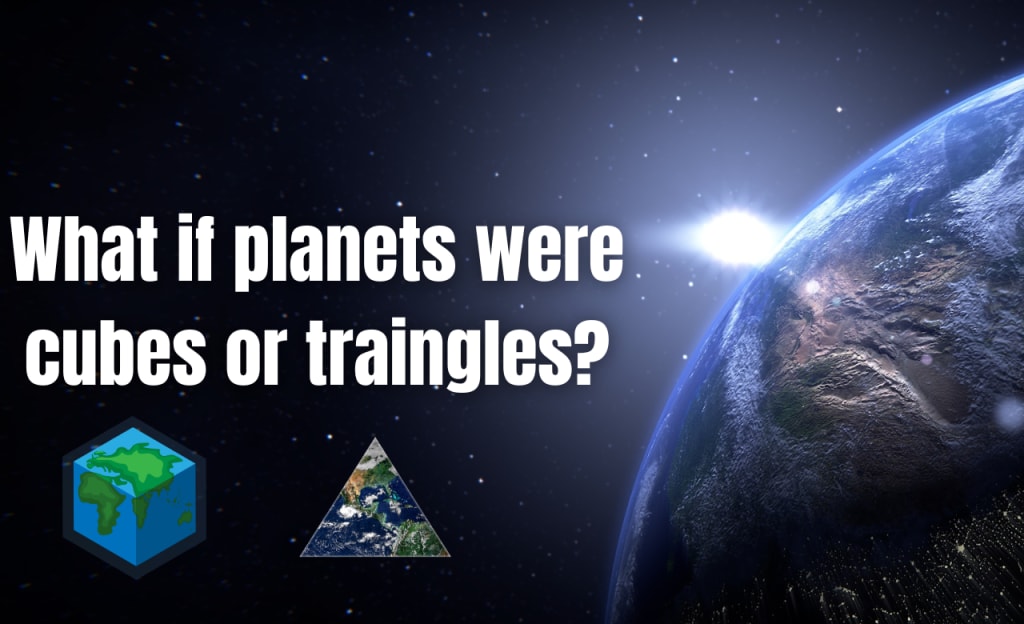
Have you ever wondered about the intriguing spherical shape of all planets? Imagine if these celestial objects decided to challenge convention and adopt different forms. Could we end up with cube-shaped planets, triangular moons, or even unimaginable intergalactic structures? Let's dive into this concept. So, how do planets actually come into existence? The universe contains massive clouds of dust and gas, known as molecular clouds, consisting of various elements like hydrogen, helium, carbon, and oxygen. These clouds act like a cosmic kitchen, providing the ingredients necessary for creating new planets. The initial step in forming planets is known as the accretion theory. Consider a scenario where an event triggers gravitational instability, perhaps a nearby supernova explosion. This disturbance causes the gas and dust within the cloud to come together due to gravity. These particles start to gather around a central point, much like squeezing a ball in your hand. Over time, they compact tightly, causing the cloud to flatten and form a disk shape, much like mixing flour and water to make pizza dough. This resulting disk is referred to as a protoplanetary disk, and its rotation is a consequence of the initial spin of the cloud particles. Visualize tiny dust particles and gas molecules dancing within the disk. Occasionally, they collide and stick together, forming clumps called planetesimals—these serve as the fundamental building blocks of planets. Through subsequent collisions and mergers, these planetesimals gradually grow larger, evolving into protoplanets. As these protoplanets gain mass, their gravitational pull intensifies, making them the dominant entities within their cosmic realms—the planets we're familiar with. Each planet possesses its own unique combination of gases, rocks, and potentially water. But what's responsible for the planets' spherical appearance? This is primarily due to gravity. Imagine squeezing a balloon—the air inside resists this pressure, resulting in equilibrium. Similarly, on planets, gravity compresses material inward, while the material's pressure pushes outward, counteracting the force of gravity. This balance is referred to as hydrostatic equilibrium. Another contributor to the spherical shape is the planet's rotation. Think of a rapidly spinning ball of Play-Doh—the material at the equator pushes outward, causing a bulge, while the poles flatten. The same principle applies to planets as they rotate on their axes. The interplay of gravity and rotation leads to a bulging effect at the equator, giving planets their spherical form. This unique interplay of factors is responsible for their distinct appearance. However, what if planets were not spherical? What if they took on cube-shaped or triangular forms? If a celestial body deviates from a sphere, its mass distribution changes significantly, impacting gravity. On a cube or triangle-shaped planet, gravity would vary across its surface. Standing at the center of a face, you'd feel the strongest gravitational pull, as the faces are closest to the center of mass. As you move toward the edges or corners, gravity's angle becomes steeper, much like ascending a mountain or steep slope. Water and atmosphere distribution would also change, rendering certain regions inhospitable due to extreme climates and reduced atmospheric pressure. To conclude, while our Earth embraces its spherical form, contemplating alternative shapes lets our imagination run wild. This exploration prompts us to appreciate the wonders of our remarkable planet, regardless of its shape.
As we ponder these fascinating concepts, it's important to remember that the existing understanding of planet formation and shape is based on our current scientific knowledge. While cube-shaped or triangular planets might be entertaining to envision, they are largely speculative and theoretical at this point. The intricacies of planetary physics and the delicate balance between gravitational forces, rotation, and material properties make spherical shapes the most common outcome in our universe. Nonetheless, exploring these imaginative scenarios can spark curiosity and deepen our appreciation for the diverse possibilities that the cosmos might hold.
About the Creator
Keep reading
More stories from Danesh Kumar Thiyagarajan and writers in Earth and other communities.
How Will Our Universe End?
We're all familiar with the concept of the Big Bang, and it's quite disheartening that the popular TV series "The Big Bang Theory" has come to an end. However, let's steer away from the candy bars and delve into a different aspect – the Big Crunch. While most people have heard of the Big Bang, fewer are acquainted with the Big Crunch. Despite various theories like the Big Freeze and the Big Rip, the Big Crunch stands out as the most plausible scenario for the eventual fate of the universe.
By Danesh Kumar Thiyagarajan2 years ago in Earth
Greenland’s Strategic Position in Seven Maps: Why Trump Wants the Island
In 2019, former U.S. President Donald Trump made waves by suggesting the United States should buy Greenland from Denmark. While his offer was quickly dismissed by the Danish government, the incident sparked a wider discussion about the geopolitical and strategic significance of the island. Why, out of all the territories in the world, would a major world power be so keen to acquire this cold, remote landmass?
By Muhammad Hassanabout 16 hours ago in Earth
Northern Lights May Be Visible in 10 States Jan. 20 as Earth’s Magnetic Field “Rings Like a Bell” After CME Impact
What Happened: A Massive CME Hit Earth On Jan. 19, 2026, a powerful CME associated with a major X1.9-class solar flare erupted from the sun and traveled the approximately 93 million miles to Earth in around 25 hours — much faster than most such events. When it reached Earth’s magnetic field at about 2:38 p.m. EST, it triggered a severe geomagnetic storm, classified as G4 on NOAA’s geomagnetic storm scale.
By Hamd Ullaha day ago in Earth


Comments
There are no comments for this story
Be the first to respond and start the conversation.