
What if Moon was 2x bigger than the Earth??
Keep on reading to find out Amazing Moon and Sun Facts You Didn't Know
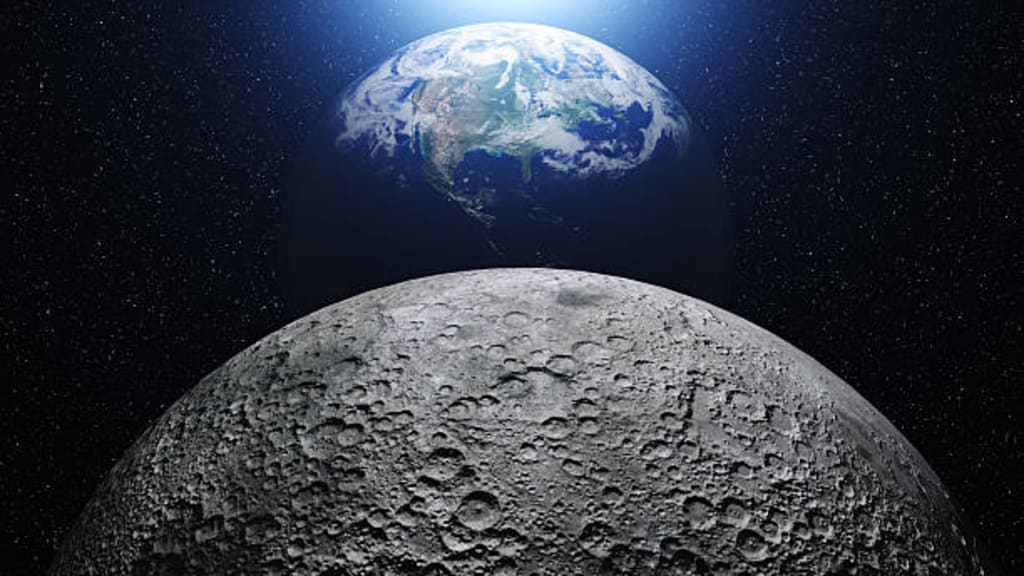
It's getting brighter outside. It's 9 30 PM and you have a big test tomorrow. You peek outside to see if your neighbors are using their floodlights again, but they're out looking up at the sky. Then you notice that the moon has gotten a lot bigger. In fact, it's twice the size it was before! You run outside and ask people what's going on, but they don't know either. You decide to take a picture of it and post it on social media, and when you view your feed you see that everyone is talking about it.
The night sky looks brighter because the moon is bigger and reflects more sunlight, making it seem brighter. When you walk, you feel a bit unsteady, like you're walking lighter than usual. This happens because the moon has grown larger, which makes its pull on gravity stronger and makes Earth's gravity weaker.
Suddenly, you notice your socks are wet, and when you look around, you see water flooding your neighborhood. People are trying to find higher ground or go back to their houses. It's not a burst fire hydrant; it's ocean water seeping in. You're confused, lose your balance, and slip into the rising water. Some people are in their cars but can't drive anywhere because of the water. Even though you live near the ocean and there have never been tsunamis or floods in your lifetime, there haven't been any recent earthquake reports either. Something strange is happening.
You rush back home to find an old inflatable raft to help with the flood. The problem is you need to inflate it, but you don't have a pump. You start blowing it up with your mouth, but it's taking too long. You search your house and find a hairdryer, which you use to partially inflate the raft before finishing it with your breath. The water keeps rising, entering your house. You pack a bag with a good flashlight, some food, and warm blankets. As you go downstairs, the water is up to your knees. When you step outside, the water pushes you around because the waves are strong due to the changed gravity. It's tough to swim, so you prepare your raft to float down the flooded street.
In the middle of February, you find yourself near a highway where water from the beach is flooding in. You manage to climb to higher ground and take out your phone, which you've kept safe. With only 15% battery left, you call your family, but they also have no idea what's happening. You venture into the forest to find an old cabin from your childhood to see if you left your bicycle there. After a few minutes, you find it and use it to escape the flood by biking across the mountain. However, the changed gravity makes it challenging to maintain your balance.
Meanwhile, some scientists are gathered with laptops and spreadsheets, trying to understand the strange events. Despite various solutions proposed, nothing seems to make sense. Eventually, NASA's head decides to launch an unmanned rocket to the moon. The rocket is prepared in a few hours, and everyone awaits its orders. The rocket takes off and approaches the moon, exiting Earth's atmosphere and traveling rapidly in that direction. After a day or two, everyone receives live footage of the moon, revealing something unexpected. The rocket can't get too close to the moon due to its increased gravitational pull. However, the footage shows tiny particles resembling Saturn's rings, but they're actually small grains orbiting the moon. The rocket suspends itself nearby and deploys a mini rocket drone to get closer, but the dense particles make it challenging to maneuver. The mini rocket finally gets past the particles, lands on the moon, and sends out a robot to explore the surface. While nothing significant happens initially, scientists notice unusual quivers from the moon's core, which appears to be expanding. To uncover the cause, they decide to drill deep inside.
Meanwhile, you continue pedaling, but the ground shakes due to the flood, making balance difficult. The other side of town is also flooded, and you use your raft to reach a lighthouse. From there, you plan to find the NASA station. Suddenly, you witness a large rocket launching from the ground, knowing your brother is on it. However, with cellular networks down, you paddle your way there for safety. Back on the moon, a small drill begins descending miles into the lunar surface. However, the moon is growing larger, and the particles surrounding it are multiplying. To prevent potential catastrophe, NASA launches another rocket with a bigger drill.
Recent research suggests that the moon has a sodium tail, which Earth passes through each month. During these days, telescopes can detect a faint yellowish glow in the sky caused by the sodium atoms. This tail, although invisible to the naked eye, is 50 times dimmer than what we can perceive. Scientists theorize about the existence of white holes, but none have been found. They speculate that if one were observed, it would emit light and matter.
Beetlejuice, a red giant star in the Orion constellation, started dimming in 2019, puzzling astronomers. Initially, they believed it was on the verge of a supernova explosion but later discovered that it had ejected some material, temporarily blocking its light.
In about 4 billion years, the Milky Way and the Andromeda galaxy will collide, eventually forming an enormous elliptical galaxy. Scientists have found evidence suggesting more water on the moon's sunlit side than previously thought, which could be valuable for future missions. Cotton candy exoplanets, known as "super puffs," have been discovered with extremely low density.
The Juno Mission observed unusual phenomena on Jupiter's upper atmosphere, including blue sprites and elves. Rogue planets, free-floating space bodies, have been detected, but they are challenging to find. Recent observations suggest that the moon is shrinking over time, causing surface quakes.
Astronomers have discovered peculiar radio circles in space, only visible through radio telescopes, with an unknown origin. Fast radio bursts, extremely bright and short bursts of radio waves, have been detected, including some originating from a magnetar. Liquid in outer space forms into spheres due to gravity, even in low Earth orbit. A massive star, 75 million light years away, mysteriously disappeared from astronomers' view.
The center of the solar system is not exactly the sun's center; it depends on the object with the greater mass, which is typically the sun, but not always. In ancient times, the geocentric model, where everything revolved around Earth, was commonly believed. If Earth were the center of the solar system, life would have evolved differently, possibly with unique adaptations due to extreme conditions.
Oxygen might not be as abundant, and the atmosphere could be thinner.
The landscape would be harsh, with intense heat, few water sources, and rugged mountains.
Animals would have adapted to the challenging conditions, possibly with larger ears, stronger bodies, and unique survival strategies.
Days and nights would differ, and weather patterns would be distinct.
Earthquakes and volcanic activity would be common due to the strong gravity.
The night sky would appear different, with no moon to reflect sunlight.
The concept of seasons might not exist.
The strong gravity might delay technological advancements.
Realistically, Earth cannot be the center of the solar system due to its size.
Our environment, weather patterns, and the natural world are all shaped by our position in the solar system. The Parker Solar Probe, launched in 2018, embarked on a mission to touch the sun. It used gravitational maneuvers and encounters with Venus to get closer to the sun. The probe explored different layers of the sun's atmosphere, including the core, radiation zone, convection zone, photosphere, chromosphere, and corona. The sun's gravity created an elliptical orbit for the probe, with a perihelion point where it got closest to the sun and an aphelion point where it moved away.
The Parker Solar Probe provided valuable information about the sun's boundary and the solar wind. Solar material and radiation escape from the sun's surface, creating the solar wind. The probe's encounters with Venus corrected its trajectory and reduced its distance from the sun. The probe touched the sun's corona, where powerful solar ejections occur. The sun's core hosts nuclear reactions that produce heat and radiation. The radiation zone transfers heat from the core to the outer layers, and photons can take thousands of years to travel through it. The convection zone is the sun's surface, where hot plasma rises and cools down, creating a distinct pattern. The sun's atmosphere consists of the photosphere, chromosphere, and corona, each with its unique characteristics. The photosphere emits light, giving the sun its visible appearance. The chromosphere adds color to the sun and features solar prominences. The corona extends millions of miles into space and is visible during solar eclipses. The Parker Solar Probe's mission provided insights into the sun's structure and behavior.
About the Creator
Keep reading
More stories from Manjari Wijekoon and writers in Earth and other communities.
Girl Discovers A Mysterious Bag That Drastically Changes Her Life
The opening scene takes place in a mental institution where a teenage girl named Sumi is undergoing treatment for shock and psychosis. The doctor tries to communicate with her using family photographs, but Sumi remains silent. The doctor asks about her experiences leading to her hospitalization, but Sumi doesn't respond.
By Manjari Wijekoon2 years ago in Horror
Earth’s Hidden Fires
The Black Scar of the Sahara and Other Fires That Shouldn’t Exist From high above, the Sahara Desert looks like a golden ocean—endless waves of sand broken only by scattered blue and green oases. But hidden among the dunes is something startling: a massive black region covering nearly 17,000 square miles. It’s so large it’s visible from space, yet it rarely appears in movies or documentaries. At first glance, it almost looks unnatural, as if something catastrophic happened there.
By Lexi Wilburn3 days ago in Earth
Cabin Fever Because of Snow, Sleet, and Freezing Rain That Turned to Icy Roads
What Is Cabin Fever? The short answer is that cabin fever is restlessness from being in a confined area. Cabin fever is the distressing irritability or restlessness experienced when a person or group is stuck at an isolated location or in confined quarters for an extended time. Research shows that prolonged cold, gray skies, and being stuck indoors can trigger mood shifts similar to “winter blues.”
By Margaret Minnicksa day ago in Humans


Comments (1)
Fantastic! Great work!