
The Last Frost of Aveline
A generational story of heritage, heartbreak, and the urgent need to adapt to a warming world

The antique thermometer on the porch didn’t lie, but Elias wished it would. It read 24°C. In the middle of October. In a valley that, thirty years ago, would have already seen its first dusting of silver frost.
Elias tapped the glass, a rhythmic habit of a man looking for a different answer. He wasn’t a scientist or a politician; he was a cider maker. And in the world of apples, timing isn’t just a preference—it’s a religion.
The Warning in the Bark
His orchard, a sprawling grid of Kingston Blacks and Foxwhelps, felt restless. Usually, by this time of year, the trees were entering their long slumber, pulling their energy deep into their roots to survive the bite of a Vermont winter. But the bite was gone. The air felt heavy, humid, and wrong.
"They're confused, Elias," his granddaughter, Maya, said, stepping off the porch with a tablet in hand. She was twenty, studying agricultural science, and possessed the bluntness of a generation that had inherited a house on fire.
"They're just stubborn," Elias grunted, though he knew better.
"The chill hours are off," Maya continued, showing him a graph that looked like a jagged mountain range collapsing into a plain. "If we don't get a sustained freeze, the buds for next year will be weak. Or worse, they’ll think it’s spring in January, bloom early, and get killed by a single late frost. We’re losing the rhythm."
A Changing Map
Climate change is often discussed in terms of melting poles and rising tides—grand, cinematic disasters. But for Elias, it was a slow, quiet erosion of the familiar. It was the disappearance of the "McIntosh climate." It was the way the bees arrived two weeks before the blossoms were ready.
He walked into the rows of trees, his boots kicking up dust instead of the usual damp mulch. He stopped at a tree he had planted the day Maya was born. The leaves were still a defiant green when they should have been a brittle gold.
"I remember when the pond stayed frozen until April," Elias said to the empty air. "We used to skate. Now, it’s just a slushy eye staring at the sky."
The Pivot
Maya joined him, her expression softening. "We can’t grow these the same way anymore, Grandpa. We have to look at heat-resistant rootstocks. We have to change the soil management to retain moisture during these weird droughts."
Elias looked at his hands—calloused, stained with the tannins of a thousand harvests. He hated the idea of "pivot." To him, it felt like a betrayal of the land. But as he looked at the sweating trees, he realized the land had already been forced to pivot. The sky had changed the rules without asking.
"What do we do?" he asked. It was the first time he had admitted he didn't have the answer.
"We adapt," Maya said firmly. "We plant for the world we have, not the one you remember. We save the orchard by letting go of the way it used to be."
The Bitter and the Sweet
That night, a storm rolled through. It wasn't the gentle, soaking rain of Elias’s youth. It was a violent, erratic downpour—the kind of "extreme weather event" the news anchors loved to talk about. It lashed the fruit from the branches and turned the dust into a treacherous mire.
As the thunder shook the floorboards, Elias sat in his kitchen, sipping a glass of last year’s vintage. It was crisp, tart, and held the essence of a cooler autumn. He realized he was drinking a relic.
Climate change wasn't just about the heat; it was about the loss of predictability. The loss of the "normal" that allowed a man to plan a life. But as he watched Maya at the kitchen table, lit by the glow of her screen as she researched sustainable irrigation, he felt a flicker of something else.
Resilience
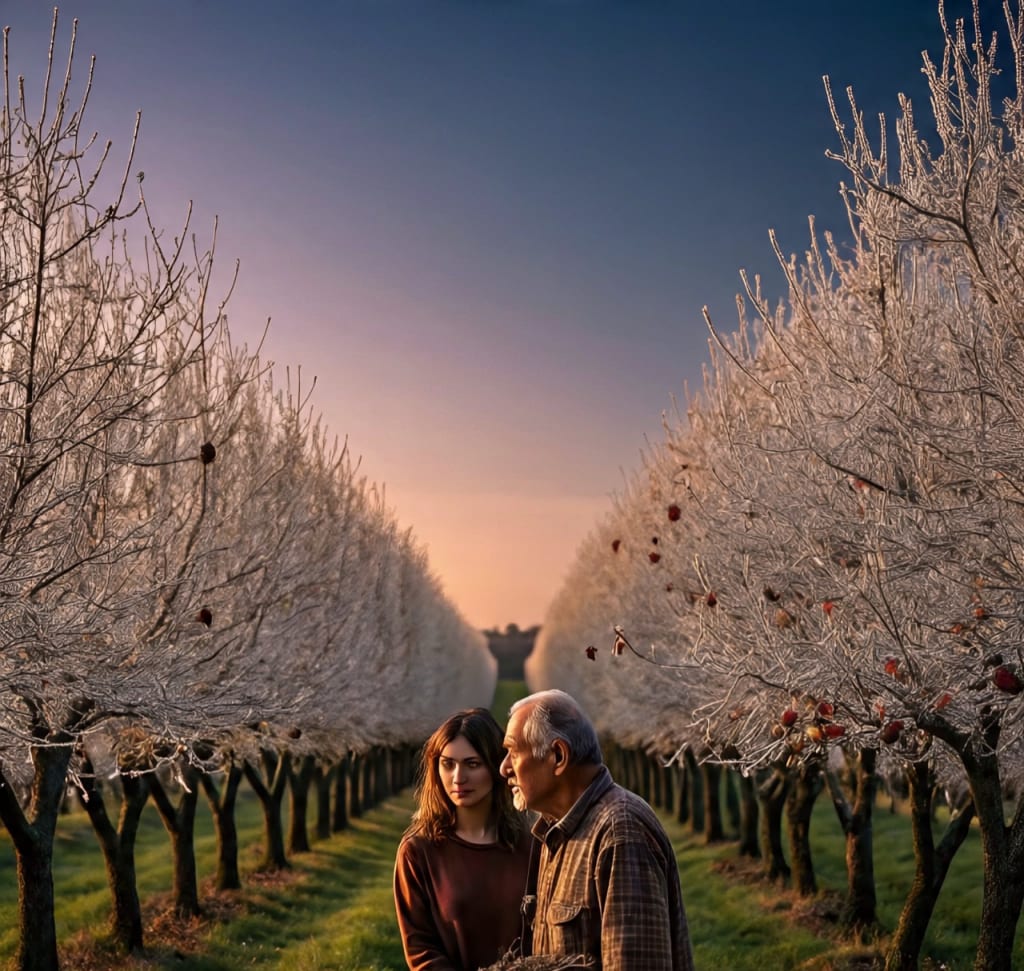
The next morning, the air finally turned sharp. A cold front had chased the storm away. Elias stepped out and saw it—a thin, precarious layer of frost coating the remaining leaves. It sparkled like crushed diamonds in the dawn light.
It was beautiful, but it was late. And it wouldn't last.
He went to the shed and grabbed a shovel. He didn't head for the old trees. He headed for the clearing Maya had suggested—the one with better drainage and space for the new, resilient varieties she had found.
The climate had changed the story, but it hadn't closed the book.
"Maya!" he called out, his voice cracking the morning quiet. "Bring those schematics. Let’s see where these new ones go."
They worked together until the sun burned the frost away, two generations stitching a new future into an old earth, learning to love a landscape that was becoming a stranger.
About the Creator
LUNA EDITH
Writer, storyteller, and lifelong learner. I share thoughts on life, creativity, and everything in between. Here to connect, inspire, and grow — one story at a time.
Keep reading
More stories from LUNA EDITH and writers in Earth and other communities.
Earth Is Not Our Property
There was a time when the Earth did not need us. Rivers carved their own paths without permission. Forests rose and fell like quiet empires. Ice learned the language of patience. The planet breathed in rhythms older than memory, older than names. Then we arrived—curious, clever, afraid of silence—and decided everything needed a fence.
By LUNA EDITH12 days ago in Earth
Beckhams Spotted Together in Paris After Brooklyn Row
A Family Reunion in the City of Light David and Victoria Beckham were recently spotted together in Paris, drawing attention from fans and media alike. The appearance comes shortly after reports of a disagreement between the famous couple and their eldest son, Brooklyn Beckham, who has been navigating his own professional and personal endeavors.
By Aarif Lashari4 days ago in Earth
No 1 for Nuns! Níall McLaughlin Is Architecture’s Discreet Daredevil
Níall McLaughlin: Redefining Architectural Boundaries Níall McLaughlin has long been known as a master of understated yet daring design. From residential homes to cultural landmarks, McLaughlin’s work demonstrates a unique ability to merge functionality with artistry, creating spaces that are both practical and visually arresting.
By Aarif Lasharia day ago in Earth


Comments
There are no comments for this story
Be the first to respond and start the conversation.