
What happen If You Entered a dark Hole?
What happen If You Entered a dark Hole?

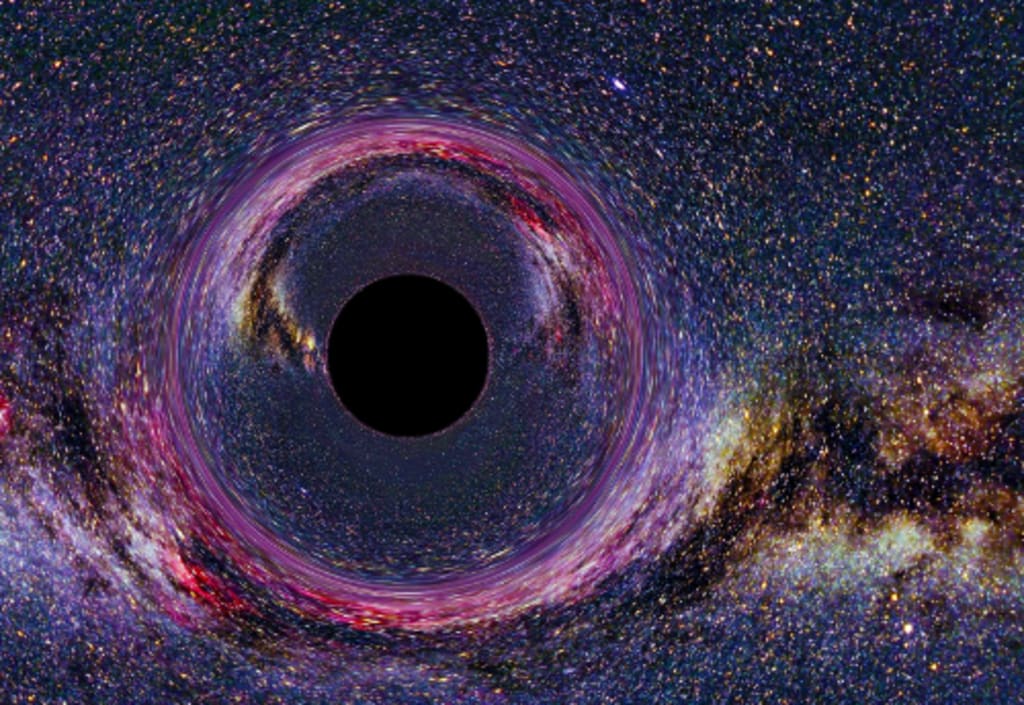
Entering a dark hole is not a well-defined scenario, so I will provide information based on the assumption that you are referring to a hypothetical scenario involving a black hole.
Entering a dark hole, or more specifically, a black hole, is a highly speculative and hypothetical scenario as our current understanding of physics breaks down at the extreme conditions within a black hole. However, based on our current scientific knowledge, here's an explanation of what might happen if you were to enter a black hole:
As you approach the black hole, the immense gravitational force would start to stretch and compress your body, a phenomenon known as "spaghettification." The tidal forces near the black hole's event horizon, which is the boundary beyond which nothing can escape, would be so strong that they would pull on your body more strongly on one side than the other, causing you to be stretched into a long, thin shape like spaghetti.
As you cross the event horizon, your fate becomes uncertain. General relativity suggests that once inside the event horizon, all paths lead to the singularity at the center of the black hole. The singularity is a point of infinite density and gravitational force, where the laws of physics as we know them no longer apply. It is often described as a region of spacetime where our understanding breaks down completely.
At the singularity, the gravitational forces are so intense that they would crush and compress your matter to an infinitely small point, resulting in what is called a "gravitational singularity." It is worth noting that our current understanding of physics does not adequately explain what happens at the singularity. It is considered a limit of our knowledge, and the true nature of what lies within a singularity remains a topic of active research and speculation in theoretical physics.
However, it is important to emphasize that venturing close to or inside a black hole is an extremely dangerous and inhospitable environment. The intense gravitational forces, extreme tidal effects, and unknown physics near the singularity would likely make survival impossible for any known form of matter.
Please note that the above explanation is based on our current scientific understanding, which may evolve or change as we gain more knowledge about black holes and the laws of physics.
If you were to enter a black hole, the exact consequences would depend on various factors such as the size of the black hole and your distance from it. However, in general, the gravitational forces near a black hole are incredibly strong, leading to several effects:
1.Spaghettification:In astrophysics, spaghettification (sometimes referred to as the noodle effect) is the vertical stretching and horizontal compression of objects into long thin shapes (rather like spaghetti) in a very strong, non-homogeneous gravitational field. As you approach the black hole, the difference in gravitational force between your head and your feet would become so extreme that you would be stretched apart in a process known as spaghettification. This is due to the tidal forces generated by the black hole's immense gravity.
2.Time Dilation:Time dilation is the difference in elapsed time as measured by two clocks, either due to a relative velocity between them (special relativity) or due to a difference in gravitational potential between their locations (general relativity). When unspecified, "time dilation" usually refers to the effect due to velocity. Time would appear to slow down as you get closer to the black hole. This means that while a certain amount of time might pass for you, an observer outside the black hole would perceive it as passing much more quickly.
3.Event Horizon: The 'event horizon' is the boundary defining the region of space around a black hole from which nothing (not even light) can escape. In other words, the escape velocity for an object within the event horizon exceeds the speed of light.The event horizon is the boundary around a black hole beyond which nothing can escape, including light. Once you cross this point, you would not be able to communicate or return to the outside universe.
4.Singularity:The term first came into popular use in Albert Einstein's 1915 Theory of General Relativity. In the theory, a singularity describes the center of a black hole, a point of infinite density and gravity within which no object inside can ever escape, not even light. At the center of a black hole lies a region of infinite density called a singularity. It is a point where the laws of physics as we understand them break down. The exact nature of what happens at the singularity is still not fully understood.
It's important to note that our current understanding of physics, particularly regarding the behavior of matter and energy near the singularity, is limited. The effects described above are based on general relativity and are subject to ongoing scientific research and investigation.
However, if you are referring to a hypothetical concept like a black hole from astrophysics, the consequences would be quite different. Black holes are incredibly dense objects with a gravitational pull so strong that nothing, not even light, can escape their grasp. If you were to venture close to the event horizon of a black hole (the point of no return), the intense gravitational forces would distort space-time, stretching you apart in a process called spaghettification.
About the Creator
JHAY EM
Why working out is great for health, but not for weight loss, explained in five minutes.
Are you ready to start losing weight at home?
Ways to Lose Weight Without Exercise.




Comments
There are no comments for this story
Be the first to respond and start the conversation.