
What exactly does the sun use as fuel?
"The source of all things"


The sun is called the "source of everything" and for the past 4.6 billion years it has never stopped sending light and heat to the Earth, which is why the Earth is such a vibrant planet.
What exactly does the sun use as fuel and how can it burn for 4.6 billion years without going out?
There was once a view that the sun's fuel should be coal, and that it could burn for a long time only because there was too much coal on the sun.
However, it was later discovered that even if the sun was composed entirely of coal, it would only burn for about 5,000 years, which is far more than 5,000 years, so this view was rejected and the burning mechanism of the sun became a mystery.
Only after the 20th century, with the development and improvement of quantum mechanics, scientists made a reasonable explanation for the source of energy of the sun, namely: the sun's energy comes from the nuclear fusion reaction at its core, and the "nuclear fuel" it uses is the most abundant and simplest structure of hydrogen in the universe.
It should be noted that the common phenomenon of combustion refers to the violent oxidation of combustible materials with oxygen and the release of light and heat in the form of flame, so strictly speaking, the sun does not burn, but for the sake of description, we still describe the phenomenon of the sun's light and heat as "combustion", so please pay attention to the distinction.
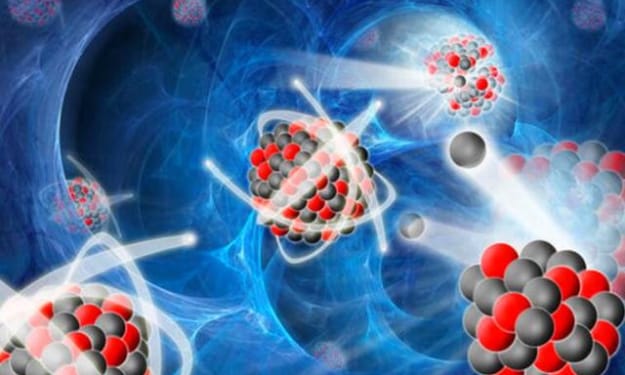
Scientists believe that in the core reaction zone of the Sun, hydrogen nuclei are constantly converging into helium nuclei through a series of reactions, releasing energy due to the loss of mass.
The "proton-proton chain reaction" can be simply divided into three steps: the first step is the polymerization of two protons into a deuteron nucleus, the second step is the polymerization of a deuteron nucleus and a proton into a helium-3 nucleus, and the third step is the polymerization of two helium-3 nuclei into a helium-4 nucleus.
But the problem is that the radius of the solar core reaction zone occupies about one-fourth of the solar radius, and theoretically, the conditions for a "proton-proton chain reaction" should be available at any location in this zone, in which case all the protons in the solar core reaction zone should undergo fusion in a very short time and release a huge amount of energy.
This did not happen, otherwise, the sun would not have burned for 4.6 billion years without going out, why? This is explainable.
The key lies in the first step of the "proton-proton chain reaction", which is the aggregation of two protons into a deuteron nucleus because the protons are positively charged, so there is a strong repulsive force between the protons and protons, to overcome this repulsive force, the protons must have a fast enough speed.
Since temperature means the intensity of the thermal motion of microscopic particles, we can assume that the temperature must be high enough for two protons to collide, and how high a temperature is needed? The answer given by scientists is at least hundreds of millions of degrees Celsius.
However, the temperature of the sun's core region is only about 15 million degrees Celsius, such a temperature can not let two protons collide, if so, why does the sun still burn? This question troubled scientists for a long time, until the discovery of the "quantum tunneling effect".
In short, the "quantum tunneling effect" means that in the case of insufficient energy, microscopic particles still have a very low probability to pass through the barrier that is impossible to pass through in classical mechanics, so this is also known as the "microscopic world through the wall".
It should be noted that the "quantum tunneling effect" can be explained by the "wave-particle duality" of microscopic particles and the "energy-time uncertainty principle" of quantum mechanics. In addition, the "quantum tunneling effect" has also been confirmed in experiments and has been applied to certain applications, for example, the "scanning tunneling microscope" used to observe and locate atoms is using the "quantum tunneling effect". For example, the "scanning tunneling microscope" used to observe and locate atoms makes use of the "quantum tunneling effect", so it can be said that this phenomenon is real.
On the other hand, when two protons collide together, they form a "double proton", which is so unstable that scientists have found that in a very short time (less than 1 nanosecond), the "double proton" has 99% of its value. The scientists found that in a very short period (less than 1 nanosecond), there is more than 99.999% probability that the "double proton" will decay into two protons again, and only in a very small probability, one of the "double protons" will become a neutron due to beta decay, thus making the "double proton The "double proton" becomes a deuteron nucleus containing a proton and a neutron.
Scientists believe that the probability of the "quantum tunneling effect" is already extremely low, and on top of that, the decay of the "double proton", the probability of the "proton-proton chain reaction" Because of this, the sun can consume the "nuclear fuel" in its core reaction zone at a very slow rate, and then continue to burn steadily.
After reading the scientists' explanations, I believe we understand the reason why "the sun can burn for 4.6 billion years without going out". It is worth mentioning that the sun's "nuclear fuel" will eventually run out, according to scientists' estimates, in about 5 billion years, the sun's core of hydrogen will be depleted, and the earth will then become no longer suitable for human survival.
About the Creator
Robert Jack
One of the secrets of emotional stability for adults is to keep the expectations of others to a minimum.
Keep reading
More stories from Robert Jack and writers in Earth and other communities.
Two billion-year-old nuclear reactor
Prehistoric civilizations have always been a topic of fascination, and no wonder, after all, humans have been on Earth for so short a time in its history that if the history of the planet were compressed into a single day, humans would have appeared in the last two minutes of that day. In the past, there have been frequent claims of the discovery of suspected prehistoric civilizations, the most notable of which would be a two-billion-year-old nuclear reactor.
By Robert Jack4 years ago in Earth
A $170 Million Gemstone Discovery Shocks Myanmar’s Mining World
Myanmar, a country long known for its rich natural resources, has once again captured global attention after the discovery of an extraordinary gemstone estimated to be worth around $170 million. The remarkable find has stunned geologists, gem traders, and mining experts, reaffirming Myanmar’s reputation as one of the world’s most important sources of precious stones.
By Irshad Abbasi about 10 hours ago in Earth
Top tipple tricks
Been thinking a lot about drinking, lately. Not least because of a recent episode of over-indulgence and the inevitable after effects. Some readers may recall the earlier articles I wrote about beating the booze. Here I set out an experiment in techniques for cutting down on my alcohol intake. The experiment was successful, the techniques worked, and I have armed myself with an arsenal of weapons in the war against the demon drink. I have yet to fire the first round however. It's all a question of timing (perhaps procrastination).
By Raymond G. Taylora day ago in Psyche



Comments
There are no comments for this story
Be the first to respond and start the conversation.