
We Just Had the Hottest Summer on Record in the Northern Hemisphere
Why This Record-Breaking Summer Needs to Be a Wake-Up Call For All Of Us


Los Angeles isn’t exactly known for its mild summers. Growing up in The Valley (San Fernando), those fateful months of every childhood year were spent hiding in neighborhood pools, running through summer camp sprinklers, and sitting in the back of minivans in bumper-to-bumper traffic trekking towards sandy shores along the coast. As a young kid, I lamented the thermostat reporting a balmy 90° Fahrenheit ( 32° C) day — or god-forbid the temperature climbed up to 100° F (38° C).
All this is to say, Los Angelenes are not unfamiliar with heat — many transplants to the city show up for that very reason. The climate is comfortable for folks who like it a little warm (or who love staying indoors and running their high-quality central air conditioning systems). But, my most recent visit made me feel nostalgic for those once-considered high LA temperatures. In early September, the weather in San Fernando hit 111° (43°) near noon. The next day, it climbed to 114° (46°). In some areas of SoCal, it climbed to a record-breaking 121° F (50°).
As I sweltered in uncharacteristically high Los Angeles heat, the same heat was scorching other parts of the Northern Hemisphere, where scientists were recording the hottest temperatures ever measured. Our global climate is changing — this year, we’re all witnessing it firsthand. The entire Northern Hemisphere was affected by this strange moment of weather. To watch the weather intensify in highs and lows with each passing year, to see strange new climate patterns emerge, to observe the shifting frequency and exacerbation of natural disasters, one just had to look outside and compare what used to be 5, 10, 20, and 30 years ago.
We just had the hottest summer on record in the Northern Hemisphere. Climate change is upon us. The time to act is now.
2024’s Place In Temperature Trends
The last summer in the Northern Hemisphere was one for the record books: a phenomenon that was felt around half of the world, that rivaled previous records set in many cities throughout all of recorded history. In some cases, cities saw their records broken for the hottest days ever experienced. According to Copernicus, the EU’s public climate change service group, it may have been globally the warmest June through September we’ve ever experienced on average since data on such variables were originally recorded by scientists (1880). Across the ‘top’ half of Earth, crops like rice and cotton died, roughly 150 reported human deaths occurred in North America, wildfires ignited, and power was lost in parts of California.
Despite the horrific effects of such heat events, looking into the past records of previous summers reveals an even more sobering fact: The years that 2024 contested to earn its title of “hottest summer on record” were all strikingly recent. In fact, the last 10 years have been the warmest on record.
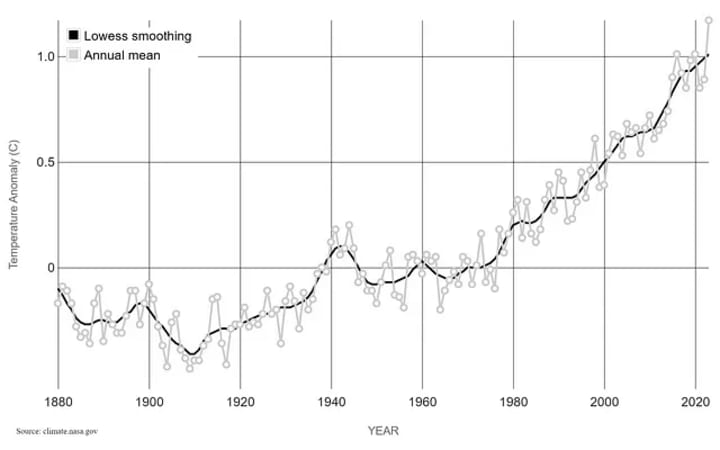
2024 wasn’t a fluke year, or a once in a lifetime swell of heat we’ll remember once the weather returns to normal. It’s an increase in heat that fits the trendline all those climate scientists were warning us about. And, if we fail to understand why this is happening on our planet and course-correct, based on the current trend, 2024 may turn out to be one of the coolest summers we’ll experience in the future, as temperatures continue to rise.
The Role of Climate Change, El Nino, and Infrastructure
The greatest contributor to increased extremity in weather patterns is, of course, human-induced climate change. The burning of fossil fuels over the last century has added a significant amount of carbon dioxide and methane into the air, both of which have effectively worked to make our atmosphere worse at releasing heat. Heat-trapping chemicals like these and others can add quite a bit of chaos to a system (recall that heat causes molecules to move about more wildly). This sort of phenomenon can have drastic effects on how extreme our weather patterns are. Very simply, there is more energy in the system that can be used, so more can happen.
Note: As much as I’d adore to rant about the wealth of information that supports climate change, the scope of this article does not have space for it. If, however, you’d be interested in learning more, see: Evidence — NASA Science; Causes and Effects of Climate Change | United Nations; Extreme Weather — NASA Science (Or, if you want me to rant about it, leave a comment on this article. I’d totally love to write more about this in a later article!)
Climate change isn’t the only contributing factor to the heat events we’ve seen this year, however. The climate is a rather complicated beast, one with a staggering number of variables that modify its output. This year, in particular, is seeing strange patterns due to the particularly strong El Nino that began in June 2023 and ended over the summer. As this particular climate pattern causes warm ocean temperatures known for releasing heat into our atmosphere, it can increase the likelihood of events like these while active. In some cases, this hot air can become trapped in regions of our atmosphere, creating a high-pressure heat dome exacerbated by the same greenhouse gasses that are infamous for causing climate change.
On top of all of these climate forces collaborating to create the perfect heat storm, much of our infrastructure fails to address or counteract these new, worsening conditions: traditionally, it wasn’t necessary to worry about. When we built high-density population zones (cities), we chopped down our trees to make buildings, and we covered our roads in cheap asphalt to bring down the cost of city spending. Now, as the climate changes around us, these zones act as heat sponges, with dark colors that absorb heat from sunlight and shadeless streets that fail to reflect anything up into the sky. This lack of forethought has made it so that now, as summers worsen in areas that traditionally didn’t worry about heat in more extreme latitudes, without urban adaptation, we are creating higher-risk areas in an already risky scenario. From our long-term policy to our short-term urban planning, we are making the impacts of heat even worse.
The Impacts of the Extreme Heat
Bouts of extreme heat are so much more than simple inconveniences to sweat through and endure. For many people, especially those without homes, of low income, or who are more susceptible to heat stress due to age or the presence of chronic conditions, extreme heat can be a killer — or a miserable exacerbation of the conditions they already experience. Heat stress is the main cause of weather-related deaths globally, causing nearly 500,000 deaths each year. And, over the last couple of decades, that number has continually increased proportionally with the changing climate. Already, healthcare systems around the globe are feeling the strain of this increase.
The temperature taking a toll on the human body isn’t the only issue, however. It affects the wildlife around us in equal measure. Like us, animals with disease or age-related vulnerabilities can suffer from unusually hot days without shade and an ample supply of water — and even die from it. Some species of domesticated dogs, like pugs, struggle to breathe in extreme heat.
In the wild world, heat stress takes a toll on nearly every aspect of species viability, affecting the success rates of reproduction, the survival of newborn animals, and the availability of food and other resources. Fragile ecosystems and species specialized for very specific regions are particularly at risk and, if we don’t find a way to mitigate the damage, are at risk of collapse. Even with our best conservation efforts, the protection of at-risk species, and careful environmental regulation, some species may still be lost due to heat.
Extreme heat can also kill plants, crops, and wildlife alike. These dried patches of plant material aren’t only rendered unusable by the harsh weather events, costing farmers billions annually in losses, but they also become incredibly effective kindling for fires, exacerbating the increasing severity of fires we’ve seen in the last few decades.
In other cases, heat may help spread certain diseases like Malaria. Warmer temperatures have been found to help lengthen active periods for disease-carrying insects like mosquitoes, increase their rate of biting, and even accelerate the incubation of West Nile Virus and other diseases within these disease-carrying pests.
And it costs us money too, all of us. Government and public services are expected to be further strained economically by the intensification of climate change when heat increases the rate of infrastructure degradation — that means more taxes. Homeowners and building owners will likely see hiked prices in their insurance bills and energy bills. Manual laborers may lose revenue when climate intensifies heat when they are forced to work shorter hours to not experience heat stroke. And, for those who need to eat (e.g. all of us), we’ll likely see increased prices on groceries. Yes, even more expensive than they are now.
On top of it all, these effects enter us into a positive feedback loop of sorts. During these high-heat events, people are more likely to increase their energy demands which, when not sourced sustainably, can continue to contribute to the problem we’re attempting to avoid. And, when infrastructure like power transmission lines are at risk and put under high stress during heat waves, people are at risk of losing power, making air conditioning no longer a viable defense against heat.
It’s clear as day: we need to adapt to mitigate what damage we can. We need systemic improvements.
Response and Adaptation
With a projected increased summer heat average for the foreseeable future, it’s more important than ever to not just take personal action but to also let legislators and other large-scale decision-makers know of the importance these issues have to all of us. We have entered into social contracts with our governments, giving hard-earned resources and personal freedoms in exchange for the protection that organized civilization can provide. If we are dying due to the climate that large corporations have caused and governments are allowing, they are not holding up their end of the bargain. We should strive for the right of safety for all of humanity — the right to survive and be. Those rights should be inalienable — every breach of that is a tragedy.
When natural disasters strike, we expect humanitarian and public aid. If someone directly caused a natural disaster, we would expect they would be held responsible. At the very least, they’d be fined. At the most, it would be their responsibility to fix it. Why, then, in the wake of the beginning of the natural disaster domino effect that is climate change, are we not doing the same? We should expect the same regarding the climate-led issues when 71% of industrial emissions are output by only 100 companies. The lack of regulation — and the results therein without timely innovation and implementation of known fixes are a failure on the part of the governments and organizations that should be responsible for them.
–
Los Angeles collectively breathed a sigh of relief as the temperature finally subsided. Fall was beginning to arrive, bringing much-needed foggy mornings and cool breezes to balance out the arid temperatures of the desertifying zone of California. For most, it was a miserable pair of weeks to sweat through. But for some, it was the last Californian summer they ever had.
As for me, I traveled home and breathed a sigh of relief as my plane touched back down in Oregon. It was only 90° F here, just like the summers of Los Angeles were when I was a child. For my fellow Oregonians, it was a shockingly hot, record-breaking event. As a climate traditionally not in need of air conditioning units, schools closed and businesses shut down early throughout the unreasonably hot — far worse than it had ever been in the history of the state. It was as if the old climate of my childhood moved northward — perhaps it did. Perhaps, indeed, the climate was shifting throughout even my little life.
It’s hard to ignore climate change when you can feel it on your skin, see it in the color of the air.
--
Crossposted from Medium. Follow my main account there for new articles on science every other week! :)
About the Creator
Olivia L. Dobbs
Science Enthusiast, Naturalist, Dreamer, Nerd.
I crosspost my Medium articles here :)
You can find my main account on Medium: https://medium.com/@oliviadobbs13
Check out my science! -> bit.ly/DobbsEtAl
Keep reading
More stories from Olivia L. Dobbs and writers in Earth and other communities.
20 of the Most Spectacular Species Discoveries in 2024
There’s so much of the world yet to discover, and so many remarkable things within it. With so much of Earth mapped and so much of it navigable with modern technology, it can feel like the days of discovery and pioneering are behind us. That is most certainly not the case, however. So many hidden fascinations lurk on and within the lovely, blue planet we call Earth. Even this year, we are discovering more about life and what comprises it as we continue research at a break-neck pace.
By Olivia L. Dobbsabout a year ago in Earth
The Refrigerant Transition
Cooling seldom features in climate headlines, yet it is one of the quietest success stories of the last decade. Under the Kigali Amendment to the Montreal Protocol, countries are phasing down hydrofluorocarbons (HFCs)—super-pollutant refrigerants—while retailers and manufacturers rapidly switch to ultra-low-GWP “natural” refrigerants such as carbon dioxide (R744) and propane (R290). Fully implemented, Kigali alone can avert roughly 0.4–0.5°C of warming by 2100; paired with efficiency improvements, the avoided warming can be closer to ~1°C—an enormous contribution from a single policy family [1–2].
By Futoshi Tachinoabout 2 hours ago in Earth
“‘Our Minerals Could Be Used to Annex Us’: Why Canada Doesn’t Want U.S. Mining
When people in rural parts of Canada heard that a major mining project backed by the U.S. Pentagon was coming to their communities, the reaction wasn’t excitement—it was concern. And not just about the usual environmental issues like open‑pit mining or water contamination. Residents began asking a bigger question: could foreign involvement in extracting Canada’s critical minerals threaten their country’s sovereignty and long-term future? This striking idea—“our minerals could be used to annex us”—has become the lens through which many Canadians view U.S. investments in their mining sector. It’s not just local worries; it’s a national conversation about resources, control, and geopolitics. The Mine That Sparked a Debate The debate started in Quebec with Lomiko Metals’ proposal for a large graphite mine in La Petite‑Nation, an area known for its lakes, forests, and small-town charm. Locals feared the mine would disrupt the environment and their way of life. But the real spark came when news broke that the U.S. Department of Defense had invested millions in the project through the Defense Production Act Investment Program. Suddenly, this wasn’t just about jobs or local development—it was about strategic resource control. In August 2025, a referendum showed 95% of locals opposed the mine, highlighting how deeply the project clashed with community sentiment. Why Canada’s Minerals Are So Important Canada is a treasure trove of critical minerals like nickel, lithium, cobalt, copper, rare earth elements, and graphite—essential for electric vehicles, clean energy, and even military hardware. For the U.S., which wants to reduce reliance on China for these resources, Canada is a logical partner. Investments in Canadian mines are part of a broader strategy to secure a North American supply chain for critical minerals. Through the Canada–U.S. Joint Action Plan on Critical Minerals, both governments coordinate on mining projects and technology development. But even with official cooperation, many Canadians worry about how much influence a foreign power should have over their resources. Sovereignty and Historical Skepticism For many Canadians, the concern isn’t just economics or environment—it’s sovereignty. There’s long-standing unease about letting foreign governments, even allies, control natural resources that are vital to the nation’s economy and security. Past U.S. political statements about resource-rich regions, like Greenland, have fueled these fears. So when a Pentagon-backed project emerges in Canada, it can feel like more than a business deal—it can feel like a loss of control over national assets. Balancing Economics and Independence Canada exports huge amounts of minerals to the U.S.—a relationship worth tens of billions of dollars annually. These minerals feed industries like defense, advanced manufacturing, and clean energy. But Ottawa wants to make it clear: access for the U.S. is not guaranteed. Canada aims to diversify partnerships and retain autonomy over its resources. In other words, Canada wants to cooperate without becoming dependent. Local Resistance and Broader Implications The Quebec graphite mine is a microcosm of a bigger issue. Locals aren’t just worried about the land—they’re worried about who controls their resources and for whose benefit. Communities increasingly support sustainable economic models, eco-tourism, and local development instead of foreign-driven extraction projects. They argue that Canada’s natural wealth should benefit Canadians first, and not just serve international strategic needs. Collaboration or Conflict? As demand for critical minerals surges globally, Canada faces a choice: Partner closely with the U.S. to strengthen North American supply chains, or Push back and diversify its partnerships to protect sovereignty. Both paths carry risks. Collaboration could bring investment and jobs, but may deepen fears of foreign control. Resistance may protect autonomy, but could slow down economic development. Conclusion: More Than Just Minerals The phrase “‘our minerals could be used to annex us’” isn’t hyperbole—it captures a real anxiety about control, identity, and power. Canada’s minerals aren’t just economic assets—they’re national assets, shaping the country’s future, environment, and global standing. How Canada manages its resources in the coming years will reflect not only its economic strategy but also its values: sovereignty, sustainability, and self-determination in a rapidly changing world
By Muhammad Hassan7 days ago in Earth
Bruce Lee and The God of War: Kuan Ti
It starts with love.. The Power to the God Of War and Wealth Walk into a Chinese restaurant (even in Oklahoma, USA), a Chinese police station, a kung fu martial arts studio or even a Chinese temple and you often see a red faced warrior holding a heavy quan-do (spear like weapon).
By WILD WAYNE : The Dragon King5 days ago in Chapters




Comments
There are no comments for this story
Be the first to respond and start the conversation.