
Water scarcity and desalination
Water scarcity is a growing issue affecting millions of people worldwide. With increasing populations, climate change, and overconsumption, freshwater resources are depleting at an alarming rate.

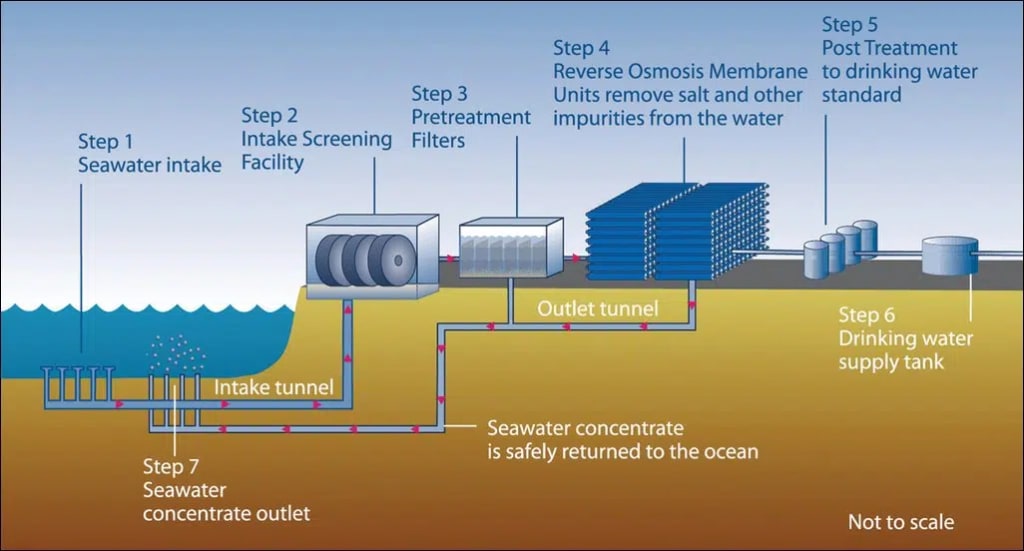
Desalination, the process of removing salt from seawater to produce drinkable water, has emerged as a potential solution to combat water scarcity, especially in coastal regions where freshwater is limited.
(I)Water Scarcity: Causes and Impacts
Water scarcity occurs when the demand for water exceeds its supply, either due to insufficient natural availability or overuse. There are two main types of water scarcity: physical and economic. Physical water scarcity happens when natural freshwater resources like rivers, lakes, and groundwater are insufficient to meet the needs of the population. Economic water scarcity occurs when there is enough water, but the infrastructure to access or manage it is lacking.
A variety of factors contribute to water scarcity:
Population Growth: The global population continues to increase, which leads to higher demands for water. More water is needed for agriculture, industrial activities, and personal consumption. Regions with dense populations often experience severe pressure on their water supplies.
Climate Change: Global warming affects rainfall patterns, leading to droughts in some areas and floods in others. Water sources are glaciers are also shrinking, reducing the availability of freshwater. Regions that depend on snowmelt for their water supply are particularly vulnerable.
Pollution: Pollution of rivers, lakes, and groundwater can make water undrinkable or difficult to treat. Contaminants such as industrial waste, agricultural runoff, and untreated sewage can lead to water shortages, especially in urban areas.
Overuse: In some regions, water is used faster than it can be replenished. This includes over-extraction from aquifers and rivers for agriculture, industry, and urban consumption. Unsustainable farming practices, such as excessive irrigation, also deplete water sources.
The impacts of water scarcity are far-reaching. It can lead to food and water shortages, poor sanitation, and the spread of waterborne diseases. In extreme cases, it can cause conflicts between communities and nations over access to water resources. Addressing this issue requires a combination of conservation efforts, efficient water management, and technological innovations are desalination.
(II)Desalination: A Solution to Water Scarcity
Desalination offers a potential solution to water scarcity, particularly for countries and regions with abundant seawater but limited freshwater. By removing the salt and other impurities from seawater, desalination provides an alternative source of drinking water. There are two main types of desalination processes: reverse osmosis (RO) and distillation.
Reverse Osmosis (RO): This method uses a semi-permeable membrane to filter out salt and other impurities from seawater. High pressure forces seawater through the membrane, leaving behind fresh, drinkable water. RO is the most widely used desalination method due to its efficiency and ability to produce high-quality water.
Distillation: In this process, seawater is heated until it evaporates, and then the vapor is condensed back into liquid form, leaving the salt behind. This method is energy-intensive but can be effective, particularly in areas where fuel or waste heat is readily available.
(III)Advantages of Desalination
Reliable Water Source: Desalination offers a consistent and reliable water supply, especially in coastal regions where freshwater is scarce. Seawater is abundant and can be desalinated regardless of the climate or weather conditions.
Drought Resilience: Desalination can help mitigate the impacts of droughts by providing a steady supply of drinking water when freshwater sources are depleted. This is particularly valuable in arid regions or areas facing the challenges of climate change.
Reduced Dependence on Freshwater Sources: By tapping into seawater, desalination reduces the reliance on freshwater resources, allowing rivers, lakes, and aquifers to be preserved for other purposes, such as agriculture and industrial use.
Technological Advancements: Over the years, desalination technologies have improved, making the process more energy-efficient and cost-effective. Innovations in membrane materials, energy recovery systems, and renewable energy integration are helping to reduce the environmental impact of desalination.
(IV)Challenges of Desalination
Despite its potential, desalination is not without challenges:
High Energy Consumption: Desalination requires a significant amount of energy, particularly for reverse osmosis and distillation. In many cases, this energy comes from fossil fuels, which can contribute to greenhouse gas emissions and climate change. However, using renewable energy sources like solar or wind power can help mitigate this issue.
Environmental Impact: The brine left over from desalination contains high concentrations of salt and chemicals, which can harm marine life if not disposed of properly. Careful management of brine disposal is necessary to minimize environmental damage.
Cost: Desalinated water is often more expensive than freshwater, primarily due to the energy requirements and infrastructure costs. For desalination to be a sustainable long-term solution, it must be economically viable, particularly in developing regions.
Limited Capacity: While desalination has the potential to provide a significant amount of drinking water, it cannot fully replace natural freshwater sources for all agricultural or industrial needs. It is typically viewed as a supplementary water source rather than a complete solution.
IN THE END
Water scarcity is one of the most pressing challenges of the 21st century, but desalination offers hope for regions struggling to meet their water needs. By turning seawater into fresh, drinkable water, desalination has the potential to provide a sustainable solution for many coastal communities. However, to be truly effective, desalination must be paired with other water conservation and management strategies, and its environmental and economic impacts must be carefully managed. Ultimately, a combination of technological innovation, responsible water use, and global cooperation will be Key to addressing water scarcity and ensuring a sustainable water future for all.
About the Creator
Badhan Sen
Myself Badhan, I am a professional writer.I like to share some stories with my friends.
Keep reading
More stories from Badhan Sen and writers in Earth and other communities.
Sustainable agriculture and permaculture
Sustainable agriculture and permaculture are two interrelated approaches that focus on creating agricultural systems that are environmentally responsible, economically viable, and socially just. Both systems aim to reduce the negative impact of conventional farming practices on the environment, while enhancing food security, biodiversity, and the long-term health of the land. While sustainable agriculture is a broad concept that includes a range of practices, permaculture is a more specific design philosophy that integrates ecological principles into agricultural practices. Both systems emphasize working in harmony with nature, rather than attempting to dominate it, which is essential for ensuring that agricultural practices remain viable for future generations.
By Badhan Senabout a year ago in Earth
Tourist Killed by Elephant Previously Linked to Two Fatal Attacks at Thailand National Park
A tragic incident at a national park in Thailand has once again highlighted the dangers of human interaction with wild animals. Authorities confirmed that a tourist was killed by an elephant that had previously been involved in two fatal incidents. The case has reignited conversations about wildlife management, tourist safety, and the growing pressure on natural habitats due to tourism and human expansion.
By Aarif Lashari4 days ago in Earth
Australia Specialty Gases Market: Industrial Applications, High-Purity Demand & Technology Growth
Australia Specialty Gases Market Overview The Australia specialty gases market is developing steadily as industries increasingly require high-purity and precisely formulated gases for advanced manufacturing, healthcare, environmental monitoring and research applications. Specialty gases include ultra-high-purity gases, calibration gases and gas mixtures designed to meet strict quality and performance specifications. These products are used in applications where consistency, accuracy and contamination control are critical. The Australia specialty gases market growth reached USD 168.4 Million in 2025. Looking forward, IMARC Group expects the market to reach USD 290.2 Million by 2034, exhibiting a growth rate (CAGR) of 6.24% during 2026-2034. This growth reflects gradual expansion of technology-driven industries and rising emphasis on quality standards.
By Amyra Singh7 days ago in Earth
The Angry Man in Your House
"If you grow up with an angry man in your house, there will always be an angry man in your house" This statement has caused plenty of controversy online, people say its a statement that blames victims while also undermining those who break traumatic cycles to form health relationships... but if I'm honest now that I'm in my 30s it makes more sense to me than ever, and I'd argue that its not just about fathers and uncles.
By S. A. Crawford2 days ago in Humans



Comments
There are no comments for this story
Be the first to respond and start the conversation.