
Venus vs. Earth: The Surprising Truths of Our Solar System's "Evil Twin"
Exploring the Mysteries and Contrasts Between Venus and Earth

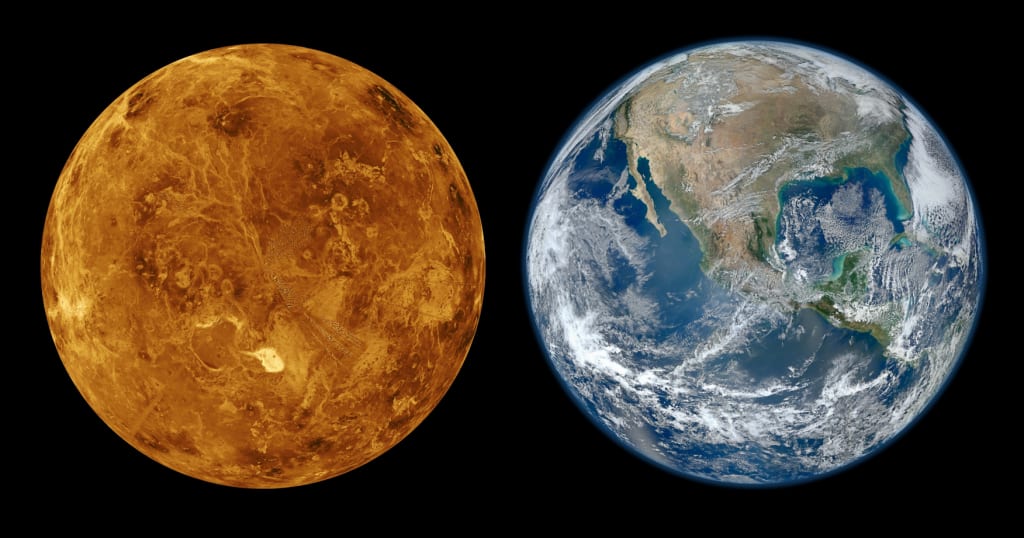
Venus and Earth are so different that a seemingly foolish question like, "What's longer, a day or a year?" makes perfect sense on Venus. A day on Venus lasts 243 Earth days, while a year is only 225 Earth days. This means on Venus, a day is longer than a year! Venus, often nicknamed Earth's "evil twin," has stark differences from Earth despite being similar in size.
Ancient Venus might have resembled Earth more closely, with NASA scientists suggesting it could have hosted liquid water oceans and moderate temperatures suitable for life for up to 2 billion years. However, modern-day Venus is drastically different, with extreme temperatures and a thick carbon dioxide atmosphere. What caused this cosmic transformation? The planet's size, location, and internal heat played significant roles.
Interestingly, there were three planets in our solar system that could have hosted life: Venus, Earth, and Mars. Picture three cupcakes in an oven: one is placed in front of an open window in winter (Mars), one is covered with a kitchen towel (Earth), and the last one is left in the oven (Venus). Mars became too cold, Earth remained just right, and Venus turned scorching hot.
Earth's development has been slow and steady, maintaining stable oceans, atmosphere, and biodiversity. In contrast, Venus experienced a runaway greenhouse effect, evaporating its oceans and becoming unbearably hot. Mars, on the other hand, might have once had flowing rivers and lakes, but now it's a frozen desert with traces of its watery past.
Mars still has water in polar ice caps and minerals in rocks. These hydrous minerals include clays, hydrates, and silicates, which contain water within their structures. Scientists have successfully grown plants in Martian-like conditions, demonstrating that agriculture might be possible on Mars. The Mars Oxygen In-Situ Resource Utilization Experiment (MOXIE) also shows promise for producing oxygen on Mars, which could be crucial for future missions.
Energy sources on Mars could include solar, wind, and geothermal power. Solar power is less effective due to weaker sunlight and dust storms, but wind and geothermal energy could be reliable alternatives. While both Mars and Earth have moons, with Mars having two, Venus has none. This absence remains a mystery for scientists.
Despite Venus's extreme conditions, recent studies suggest it might still harbor potential for life. A 2020 MIT study found 19 amino acids surviving in a Venus-like solution for a month. Rocket Lab and MIT are planning the Venus Life Finder mission to search for signs of life in Venus's atmosphere, using a special instrument called an autofluorescing nephelometer. Originally set to launch in 2023, the mission is now scheduled for December 2024, with arrival at Venus in May 2025.
In 2020, scientists announced the detection of phosphine on Venus, a compound potentially linked to life. While this discovery has stirred excitement, it remains controversial. Scientists are re-evaluating old NASA data and planning new missions to confirm the presence of phosphine and understand its source. If phosphine is found, it could suggest some form of life producing it in Venus's clouds.
To date, there have been 46 space missions to Venus, including flybys and landings. The last successful landing on Venus was in June 1985 as part of the Vega 2 mission. The Venus Life Finder mission aims to uncover more about this enigmatic planet and its potential for life.
Venus's transformation from a potentially habitable world to a hostile environment serves as a reminder of the dynamic and unpredictable nature of planetary evolution. While we continue to explore and uncover the mysteries of our solar system, Venus remains a fascinating subject of study, offering insights into both its past and its potential for future discoveries.
[Written with assist of AI for grammar, readability, and fact checking.] - Mc
About the Creator
Eldrick
˚ ༘♡ ·˚꒰ᥕᥱᥣᥴ᥆꧑ᥱ t᥆ ꧑ᥡ bᥣ᥆g꒱ ₊˚ˑ༄
Hello I am Eldrick, and LOVE to write about random cool things!!
!!Some of my content uses the help of AI for grammar, english is not my first language. I hope you understand!!
Verizon Outage Today
A sudden Verizon outage can feel unsettling, especially when your phone switches to “SOS” or “emergency calls only” without warning. Across social media and outage-tracking platforms, users often rush to ask the same questions: Is Verizon down right now? Why is my phone in SOS mode? What happened to Verizon today, and when will Verizon be back up? While outages are never convenient, they are not uncommon for large national carriers like Verizon Wireless. Understanding what a Verizon service outage means—and how to respond—can help reduce confusion during moments when connectivity disappears. Is Verizon Down? Understanding Service Outages A Verizon wireless outage occurs when part of Verizon’s cellular or data network becomes unavailable. This can affect voice calls, text messages, mobile data, or all services at once. Some outages are isolated to specific cities, such as Verizon outage NYC, Atlanta, Houston, or New Jersey, while others expand into a broader Verizon nationwide outage. When service is disrupted, users commonly report: Verizon down today Verizon network down Verizon not working Is Verizon down in my area? Verizon service outage These reports often surface within minutes, especially on outage-monitoring platforms. Why Does My Phone Say SOS? One of the most alarming signs during a Verizon outage today is seeing SOS, SOS only, or emergency calls only at the top of an iPhone. This leads many to ask, “Why is my phone in SOS mode Verizon?” SOS mode does not mean your phone is broken. It indicates that your device cannot connect to the Verizon network but can still place emergency calls using any available carrier signal. Common searches during outages include: Why does my phone say SOS only? iPhone stuck in SOS mode Why is my phone on SOS Verizon? What does SOS mean on iPhone? How to get phone out of SOS mode In most cases, the issue resolves automatically once Verizon restores network connectivity. What Caused the Verizon Outage Today? When connectivity drops, users naturally want immediate answers to what caused the Verizon outage today. Verizon does not always publish technical details right away, but outages are typically linked to: Network maintenance or system upgrades Fiber or backend routing failures Power outages affecting Verizon towers Severe weather or environmental damage Unexpected network congestion Despite online speculation, most Verizon outages are not related to cyberattacks. Searches like “Verizon cyber attack today” often trend during disruptions, but confirmed causes are usually infrastructure-related and temporary. How to Check Verizon Outage Status in Real Time If you’re wondering “Is Verizon still down?”, there are several reliable ways to check. Downdetector Verizon Platforms like Downdetector and Down Detector Verizon track real-time user reports. A spike in complaints usually confirms a Verizon outage before official statements are released. Verizon Outage Map Verizon provides a Verizon wireless outage map, sometimes including outage views by ZIP code. This helps answer questions like: Is there a Verizon outage near me? Is Verizon down in my area? My Verizon App and Network Status Pages The My Verizon app and Verizon’s official network status tools may display service alerts and updates during larger outages. Verizon Customer Service During an Outage During a widespread Verizon service outage, many users attempt to call Verizon customer service or search for the Verizon customer service number. While support teams remain active, wait times often increase significantly during major disruptions. Important things to keep in mind: Customer service representatives usually cannot provide exact repair timelines Rebooting your phone repeatedly during an outage rarely helps Network restoration often happens region by region Monitoring Verizon outage updates is typically more effective than calling support during peak outage periods. When Will Verizon Be Back Up? The most pressing question remains: When will Verizon service be restored? The answer depends on: Whether the outage is local or nationwide The cause of the disruption Whether physical repairs are required Minor outages may resolve within minutes or hours. Larger incidents—such as a Verizon cellular outage affecting multiple states—can take longer. Verizon generally prioritizes emergency communications before restoring full voice and data services. Search trends during outages often include: When will Verizon be fixed? How long will Verizon be down? When is Verizon going to be back up? While exact times are rarely guaranteed, service usually returns gradually rather than all at once. Verizon, Competition, and Broader Impact High-profile outages often spark comparisons with competitors like AT&T and T-Mobile. Searches for AT&T outage or T-Mobile outage frequently rise at the same time, as users explore alternative networks. Although outages generate headlines and social media frustration, they rarely have lasting effects on Verizon stock unless disruptions become frequent or prolonged. What to Do If Your Phone Is in SOS Mode If your phone shows SOS only during a Verizon outage: Enable Wi-Fi calling if available Avoid changing SIM or resetting network settings mid-outage Keep your device charged and updated Check Verizon outage updates periodically Once Verizon’s network stabilizes, most phones exit SOS mode automatically. Final Thoughts A Verizon outage can be disruptive, especially when communication suddenly feels out of reach. However, seeing SOS mode does not mean your phone is damaged—it simply reflects a temporary network issue. Staying informed through trusted sources like Downdetector, Verizon’s outage maps, and official Verizon updates can help users navigate these moments with clarity. While outages are frustrating, they are typically temporary, and service restoration is usually a matter of time rather than cause for alarm.
By Saboor Brohi 3 days ago in Earth
El Niño is likely to return in 2026. Here's what that means for Houston and Texas.
La Niña has been active since mid-October. However, according to the January update from the National Oceanic and Atmospheric Administration, it’s likely to end over the next couple of months, and a transition to El Niño is likely to occur later this year.
By Dena Falken Esq4 days ago in Earth
Rachel Reviews: The Spiral Archive by Pieter Hendrik
It's difficult for me to know where to start with a review of this book as it was, for me, an entirely unique experience and one that I'll probably never have again. I don't want that to be interpreted as unenjoyable but it has left me scratching my head a little and ruminating on its content, its themes and its characters.
By Rachel Deemingabout 5 hours ago in BookClub



Comments
There are no comments for this story
Be the first to respond and start the conversation.