
US tsunami warning issued after 7.2 magnitude earthquake in Alaska Peninsula region
7.2 magnitude earthquake in Alaska Peninsula

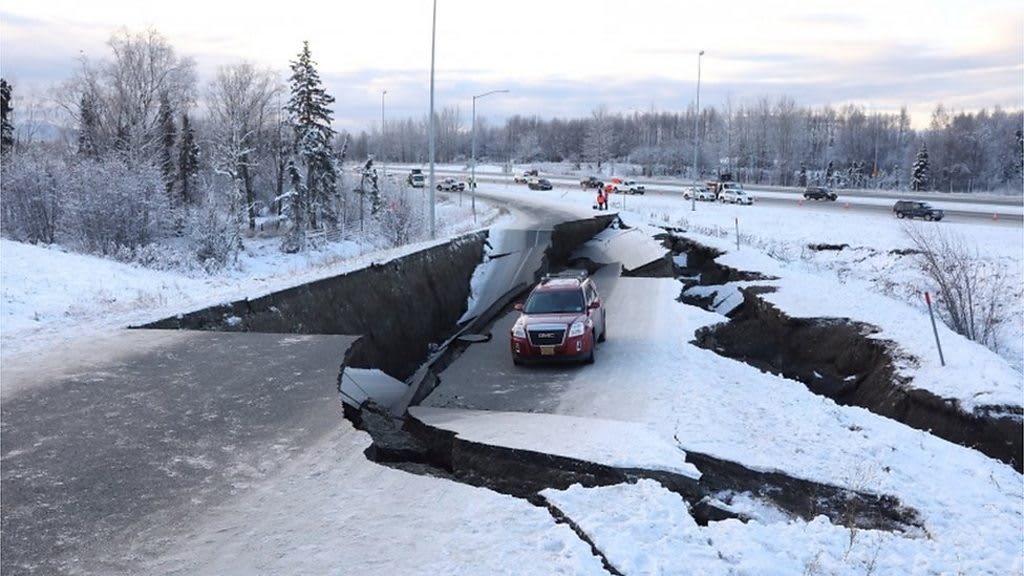
A tsunami warning was issued by the United States Geological Survey (USGS) following a 7.2 magnitude earthquake that struck the Alaska Peninsula region. The initial measurement of the quake was reported as 7.4 magnitude but was later revised by the USGS. Despite the downgrade, it was still classified as a "strong" earthquake on the survey's scale. The depth of the earthquake was initially recorded at 9.3 km (5.78 miles) but was later adjusted to 32.6 km (20.3 miles).
Fortunately, the USGS reported that little to no population was exposed to the earthquake, which helped mitigate the potential impact on human lives. Additionally, the survey indicated that there was little to no expectation of landsliding, although some highly susceptible areas might have experienced slight movements.
The effects of the earthquake were widely felt throughout the Aleutian Islands, the Alaskan Peninsula, and the Cook Inlet regions, as reported by the Alaska Earthquake Center. These areas are known to be prone to seismic activity, making earthquakes relatively common occurrences. Shortly after the 7.2 magnitude earthquake, the USGS recorded a 5.2 magnitude earthquake in the same area. Furthermore, a 3.5 magnitude quake was detected in the peninsula a few hours later. While earthquakes with magnitudes below four or five generally do not cause significant damage, they serve as reminders of the ongoing seismic activity in the region.
Following the earthquake, a tsunami warning was issued by the US Tsunami Warning System. However, the warning was later changed to an advisory, indicating that strong currents or dangerous waves were expected, imminent, or occurring. The National Tsunami Warning Center in Palmer, Alaska specified that the warning applied to South Alaska and the Alaska Peninsula. They also stated that they were assessing the level of tsunami hazard for various US and Canadian Pacific coasts in North America.
When reflecting on past seismic events in Alaska, the 1964 earthquake stands out as the most destructive. This earthquake, with a magnitude of 9.2, remains the largest ever felt in North America. It caused extensive damage to Anchorage and triggered tsunamis that affected the Gulf of Alaska, the US west coast, and Hawaii. The resulting tsunamis caused the loss of more than 250 lives.
Given the potential devastation caused by earthquakes and tsunamis, authorities diligently monitor seismic activity in high-risk areas like the Alaska Peninsula. The implementation of efficient tsunami warning systems and the establishment of centers responsible for monitoring and issuing alerts are vital for safeguarding coastal communities. Additionally, public awareness and preparedness play crucial roles in reducing the impacts of these natural disasters.
In conclusion, a 7.2 magnitude earthquake in the Alaska Peninsula region prompted a tsunami warning that was later downgraded to an advisory. While the earthquake was categorized as strong, its depth and location limited the immediate impact on populated areas. The Alaska Peninsula, known for its seismic activity, has experienced significant earthquakes in the past, underscoring the importance of preparedness and robust warning systems. By remaining vigilant and informed, communities can work towards mitigating the potential consequences of earthquakes and tsunamis.
In the aftermath of an earthquake and the issuance of a tsunami warning, emergency response teams and authorities play a critical role in ensuring the safety of affected communities. Evacuation plans and procedures are activated to move residents to higher ground or designated safe areas to minimize their exposure to potential tsunami waves. Public education campaigns are also launched to raise awareness about the signs of a tsunami and the necessary actions to take in such situations. These efforts aim to empower individuals with the knowledge to protect themselves and their loved ones during times of crisis.
Furthermore, the geological characteristics of the Alaska Peninsula region contribute to its susceptibility to earthquakes. The area sits along the boundary between the Pacific and North American tectonic plates, which are constantly interacting and generating significant seismic activity. The Pacific Plate is subducting beneath the North American Plate, creating intense pressure and leading to frequent earthquakes in the region. This tectonic activity is part of the larger Pacific Ring of Fire, an area known for its seismicity and volcanic eruptions encircling the Pacific Ocean.
The lessons learned from previous earthquakes and tsunamis have driven advancements in engineering and construction practices to enhance the resilience of infrastructure in high-risk areas. Building codes have been updated to include provisions for seismic resistance, ensuring that structures can withstand the forces generated by earthquakes. Additionally, the development of early warning systems has enabled authorities to issue alerts and advisories promptly, providing valuable time for evacuation and emergency response preparations.
Collaboration between scientific institutions, government agencies, and international organizations continues to play a crucial role in understanding and mitigating the impacts of earthquakes and tsunamis. Data sharing, research, and joint projects contribute to improved monitoring capabilities, hazard assessment, and risk reduction strategies. Through these collective efforts, communities at risk can benefit from the latest scientific knowledge and technological advancements, reinforcing their ability to respond effectively to future seismic events.
In conclusion, the occurrence of a 7.2 magnitude earthquake in the Alaska Peninsula region triggered a tsunami warning, emphasizing the potential risks and hazards associated with such events. Efforts in monitoring, early warning systems, emergency response, and public awareness are vital in mitigating the impact of earthquakes and tsunamis. The Alaska Peninsula's geological characteristics, including its location along tectonic plate boundaries, make it susceptible to seismic activity. By learning from past events, implementing robust safety measures, and fostering collaboration, communities can enhance their resilience and reduce the vulnerability to these natural disasters.
About the Creator
sagar dhital
I'm a creative writer in the way that I write. I hold the pen in this unique and creative way you've never seen. The content which I write... well, it's still to be determined if that's any good.
Keep reading
More stories from sagar dhital and writers in Earth and other communities.
Khotang Municipality Distributes 400 Bulls to Farmers for Self-Employment
Diktel Rupakot Majhuwagadhi Municipality has launched a program to distribute high-breed bulls to local farmers. The initiative aims to promote self-employment among farmers and make the municipality self-sufficient in buffalo meat production. This year, bulls worth approximately NPR 62 million are being distributed under the program.
By sagar dhital10 months ago in Earth
Microbiota, microbiome or microflora: how to speak correctly and why it is for health.
You've probably heard the phrase, "We are what we eat." But modern science says more precisely: we are also those who live in us. Until 2016, it was believed that there are many times more bacteria in our body than our own cells. The latest calculations by mathematicians show that we divide the body with our microorganisms by about 50/50: about 30 trillion of our cells versus 38 trillion bacterial ones.
By Yaroslav Gorohov4 days ago in Earth
Chinese EVs Closing In on America After Canadian Tariffs Deal
The electric vehicle race is no longer just about climate goals or consumer choice — it has become a geopolitical contest. And in early 2026, a subtle but powerful move by Canada may have tilted the board. By agreeing to sharply reduce tariffs on Chinese electric vehicles, Canada has opened a door that the United States has worked hard to keep shut. While Chinese EVs are still largely barred from the American market, they are now edging closer than ever — not by crossing the border directly, but by entering through Canada. This development raises a pressing question: Are Chinese EVs closing in on America, and what does that mean for the future of North American auto markets? The Deal That Changed the Game Canada’s new agreement with China allows up to 49,000 Chinese-made electric vehicles per year to enter the Canadian market at a tariff rate of just over 6%, a dramatic drop from the previous 100% tariff that effectively blocked them. On paper, the quota seems small. In reality, it carries enormous symbolic and strategic weight. For years, both Canada and the United States aligned closely on keeping Chinese EVs out, citing concerns over unfair subsidies, national security, and the protection of domestic auto industries. This new deal marks a clear shift — and a divergence from U.S. policy. Canada didn’t make the decision in isolation. The EV tariff reduction was part of a broader trade reset with China, tied to agricultural exports such as canola and efforts to stabilize a strained economic relationship. Why Chinese EVs Matter So Much China is the undisputed leader of the global electric vehicle industry. Its manufacturers produce EVs at scale, often at prices Western automakers struggle to match. Brands like BYD, Nio, and Xpeng have already expanded aggressively into Europe, Southeast Asia, and parts of the Middle East. North America has remained one of the final fortified markets — until now. Chinese EVs are appealing not just because they’re cheaper, but because they’ve rapidly improved in quality, range, and technology. For consumers priced out of North American and European EV models, Chinese vehicles offer something rare: affordability without sacrificing features. Canada’s decision gives Chinese automakers their first legitimate foothold in North America — and footholds tend to grow. Why the U.S. Is Nervous The United States still enforces a 100% tariff on Chinese EV imports, making them effectively unsellable in the American market. But Canada’s move has triggered concern in Washington. U.S. officials argue that Chinese EVs entering Canada could indirectly pressure American markets, influence supply chains, and weaken Washington’s leverage in future trade negotiations. There’s also a political dimension. Both major U.S. parties have framed Chinese dominance in EVs as a strategic threat — not just to auto jobs, but to technological leadership. Modern EVs collect vast amounts of data, and lawmakers have raised concerns about cybersecurity and foreign data access. While Chinese EVs aren’t rolling onto American roads yet, their presence just across the border changes the conversation. Canada’s Risk — and Opportunity Inside Canada, the reaction has been mixed. Automotive hubs like Ontario worry that opening the market could undermine domestic manufacturing and strain relations with the U.S., Canada’s largest trading partner. Some leaders have called the deal “lopsided,” warning it could cost jobs if American retaliation follows. Others see opportunity. A more competitive EV market could lower prices for Canadian consumers and accelerate EV adoption. It may also attract Chinese investment into Canada itself — including factories, battery plants, and supply chain partnerships. If Chinese automakers choose to build in Canada rather than simply export to it, the country could position itself as a bridge between Chinese EV innovation and North American demand. That balancing act — between economic opportunity and political risk — defines Canada’s strategy. Are Chinese EVs Really ‘Closing In’ on America? For now, the answer is: not directly — but strategically, yes. Chinese EVs sold in Canada won’t automatically flood the U.S. market. Regulations, trade rules, and tariffs still stand in the way. But proximity matters. Supply chains overlap. Consumer awareness spreads. Manufacturing footprints expand. There’s also the possibility of a workaround: Chinese companies could eventually build EVs in North America to bypass tariffs altogether. This idea has already been floated — but it faces fierce resistance from U.S. lawmakers and unions. Still, history shows that once a global industry leader gains regional access, momentum often follows. What This Means for Consumers For Canadian buyers, the impact could be immediate: more choice and lower prices in an EV market that has long been criticized for being expensive and limited. For American consumers, the effect will be indirect — at least at first. But increased competition could eventually pressure U.S. automakers to reduce prices, improve features, and accelerate innovation. The larger question is whether North America wants competition or insulation — and how long insulation can realistically last in a globalized EV economy. The Bigger Picture: A Global EV Power Shift Canada’s tariff deal reflects a broader reality: China’s dominance in electric vehicles is reshaping global trade, whether governments like it or not. Europe is already grappling with an influx of Chinese EVs. Emerging markets are embracing them. And now, North America has its first real crack in the wall. This isn’t just about cars. It’s about who controls the future of clean transportation, supply chains, and industrial policy. Final Thoughts Chinese EVs aren’t driving down American highways yet — but after Canada’s tariff deal, they’re closer than ever. This move doesn’t spell immediate disruption, but it does signal a shift. One country has decided that economic pragmatism outweighs political alignment. And in doing so, Canada may have opened the door to a new phase of EV competition in North America. Whether that door swings wider — or slams shut — will depend on how the U.S., automakers, and consumers respond. One thing is certain: the EV race just entered a new chapter.
By Muhammad Hassana day ago in Earth




Comments
There are no comments for this story
Be the first to respond and start the conversation.