
US-China Collisions
The United States and China have conflicting interests in the South China Sea, where China has been asserting territorial claims.

Once upon a time, in the vast expanse of the South China Sea, a clash of interests and territorial claims brewed between two global powers: the United States and China. The azure waters that had long been a vital international trade route became the stage for a high-stakes geopolitical battle.
In the bustling streets of Washington D.C., President James Bennett sat in the Oval Office, surrounded by advisors, poring over intelligence reports. The South China Sea had become a hotbed of tension as China asserted its territorial claims, encroaching upon the maritime boundaries of neighboring nations. President Bennett understood the significance of maintaining freedom of navigation in the region and protecting the interests of the United States and its allies.
Halfway across the world, in the vibrant metropolis of Beijing, President Li Wei grappled with his own concerns. China, with its growing economic and military prowess, sought to strengthen its influence and secure its perceived historical rights over the South China Sea. The extensive coastline, dotted with archipelagos and rich in resources, was a strategic treasure that China was determined to protect.
As the rivalry intensified, the United States decided to challenge China's claims through freedom of navigation operations (FONOPs). With this decision, the U.S. Navy dispatched its mighty warships into the disputed waters, asserting the right to sail and operate in international waters.
In the heart of the South China Sea, near the contested Spratly Islands, a U.S. destroyer named USS Jefferson sailed boldly. The ship's captain, Commander Sarah Anderson, understood the significance of her mission. She navigated treacherous waters while balancing the responsibility of safeguarding international law and ensuring the safety of her crew.
Commander Anderson's actions did not go unnoticed by China. The People's Liberation Army Navy (PLAN) closely monitored the U.S. vessel's movements, perceiving them as provocative and challenging their sovereignty. Tensions escalated, and near-miss encounters between the two navies became all too frequent.
On a warm summer day, the USS Jefferson found itself in the midst of a fierce storm. As the wind howled and the waves crashed against the ship's hull, a distress call came in from a Chinese fishing vessel caught in the tempest. Commander Anderson, committed to the principles of humanitarian assistance, launched a rescue operation, defying the brewing storm and the growing tensions.
The crew of USS Jefferson worked tirelessly to save the stranded fishermen, unaware that their actions would become a turning point in the South China Sea dispute. News of the rescue operation spread across international media, creating a ripple effect that transcended political boundaries. People around the world witnessed the U.S. Navy's commitment to freedom of navigation and its willingness to extend a helping hand even in the midst of conflict.
The event sparked a glimmer of hope amidst the sea of tensions. Public sentiment pressured leaders on both sides to seek a diplomatic resolution to the South China Sea disputes. Behind closed doors, negotiations commenced, spearheaded by diplomats from the United States, China, and the affected nations.
Currently, discussions are underway to establish a framework that respects the rights and interests of all parties involved. The international community eagerly awaits the outcome, hoping for a peaceful and mutually beneficial resolution that upholds freedom of navigation, respects territorial integrity, and fosters cooperation in the region.
As the story of the South China Sea continues to unfold, the world watches with bated breath. The clash of interests between the United States and China remains a complex challenge, but the spirit of humanity and cooperation displayed in the face of adversity offers a glimmer of hope for a brighter future in this corner of the world.
About the Creator
Keep reading
More stories from writers in Earth and other communities.
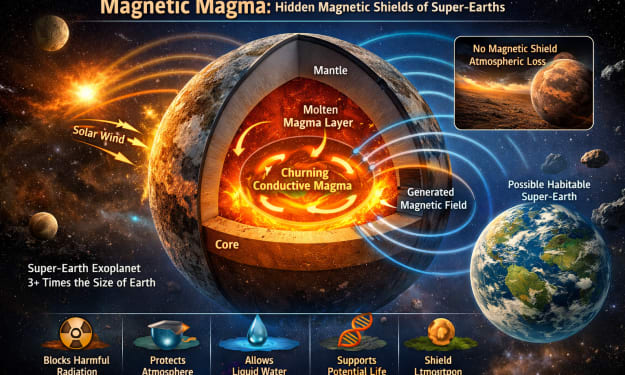
Magnetic Magma earth
Super-Earths are rocky exoplanets more than three times the size of our planet, with far greater internal pressures and temperatures. For years, scientists assumed that if these worlds had magnetic fields, they would form the same way Earth’s does — through movement in a molten iron core. However, new laboratory experiments suggest something very different may be happening deep inside these massive planets. Under extreme pressure, certain molten rocks become electrically conductive. When these materials churn and circulate between the core and the mantle, they can generate magnetic fields on their own. This means a super-Earth might not rely solely on its core for protection. Instead, a thick, dynamic layer of magma could act as a natural magnetic shield, powered by internal heat and motion.
By USA daily update 6 days ago in Earth
Media: The Amplifier of Injustice
Media does not report reality. It selects, compresses, and amplifies fragments of it according to incentives largely unrelated to truth. What reaches the public is not an account of events; it is an engineered sequence designed to capture attention, provoke reaction, and sustain engagement.
By Meridian Vox3 days ago in Earth



Comments (1)
Hello, it is a Vocal policy that content created with AI is identified as such at the start of the story/article. Your article/story has many hallmarks of AI-assisted/generated content. You can find the details of the Vocal policy here: https://shopping-feedback.today/resources/an-update-from-vocal-on-ai-generated-content%3C/span%3E%3C/span%3E%3C/span%3E%3C/a%3E, Please amend your piece to be in compliance. If you are not a Vocal+ member you will need to contact Vocal here ([email protected]) and ask them to edit your story/article/poem for you. If you don’t correct this the content may be removed by Vocal and/or you may be deleted from the platform.