
"Unveiling the Secrets of Space Weather: How Scientists Monitor Solar Storms from the Ground"
Space weather refers to the various conditions in the Earth's near-space environment that can affect our planet and our technology. This includes solar flares, coronal mass ejections, and geomagnetic storms, all of which are caused by activity on the sun. While these phenomena occur in space, their effects can be felt on Earth, and they can have significant impacts on our technology and infrastructure.
To monitor space weather, scientists use a variety of ground-based and space-based instruments. These include solar telescopes, which are used to observe the sun and track solar flares and coronal mass ejections, as well as magnetometers, which are used to measure changes in the Earth's magnetic field caused by geomagnetic storms. Other instruments, such as radar and radiometers, are used to study the ionosphere and measure the effects of space weather on radio communications.
One important aspect of monitoring space weather is tracking solar flares and coronal mass ejections. Solar flares are sudden bursts of energy that are released from the sun's surface, while coronal mass ejections are large eruptions of plasma and magnetic fields that can be released from the sun's corona. Both of these events can cause solar energetic particles (SEPs) to be expelled into space, and if these particles reach Earth, they can cause geomagnetic storms, which can disrupt power grids, satellite communications, and GPS navigation.
To track solar flares and coronal mass ejections, scientists use a variety of telescopes, including the Solar and Heliospheric Observatory (SOHO) and the Solar Dynamics Observatory (SDO), which are both operated by NASA. These telescopes provide images and data of the sun's surface and corona, allowing scientists to track the development of solar flares and coronal mass ejections in real time. In addition, the National Oceanic and Atmospheric Administration (NOAA) also operates a network of space weather sensors called the Advanced Composition Explorer (ACE) that can detect and track SEPs as they travel toward the Earth.
Another key aspect of monitoring space weather is measuring the effects of geomagnetic storms on the Earth's magnetic field. Geomagnetic storms are caused by the interaction of the solar wind with the Earth's magnetic field, and they can cause changes in the magnetic field that can disrupt power grids, satellite communications, and GPS navigation. To measure these changes, scientists use a network of magnetometers, which are instruments that measure the strength and direction of the Earth's magnetic field.
The US National Oceanic and Atmospheric Administration (NOAA) operates the USGS Ground Magnetometer Network, which is a network of magnetometers located around the United States. These instruments measure changes in the Earth's magnetic field caused by geomagnetic storms, and the data is used to create geomagnetic storm forecasts and warnings.
In addition to these instruments, scientists also use radar and radiometers to study the ionosphere. The ionosphere is a layer of the Earth's upper atmosphere that is ionized by the sun's ultraviolet radiation. It plays a critical role in radio communications, as it reflects and refracts radio waves. Space weather can affect the ionosphere, and radar and radiometers are used to study these effects.
Radar is used to study the ionosphere by bouncing radio waves off the ionosphere and measuring the reflection. This allows scientists to study the density and structure of the ionosphere, and how it is affected by space weather. Radiometers, on the other hand, measure the amount of ionospheric absorption of radio waves at different frequencies. This allows scientists to study how space weather affects the ionosphere's ability to reflect and refract radio waves.
In addition to these ground-based instruments, scientists also use space-based instruments to monitor space weather. The most important of these is the Solar Terrestrial Relations Observatory (STEREO) mission, which is a pair of spacecraft that was launched by NASA in 2006. These spacecraft are positioned at different points in the Earth's orbit, allowing scientists to study the sun and the solar wind from different angles. This provides a more complete picture of space weather and allows for more accurate predictions of geomagnetic storms and other space weather events.
Another important space-based instrument is the Geostationary Operational Environmental Satellite (GOES) system, which is operated by NOAA. These satellites are positioned in geostationary orbit, which means they remain in the same location relative to the Earth's surface. This allows them to continuously monitor the sun and the Earth's atmosphere, providing real-time data on solar flares, coronal mass ejections, and geomagnetic storms.
To further improve space weather monitoring, NASA and NOAA are planning to launch a new generation of space weather instruments in the coming years. These include the Deep Space Climate Observatory (DSCOVR), which will be positioned at the L1 Lagrange point, where it will be able to provide early warning of incoming solar storms, and the Solar Probe Plus mission, which will fly closer to the sun than any other spacecraft in history, allowing scientists to study the sun's corona and solar wind in unprecedented detail.
In summary, monitoring space weather from the ground is a critical task for scientists, as it allows them to track solar flares, coronal mass ejections, and geomagnetic storms, and to predict their effects on the Earth's technology and infrastructure. This is accomplished through the use of a variety of ground-based and space-based instruments, including solar telescopes, magnetometers, radar, and radiometers. With the launch of new instruments and missions, scientists will be able to better understand and predict space weather, which will help to protect our technology and infrastructure from the effects of solar activity.
About the Creator
Keep reading
More stories from mohamed hasif and writers in Earth and other communities.
How will you make money online in 2023?
How to make money from home Making money from home has become increasingly popular in recent years, as more and more people are looking for ways to earn an income while also maintaining a good work-life balance. There are several ways to make money from home, depending on your skills and interests.
By mohamed hasif3 years ago in Lifehack
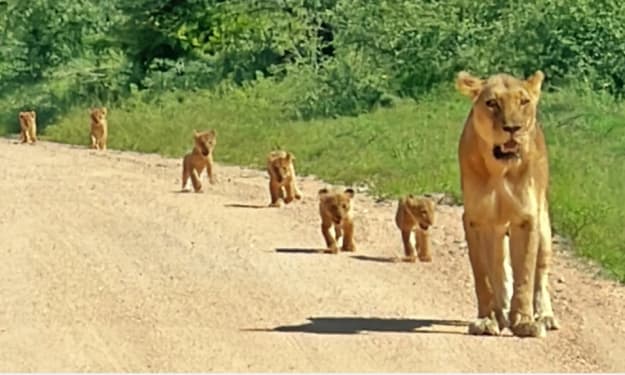
Tiny Lion Cubs Struggle To Keep Up With Mom
In the heart of the African savannah, life is a constant lesson for young animals. Few scenes are as endearing — or as heartwarming — as tiny lion cubs trying to keep pace with their mother. These little bundles of fur face a world full of challenges, from learning to hunt to avoiding dangers, all while depending on the guidance and protection of their experienced mom. Watching cubs wobble and tumble as they attempt to keep up with their mother reminds us that growing up, even in the wild, is a journey full of struggle, determination, and adorable missteps. The Early Days of Lion Cubs Lion cubs are born blind and helpless, usually in litters of two to six. For the first few weeks, they rely entirely on their mother for warmth, food, and safety. Even after opening their eyes and beginning to explore, the cubs are far from independent. The first months are crucial. Cubs learn social cues, hunting basics, and survival skills simply by watching their mother and the pride. But as anyone who has observed them knows, there’s often a huge gap between observation and action. Tiny cubs often struggle to match their mother’s pace, especially when she moves through long stretches of savannah or leads the family on patrols. A Mother’s Role in the Wild For a lioness, raising cubs is a full-time commitment. She hunts, defends her territory, and teaches her young, all while staying alert to predators such as hyenas, leopards, and even rival lions. The cubs, meanwhile, attempt to mimic her every move — often with clumsy yet charming results. A mother lion’s patience is remarkable; she frequently slows down, nudges them along, or stops to ensure no cub is left behind. These moments, while stressful for the tiny cubs, are vital learning opportunities. Struggling to Keep Up: Why It’s So Hard There are several reasons why tiny lion cubs have trouble keeping pace with their mother: Short Legs, Big Steps: Lion cubs’ legs are tiny and their coordination is limited, making it difficult to cover the same distance as an adult lioness. Curiosity: Cubs are naturally curious. A single butterfly or rustling bush can distract them, leaving mom to pause repeatedly. Energy Levels: Young lions tire quickly. Even with frequent naps, the cubs’ stamina is far lower than their mother’s. Learning Through Play: Play is not just fun; it teaches hunting, balance, and social skills. Running off to pounce on a sibling or chase an insect is all part of their education. Despite these challenges, the cubs’ determination to keep up demonstrates their resilience and growing understanding of the wild world. Lessons in Teamwork and Survival Every cub struggling to keep up is also learning crucial survival skills. The journey across the savannah is more than a test of speed — it’s a lesson in: Coordination: Cubs learn how to move efficiently across different terrains. Patience: They begin to understand the rhythms of adult life and the pace required for survival. Social Skills: Staying with the group teaches cubs how to interact with siblings and the pride, which is essential for their future roles. Observation: By following their mother, cubs study hunting techniques, territorial behavior, and predator awareness. Even the moments when cubs stumble or lag behind are essential for their development. These experiences prepare them for independence, which comes sooner than many might expect. The Cutest Moments in the Wild Anyone who has watched tiny lion cubs knows that their struggles are often irresistibly cute. Video clips from wildlife reserves frequently show cubs toddling along, tumbling over each other, or getting distracted mid-step. Observers often comment that these little stumbles reveal personality, determination, and playfulness, making them one of nature’s most heartwarming spectacles. While their mother is serious and focused, the cubs inject a sense of humor and lightness into life on the savannah. Why This Matters The struggles of lion cubs aren’t just adorable — they’re vital for understanding wildlife behavior. Conservationists and animal behaviorists use these moments to study growth patterns, social structures, and survival strategies in lion populations. These observations also highlight the importance of preserving natural habitats. Cubs must learn in a safe environment to survive; habitat loss, poaching, and climate change make these early struggles even more dangerous. Protecting the African savannah ensures that future generations of lions can experience the same lessons and playful tumbles. The Road to Independence Within a year, these tiny cubs will be more agile, faster, and more confident. By the time they reach two to three years old, males may begin to leave the pride, while females often stay and become caretakers themselves. Every misstep, tumble, and lagging moment is part of the journey toward strength, coordination, and independence. Watching them now gives us a glimpse of the challenges they will overcome, and the survival skills they will carry for life. A Celebration of Motherhood Ultimately, these scenes remind us of the incredible bond between mother and cubs. Her patience, vigilance, and teaching are the foundations of their future. The cubs’ struggles highlight the trials of growing up, while their determination showcases the resilience and beauty of wildlife. For those observing, it’s a powerful lesson in care, guidance, and perseverance, not just in lions but in the natural world as a whole. Final Thoughts Watching tiny lion cubs try to keep up with their mother is both entertaining and enlightening. It’s a story of growth, struggle, and resilience — a reminder that even the fiercest creatures start small, learning step by step. These little lions capture hearts while teaching life lessons: patience, determination, teamwork, and the importance of guidance. As they tumble and waddle across the savannah, they show us that growth is a process, one adorable misstep at a time. For wildlife enthusiasts, animal lovers, and anyone enchanted by nature, these tiny cubs are proof that even in the wild, love, care, and persistence are universal truths.
By Aarif Lashariabout 18 hours ago in Earth
Microbiota, microbiome or microflora: how to speak correctly and why it is for health.
You've probably heard the phrase, "We are what we eat." But modern science says more precisely: we are also those who live in us. Until 2016, it was believed that there are many times more bacteria in our body than our own cells. The latest calculations by mathematicians show that we divide the body with our microorganisms by about 50/50: about 30 trillion of our cells versus 38 trillion bacterial ones.
By Yaroslav Gorohov5 days ago in Earth



Comments
There are no comments for this story
Be the first to respond and start the conversation.