
"Unleashing the Terror: Exploring the World of Monsters"
The unknown

Scientists are known to make groundbreaking discoveries, but even they face mysteries that leave them baffled. Here are ten such enigmas that still remain unsolved:
The Hum - Approximately 4% of the world's population hears a low-frequency hum that has no known source. People from all over the world hear it, and it is just on the threshold of human hearing. Some say it began in London around the time of Charles Dickens, while the earliest cases were recorded in Bristol, UK, in the mid-1970s. Scientists have various theories about where the hum comes from and why only some people can hear it, but they don't have a clear answer.
Upsweep - Discovered in 1991 in the Pacific Ocean, this sound is high enough to be recorded throughout the ocean. Scientists believe that the sound could be related to underwater volcanic activity. Interestingly, the volume of the sound has been diminishing compared to its volume when it was first discovered, yet it still can be detected, and it's seasonal. It reaches its highest volume in Spring and Fall, but no one knows for sure if it's related to seasonal changes.
Sea of Galilee Monument - A cone-shaped monument found in the Sea of Galilee in Israel. The monument weighs 60,000 tons, and it was once submerged by rising waters. Archaeologists say the monument is enigmatic because they can't figure out where it's from, what it's connected to, or its function.
Gobekli Tepe - This archaeological site in Turkey has massive carved stones that are about 11,000 years old. To put it into perspective, they're 6,000 years older than Stonehenge. Ancient people placed these stones before they began farming or crafting metal tools or pottery. So the existence of this place goes against the chronology of civilization we're familiar with where people farmed first and built second. Archaeologists believe it might be the world's oldest temple.
Paleodictyon - This is a living fossil found deep down on the ocean floor. A creature makes these hexagonal burrows that for sure, yet scientists can't identify the artist. Paleo dictyon is a creature believed to produce a burrow nearly identical to paleodiction fossils. Is it a worm-like animal that made them? Scientists don't know, but one thing is clear. This isn't some random stuff created by geological forces.
Godzillius - An almost seven-foot-long and nine-foot-tall fossil was discovered in 2011 by an amateur paleontologist. It's 450 million years old, coming from the time when Cincinnati was underwater. It might be a fossilized algae mat, but some scientists have different opinions.
The Paleolithic Tunnels - The tunnel is at least 8,000 to 10,000 years old, and it is the largest known borough from the Paleolithic Age in the Amazon. Researchers discovered claw marks on the walls of the ceiling and reasoned that some extinct species could be the ones to have left these marks. Many geologists strongly believe they found the burrows of giant ground sloths and armadillos. However, experts still have many questions about how such a deliberate-looking structure could form naturally.
The Wow! Signal - This was a strong radio signal received on August 15, 1977, by Ohio State University's Big Ear radio telescope. The signal was so unusual that astronomer Jerry R. Ehman, who discovered it, circled the reading on the computer printout and wrote "Wow!" in the margin. Despite decades of searching, no one has been able to explain where the signal came from, and it remains one of the greatest astronomical mysteries.
Dark Matter - Scientists have been trying to understand dark matter for decades, but they still don't know what it is. Dark matter is believed to make up around 85% of the universe's mass, but it doesn't emit, absorb, or reflect light, so it can't be directly observed. Scientists can only detect its effects on visible matter, such as stars and galaxies. The leading theory is that dark matter is made up of some unknown particle that interacts only weakly with other matter.
Dark Energy - Like dark matter, dark energy is another mysterious component of the universe. Dark energy is believed to be responsible for the accelerating expansion of the universe, but scientists don't know what it is or how it works. Some theories suggest that it's a new type of energy field that permeates all of space, while others propose that it's a property of space itself.
The Fermi Paradox - Named after physicist Enrico Fermi, the Fermi paradox asks the question, "Where is everybody?" In other words, if the universe is so vast and there are so many potentially habitable planets, why haven't we detected any signs of intelligent alien life? Some possible explanations for the paradox include the idea that intelligent life is extremely rare, that we haven't been looking in the right way, or that civilizations tend to self-destruct before they can make contact.
The Pioneer Anomaly - The Pioneer 10 and 11 spacecraft were launched in the early 1970s and were the first spacecraft to fly by Jupiter and Saturn. However, scientists noticed that the spacecraft were experiencing a slight but unexplained deceleration. The Pioneer anomaly has been studied extensively, but no one has been able to fully explain its cause.
The Tunguska Event - In 1908, a massive explosion occurred over the Tunguska region of Siberia, flattening trees and causing shockwaves that were felt hundreds of miles away. The cause of the explosion is still unknown, but it's widely believed to have been caused by a meteoroid or comet exploding in the atmosphere. However, no fragments of the object have ever been found.
The Bloop - In 1997, an underwater microphone recorded a loud, low-frequency sound that was heard across thousands of miles of ocean. The sound was so powerful that it was picked up by sensors nearly 5,000 kilometers apart. Some scientists believe the sound could have been produced by a massive creature, like a giant squid, while others suggest it was an iceberg calving. However, no definitive explanation has been found.
Black Holes - Black holes are objects with such strong gravitational fields that nothing, not even light, can escape them. They form when massive stars collapse in on themselves. Despite their incredible power, black holes are invisible, as they don't emit any light. Scientists can only detect them by observing their effects on nearby matter, such as stars that orbit them.
The Multiverse - The idea of a multiverse suggests that our universe may be just one of many parallel universes that exist alongside each other. Each universe would have its own set of physical laws and constants, making them potentially very different from our own. While the idea of a multiverse is still largely theoretical, it has gained popularity in recent years as a way to explain certain phenomena, such as the fine-tuning of physical constants that allow life to exist in our universe.
Quantum Entanglement - Quantum entanglement is a phenomenon where two particles become intertwined in such a way that the state of one particle is instantly affected by the state of the other, regardless of how far apart they are. This seemingly instantaneous connection between particles has been the subject of much research and speculation, and its potential uses in fields such as cryptography and quantum computing are still being explored.
The Wow! Signal - In 1977, a radio telescope in Ohio picked up a radio signal that lasted for 72 seconds and has never been detected again. The signal was so unusual that the astronomer who discovered it wrote "Wow!" in the margin of the printout. While the origin of the signal is still unknown, some scientists have speculated that it could be evidence of extraterrestrial intelligence.
The Great Attractor - The Great Attractor is a mysterious region of space that seems to be pulling nearby galaxies towards it at incredible speeds. Despite its powerful gravitational pull, the Great Attractor is invisible, as it doesn't emit any light. Its exact location and composition are still unknown, but it's believed to be a massive concentration of dark matter and galaxies.
The Higgs Boson - The Higgs boson is a particle that was first theorized in the 1960s as a way to explain why other particles have mass. It wasn't until 2012 that scientists at CERN's Large Hadron Collider confirmed the existence of the Higgs boson. Its discovery was a major breakthrough in particle physics and has helped to shed light on the fundamental workings of the universe.
The Kuiper Belt - The Kuiper Belt is a region of space beyond Neptune that is home to a large number of icy objects, including Pluto. It's believed to be the source of many short-period comets that orbit the sun. Despite its importance, the Kuiper Belt is still largely unexplored, with only a handful of spacecraft having visited it.
Dark Flow - Dark flow is a phenomenon where galaxy clusters appear to be moving towards a specific point in the universe at a velocity that can't be explained by the known forces of gravity. Some scientists have suggested that this mysterious flow could be evidence of the existence of other universes beyond our own.
The Great Filter - The Great Filter is a hypothetical event or series of events that could prevent the evolution of intelligent life beyond a certain point. Some scientists have suggested that the Great Filter could be behind the Fermi paradox, as it would explain why we haven't detected any signs of alien life despite the apparent abundance of habitable planets.
The Hubble Constant - The Hubble constant is a measure of the rate at which the universe is expanding. Despite its importance, the value of the Hubble constant has been a subject of much debate and controversy over the years. Recent measurements have suggested that the universe may be expanding at a faster rate than previously thought, which could have significant implications for our understanding of the cosmos.
Conclusion:
These ten mysteries are just a small sample of the many unsolved enigmas that scientists are grappling with. From unexplained sounds and ancient monuments to dark matter and the search for extraterrestrial life, these mysteries continue to challenge our understanding of the universe. As technology advances and new discoveries are made, perhaps we'll one day have answers to these and other enduring questions. Until then, these mysteries remain a testament to the boundless curiosity and ingenuity of the human mind
About the Creator
Keep reading
More stories from writers in Earth and other communities.
Hunt for the Names of Mysterious Dwarf Planets
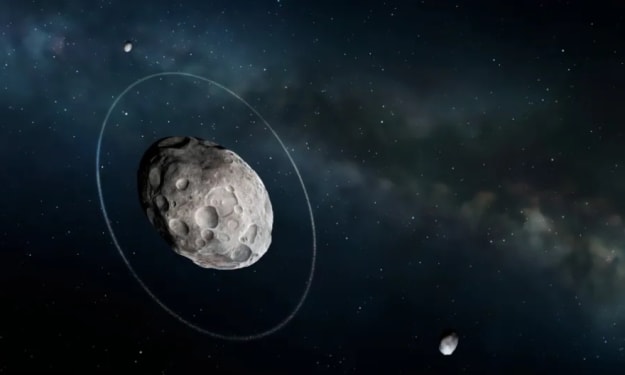
Far beyond the familiar planets of our solar system lies a cold, dark region filled with icy bodies, ancient debris, and mysterious worlds yet to be fully understood. Among these distant objects are dwarf planets, many of which orbit on the fringes of our solar system in regions like the Kuiper Belt and beyond. While some, such as Pluto, have captured public imagination for decades, many others remain unnamed, sparking a fascinating hunt among astronomers to discover, study, and ultimately name these elusive celestial bodies.
By Aarif Lashariabout 7 hours ago in Earth
Nvidia CEO Says AI Will Create Jobs for Electricians and Plumbers
For years, artificial intelligence has been associated with job loss fears. From factory automation to office software, the dominant narrative has suggested that AI will replace human workers across industries. But according to Nvidia CEO Jensen Huang, the AI revolution tells a more complex—and surprisingly optimistic—story.
By Muhammad Hassan6 days ago in Earth


Comments
There are no comments for this story
Be the first to respond and start the conversation.