
Unleashing the Power of Earth
Exploring the Fascinating World of Volcanoes
________________________________________
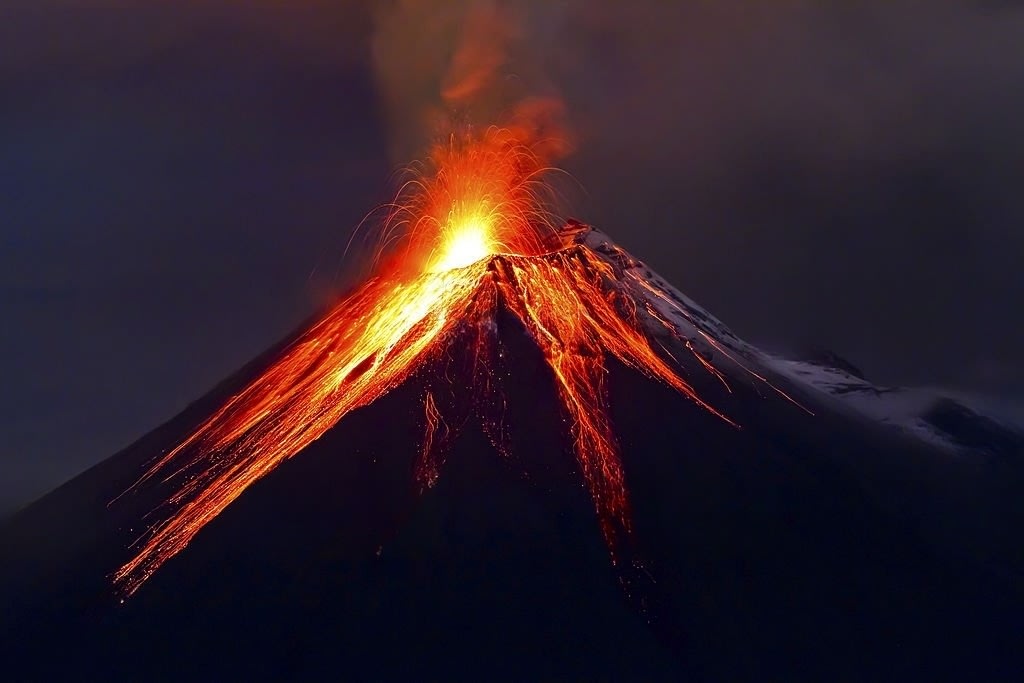
The Earth, our vast and dynamic planet, harbors a fiery core as scorching as the surface of the Sun. It contains immense heat from its birth and the decay of radioactive elements. This energy, trapped beneath the Earth's crust, creates a complex system of rock currents that transport the heat to the surface. Despite appearing solid, our planet's crust is merely a fragile barrier enveloping a colossal force waiting to erupt—supervolcanoes.
Volcanoes come in various forms, from towering mountains to lava domes. They primarily emerge at the boundaries between tectonic plates, which are like puzzle pieces covering the Earth's surface. With seven major plates and numerous smaller ones, these colossal chunks of crust move at a slow pace—around 15 cm per year. Yet, on geological timescales, this movement engenders a titanic struggle for surface dominance.
When tectonic plates clash, one plate crumples, forming mountain ranges, while the other plate submerges into the hot rock beneath—known as the asthenosphere. This submerged plate, previously in contact with water for thousands of years, undergoes chemical transformations as it sinks deeper. These changes cause some portions of the plate to melt into magma, which is less dense than solid rock, leading it to ascend beneath the crust.
Given enough time and accumulation, magma gains the strength to pierce through the Earth's crust, resulting in volcanic eruptions. This process typically occurs beneath the winning plate, as if the losing plate retaliates before its complete disappearance.
Apart from plate boundaries, mantle plumes are another source of volcanic activity. These plumes consist of exceptionally hot rock rising from the core-mantle boundary. While their mechanisms remain less understood, they can create volcanoes in unexpected locations, unaffected by the motions of tectonic plates.
Scientists gauge the scale of volcanic eruptions using the Volcanic Explosivity Index (VEI), a logarithmic scale that measures the volume ejected during an eruption. A VEI 2 eruption fills around four hundred Olympic swimming pools with lava, and we experience around ten of these each year. Devastating effects become apparent at VEI 3, causing significant destruction, while VEI 5 eruptions unleash catastrophic amounts of materials, equivalent to entire lakes of molten rock expelled into the air.
Reaching a VEI 6, an eruption has the potential to alter the world dramatically. The 1883 eruption of Krakatoa stands as an example, generating the loudest sound in recorded history and impacting global temperatures. Super-colossal VEI 7 eruptions, occurring only a few times in history, have caused famines, extreme cold periods, and even civilization-altering events. For instance, the Lake Toba eruption 74,000 years ago led to rapid global temperature drops and widespread droughts lasting centuries.
Though "supervolcano" is not a scientific term, it captures the imagination. What makes these volcanoes extraordinary is their ability to store immense pressure for hundreds of thousands of years. When the pressure becomes too great, they release colossal amounts of gas and ash, impacting the entire globe. After these eruptions, the ground collapses, creating a caldera. The cycle begins anew, but the build-up can take hundreds of thousands of years.
While super-eruptions are awe-inspiring, they are extremely rare events. The chances of a VEI 8 eruption within the next few hundred years are less than 2%. Furthermore, the eruption wouldn't catch us off guard. However, less powerful but more frequent eruptions pose a significant threat to civilization. Monitoring changes in magma reservoirs, such as ground swelling and temperature increases, can provide early warnings to protect those living closest to volcanoes.
So, there's no need to be scared of super-volcanoes. While they may cause natural disasters, they are not an imminent apocalypse that will devastate humanity. Instead, our focus should be on understanding and preparing for the risks posed by volcanic activity on a smaller scale.
About the Creator
Keep reading
More stories from Myke & Amy and writers in Earth and other communities.
Surviving the Scorch
Summer is here, and temperatures are soaring worldwide, bringing with them dangerous heat waves that affect people of all ages. It's crucial to be prepared for these extreme weather conditions to stay safe and comfortable. In this blog post, we'll delve into how you can effectively get ready for a heat wave. From keeping your room cool to staying hydrated and choosing the right clothing, we'll cover it all. So, let's jump in and learn how to beat the heat!
By Myke & Amy3 years ago in Earth
Relativistic Colour and the Physics Behind Gold's Golden Glow
Pick up a piece of gold jewellery and hold it near a window. That warm, unmistakable yellow glow catches the light in a way that feels almost alive. It is not simply pretty. It is, as it turns out, physically extraordinary.
By CurlsAndCommas3 days ago in Earth




Comments
There are no comments for this story
Be the first to respond and start the conversation.