
U.S. reveals UFO footage for the first time in 50 years, so why not engage with us?
Alien life is smart but not wise

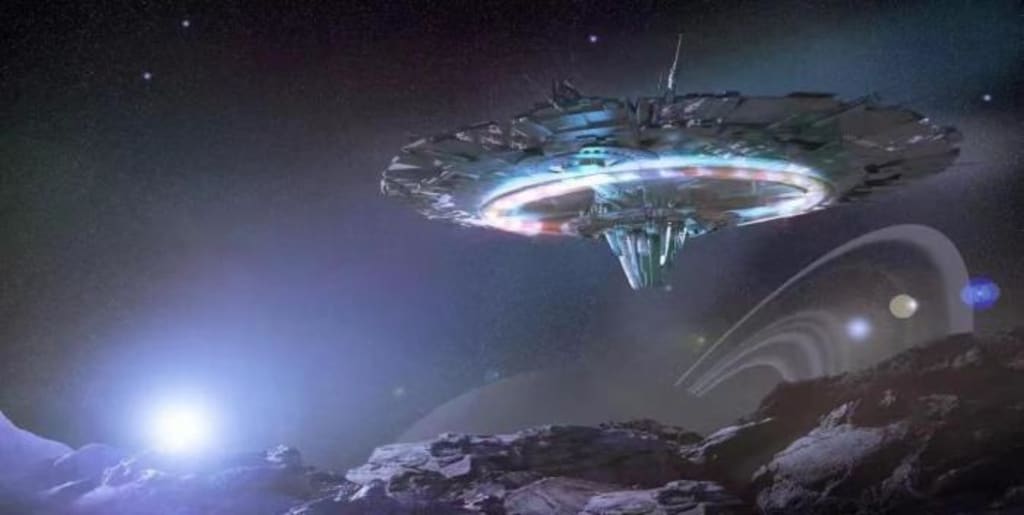
Following the discovery of a mysterious "stone door" on Mars by the Curiosity rover, the U.S. Pentagon has released images of a UFO (Unidentified Flying Object).
It is worth noting that this is the first time in the 50 years since the 1969 "Blue Book" program that a committee of the U.S. House of Representatives held a public hearing on the subject of UFOs. This is the first time in 50 years since the 1969 "Blue Book" program that a committee of the U.S. Congress held a public hearing on the subject of unidentified flying objects.
And public speculation about the concept of UFOs and their potential connection to extraterrestrial intelligent life has been widely contested by the public since the Roswell incident in 1947. The current U.S. hearing, however, focuses on a series of events in recent years.
It began with several documented Unidentified Aerial Phenomena (YAP) sightings by military personnel over the past few decades, which were first leaked, then confirmed, and declassified by the U.S. government.
From the videos released at the hearing, one shows a spherical object floating outside the aircraft, overtaking the military jet at hyper-sonic speeds. Another video shows two triangular objects that keep flashing past the cockpit of a plane. This reveals the tip of the iceberg of mysterious UFOs, and the whole "iceberg" is about 400 reports.

According to Scott Bray, deputy director of the U.S. Office of Naval Intelligence, nearly 400 reports of "unexplained aviation phenomena" have been received from military personnel, and the number has increased significantly over previous years, and many more incidents may be dangerous.
And he stressed that YAP has had 11 near collisions with U.S. military aircraft, and even some incidents over sensitive nuclear facilities. One incident at Maelstrom Air Force Base in Montana, for example, rendered 10 nuclear intercontinental ballistic missiles (ICBMs) inoperable and a glowing red sphere appeared overhead. The Pentagon cannot rule out the possibility that the sighting was related to extraterrestrial life.
Above: On December 16, 1957, a government employee photographed a UFO hovering near Holman Air Development Center in New Mexico for 15 minutes.
In addition, not only do Americans want to believe in the existence of extraterrestrial civilizations but even our Chinese Academy of Sciences members have also declared their belief in the existence of aliens in their 2022 New Year's speech. These professionals' "stand-up behavior" not only shakes the public's perception but also triggers a lot of people's hot debate. And made some people believe that alien civilizations exist. So is it possible that the UFOs disclosed by the United States are from an extraterrestrial civilization? But why are they not in contact with us again? Is it really that we are not worthy?
Disappointingly, the U.S. congressional hearing only reviewed some details of the incident and did not determine what this UFO is. So the origin of the unidentified flying object is still a mystery to us. And, for scientists, alien civilizations may have long been "dead"!
The idea that "advanced civilizations may be doomed to stagnation or death" comes from an article published on May 4 in the journal Open Science of the Royal Society, which attempts to find a solution to the Fermi paradox. The paradox, in turn, takes its name from a random lunchtime meditation by Nobel Prize-winning physicist Enrico Fermi.
"The universe is vast, clearly tens of billions of years old, and should be alive, but why is it dead, as if we were the only life." Fermi's casual musings led to the discovery of a connection between the vastness of the universe, its age, and life.
This new hypothesis suggests that spa-space-faring civilizations grow in size and technology, they will eventually reach a crisis point where innovation can no longer keep up with people's need for energy. What follows is a civilization collapsing from burnout, or shifting its goals to prioritize the steady state of its civilization.
In this state, cosmic expansion is no longer the goal, which makes contact between two civilizations impossible. And, whether the end of the civilization is a "steady state awakening" or a "civilization collapse", it will result in the civilization growing into an "island" in the universe! Is the end so sad? Is this hypothesis, which sounds alarming, reliable?
The researchers who made this assumption came up with their hypothesis through studies of the "super-linear" growth of cities. These studies suggest that as populations grow, cities grow exponentially in size and energy consumption, inevitably leading to crisis points - or singularities - that lead to the rapid collapse of growth, followed by an even sharper, potentially civilization-ending collapse.
They say that once a planetary civilization transforms into a state that can be described as a virtually connected global city, it will face "asymptotic burnout," the ultimate crisis in which the time scale between singularities becomes smaller than the time scale of innovation.
The researchers believe that these civilizations on the verge of collapse would be the easiest for humans to discover because they would dissipate large amounts of energy in a "highly unsustainable" manner. So much alien life may be smart, but it's not smart.
So to avoid the doom of the end, civilizations could undergo a "steady-state awakening" and shift their production from infinite interstellar growth to one that prioritizes social well-being, sustainable and equitable development, and harmony with the environment. While such civilizations may not abandon space exploration altogether, they will not expand to a scale large enough to make contact with Earth.
Therefore, the only alternative way to avoid infinite expansion and the eventual end is to reject the "unbridled growth" model to maintain balance, but at the cost of reducing the ability of civilizations to cross stars.
About the Creator
Stajila
The progress of scientific research and its increasingly expanding fields will arouse our hope。
The Day the Forest Spoke
A Walk Into the Unknown It began as an ordinary hike, a chance to escape the chaos of the city and immerse myself in the green stillness of the old Redwood Forest at the edge of my town. The sun filtered through the towering trees in long golden beams, the leaves rustling faintly with a whisper of wind, and for a moment, I felt at peace — detached from deadlines, notifications, and the endless noise of human life. I hadn’t planned for anything extraordinary, just a few hours of solitude surrounded by the ancient giants that had stood for centuries, quietly observing the world.
By The Curious Writer4 days ago in Earth
Author’s Advice
If you would’ve asked me 20 years ago did I know I’d become a writer and an author, I would’ve said “nope, ain’t happening”. As fate would have it I did become an author and I can honestly say I’m loving it so far. It really does feel good to be a writer. I’ve learned a lot on this journey and I feel like with even me being as new to this world as I am, there’s some wisdom I need to share with every other aspiring author.
By Joe Patterson5 days ago in Journal



Comments
There are no comments for this story
Be the first to respond and start the conversation.