
Title: Earth's New Companion: The Discovery of Quasi-Moon 2023 FW-13
Earth's New 'Moon'?
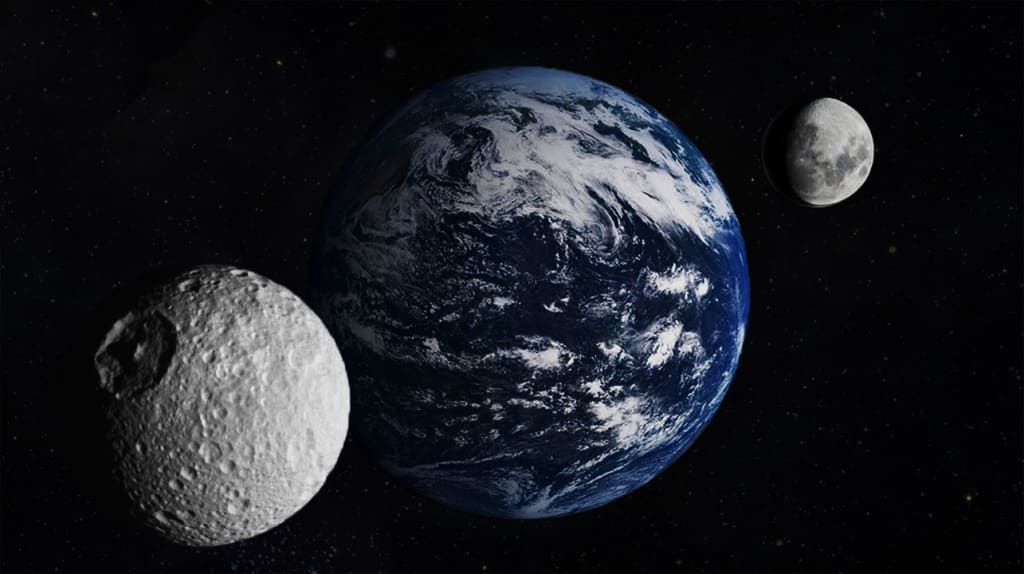
In a remarkable celestial discovery, astronomers have unveiled a new member of Earth's cosmic entourage - an asteroid named 2023 FW-13. This intriguing space object, while not a traditional moon, follows a complex semi-orbital path alongside our planet, sparking interest and curiosity in the scientific community.
Unlike our beloved Moon, which gracefully orbits Earth, 2023 FW-13's primary allegiance lies with the Sun. However, its orbit takes an unconventional route, causing the asteroid to weave around Earth, keeping it within relative proximity despite not being in direct orbit.
The Tiny Quasi-Moon
It's essential to clarify that 2023 FW-13 is far from being a suitable target for future space missions. This celestial companion is significantly smaller and more distant than our natural satellite. Measuring a mere 50 feet in diameter and hovering at a staggering distance of 9 million miles from Earth at its closest approach, it stands in stark contrast to the Moon's proximity.
The disparity between Earth and this quasi-moon is evident when considering that the distance between Earth and the Moon is approximately 35 times smaller than the gap between Earth and 2023 FW-13. However, in cosmic terms, this newcomer could be seen as a neighbor.
The Enigmatic Quasi-Moon Phenomenon
Astronomers at the Pan-STARRS Observatory on Haleakalā in Hawaii first identified this quasi-moon in March 2023. A quasi-moon is a celestial body that shares a similar orbital path with a planet, even though it does not orbit the planet directly. These objects maintain a steady relative position to the planet they accompany, in contrast to natural moons, which adhere to more predictable orbits.
Quasi-moons owe their erratic paths to the gravitational influences of both the Sun and the planet, resulting in intricate, horseshoe or tadpole-like orbits. This dynamic interplay creates a delicate balance that keeps them in proximity to their parent planet.
The Scientific Significance of Quasi-Moons
Quasi-moons offer a unique opportunity for scientific research, given their unconventional orbits. These celestial oddities serve as excellent subjects for studying gravitational influences and the complexities of celestial mechanics. Their proximity to their host planet also provides valuable insights into the formation and evolution of planetary systems, potentially aiding future space exploration missions.
The Fate of 2023 FW-13
Current data suggests that 2023 FW-13 entered its current orbit over 2,100 years ago. Based on preliminary orbital calculations, this quasi-moon is expected to accompany Earth for another 1,700 years or so. Fortunately, there is no cause for concern about a collision with Earth, as the asteroid's trajectory remains within safe parameters.
This discovery follows the fascinating appearance of another temporary moon-like object, known as 2020 CD3, which briefly entered Earth's orbit. Although it was no larger than an average car, its capture by Earth's gravitational pull was a rare occurrence.
The Lunar Mystery of Kamo'oalewa
In 2016, astronomers stumbled upon an asteroid named Kamo'oalewa, sparking considerable interest due to its peculiar properties. This space traveler raised questions about its origin, as its composition didn't align with known near-Earth asteroids.
Researchers turned to advanced telescopes, such as the Large Binocular Telescope and the Infrared Lowell Discovery Telescope, to investigate Kamo'oalewa further. The results revealed a remarkable similarity between the asteroid's spectral characteristics and lunar material collected during the Apollo missions of the 1960s and 1970s.
This unexpected connection suggests that Kamo'oalewa may be a fragment of the Moon, potentially formed during a distant collision with an asteroid.
Asteroids: Cosmic Relics from Our Solar System's Dawn
Asteroids, often referred to as minor planets or planetoids, are remnants of our solar system's formation, which occurred roughly 4.6 billion years ago. These rocky bodies inhabit the asteroid belt, found between the orbits of Mars and Jupiter, where millions of them vary in size and shape.
Asteroids display a wide range of sizes, from minuscule dust particles and modest-sized boulders to massive objects spanning up to 600 miles in diameter. Unlike planets, asteroids lack distinct layers and atmospheres. Some even have their own moons, and occasionally, two similarly sized asteroids engage in mutual orbits.
While the asteroid belt harbors countless members, the likelihood of a spacecraft colliding with one is relatively low due to the vast expanse of space. However, near-Earth asteroids are closely monitored due to their potential impact risk, harkening back to the asteroid that led to the extinction of dinosaurs.
Exploring the Cosmos Through Asteroid Missions
International space agencies, including NASA, have embarked on missions to explore and study asteroids. Some missions aim to collect samples from these space rocks and return them to Earth for detailed analysis, furthering our understanding of the solar system's early history and evolution.
Intriguing discoveries like 2023 FW-13 and Kamo'oalewa continue to shed light on the mysteries of our cosmic neighborhood, reminding us of the ever-evolving nature of scientific exploration in the boundless expanse of space. As we unravel these celestial enigmas, we gain valuable insights into the history and dynamics of our solar system. Who knows what other cosmic wonders await our discovery in the future?
About the Creator
Keep reading
More stories from Annie Lobo and writers in Earth and other communities.
Unveiling the Marvels of 2023: From Alzheimer's Breakthroughs to Plant Whispers and Cosmic Mysteries
The journey of human knowledge is akin to a rocket hurtling through the cosmos, perpetually advancing at an exponential rate. Every passing moment heralds new discoveries, unveiling the mysteries of our world and beyond. In the year 2023, the scientific community witnessed a crescendo of breakthroughs, each unveiling a new facet of our understanding. From groundbreaking strides in Alzheimer's research to deciphering the enigmatic language of plants and challenging our very concept of the universe's age, this year has been a symphony of scientific marvels.
By Annie Lobo2 years ago in Humans




Comments (1)
Great work! Good job!