
This Wave Happens Once in 10,000 Years; Scientists Have Finally Captured It
The waves mysteries uncovered
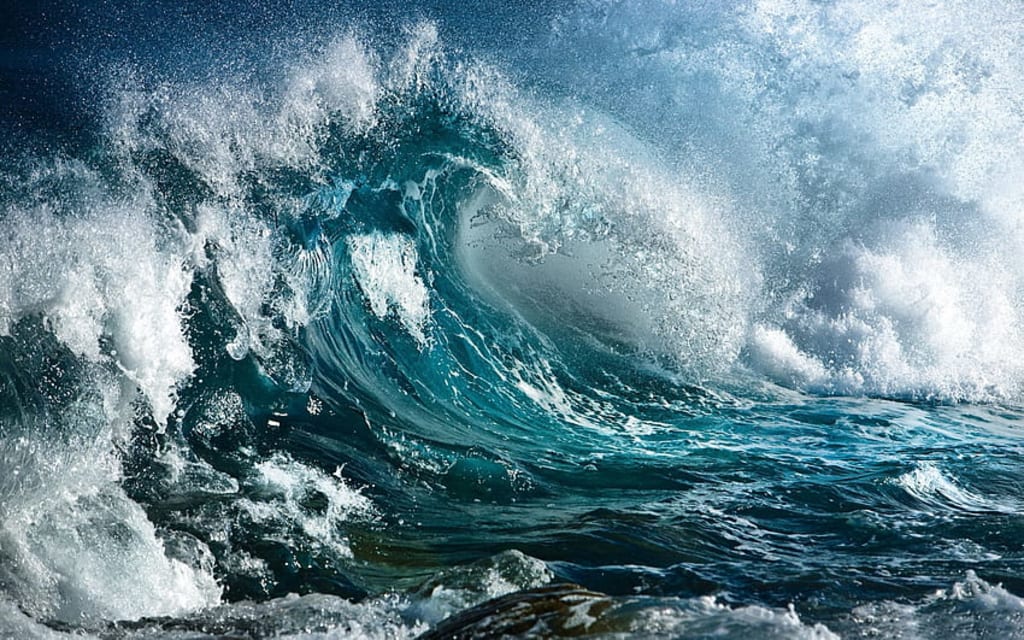
On December 7th, 1978, the MS München, a German container transport ship, departed the port of Bremerhaven bound for Savannah, Georgia. This would be its 62nd voyage across the North Atlantic, practically routine to the crew on board. But tragically, it never arrived, nor was it ever seen again. Something claimed this ship, something huge, something deadly, something once believed to occur only once every 10,000 years and horrifically, it's something that's still out there to this day. Now for perspective, the MS München was an enormous 857-foot-long ship that was carrying 83 shipping containers known as lighters, along with 28 members of the experienced crew. At its top speed of 18 knots, the journey from Germany to America, was a little under 5,000 nautical miles and would take them some 11 days at sea. However, a violent storm had been raging over the ocean since November. But the challenging waves and winds were no match for München's exceptional flotation capabilities and so it carried on with its voyage. Suddenly, at 3:00 AM on December 12th, the ship sent out a distress call sent by Morse Code. Only fragments of the call were received by surrounding vessels, but before they could respond, the München went silent. Assuming the worst, rescue efforts began immediately. Occasionally, snippets of automated messages and calls from the ship would be received.
There was still hope.
Despite high winds and difficult conditions, the search continued. More than 100 ships and 16 aircraft, scoured the area around the ship's last known coordinates, day and night until finally on December 14th, they found something. A life raft close to where the München had sent its original harrowing distress call, but it was empty. Horrifyingly the München's life rafts, which had been bolted to the ship 66 feet above the water, didn't appear to have been lowered by the crew. They'd been ripped from the ship's stern by some terrifying force and flung into the ocean. According to the records of the time, there was no wave in history , big or powerful enough to have done this; not to a ship as big and resilient as the München. It was almost like some sea monster had risen and torn it off. As the days rolled on, more damaged life rafts and three lighters belonging to the München were discovered in the water, all of them empty. On December 20th, after the last hope was extinguished, the search was called off. The MS München and all 28 of its crew, were considered lost to the waves or to whatever was lurking within them. Researchers and oceanographers were left confused and scared as to what could have done this, but the old sailors and experienced mariners knew what it was all too well. For centuries, they had traded stories and passed rumors of events at sea, that defied science and belief. And while very few truly believed them, ancient tales of towering waves more than 100 feet tall, that would rise out of the ocean and swallow ships whole, suddenly seemed to be more truth than tale. Still, scientists remained skeptical. The idea of supersized waves some 100 feet tall rolling rogue around the ocean sounded insane and without any data, they dismissed it as a load of bunk. But with the turn of the 20th century, came the arrival of steel double-hulled ships, replacing their timber predecessors. With greater structural integrity, ships that would've otherwise sunk, started returning from sea damaged beyond belief. Survivors described nightmarish visions of gigantic freak waves randomly appearing in the ocean and smashing into them with such force, that huge chunks of them were easily ripped away.
Yet still, scientists denied the existence of waves this deadly, but why were they so adamant, that waves could only reach a certain height in the first place? Well, it's because water doesn't actually travel in waves, rather energy travels in waves.
Now, you may think I'm tricking you here, as we've all definitely seen waves of water crashing into the shore, but have you ever seen a boat or a buoy, floating in the ocean?
They bob up and down in a rise-and-fall pattern. This isn't the ocean moving on its own, rather its waves of energy moving through the water, that's displacing it on the surface. Energy is transferred to the ocean through friction, caused by the wind blowing along the surface, as well as the gravitational pull of the sun and moon upon the Earth. This energy travels through the water as a wave, until an obstacle eventually breaks it up or crashes into the shore.
Now to be more Pacific, sorry, specific, scientists initially thought these waves of energy were linear. Any musician reading, might recognize these as harmonic waves, where the height of the crest is equal to the depth of its trough.
The size of these waves can be predictably calculated, with some simple math. So scientists thought, based on their calculations, that oceanic waves could only reach a maximum height of 30 feet tall.
Any wave larger than that was thought to be impossible, until an event on New Year's Day in 1995, which changed everything. While the rest of the world, was nursing hangovers that morning, the crew of the Draupner oil installation, were trying to stay steady on their feet in the rough and turbulent waters of the Norwegian North Sea. A relatively shallow stretch of water, that only runs 328 feet deep. Meanwhile, the Pacific Ocean, reaches over six and a half miles deep. Due to the North Sea's shallow depth, it's full of churning, violent waters and this turbulent nature of the North Sea, is why structures such as oil platforms, have to be anchored to the ground, to prevent them being washed away. These installations harvest the rich supply of crude oil and natural gas located there beneath the Earth's crust. To survive this hellish stretch of water, the Draupner platform was equipped with a downward-pointing laser, to keep track of the surrounding sea state. Little did the crew know, that this device would soon make a startling discovery, because on this day, the platform laser measured a mammoth 85-foot wave, rising out of the ocean. Finally, irrefutable proof of a rogue wave had been captured. Not only did it dwarf all scientific estimates of the maximum height of a wave, but it was also more than twice the size, of the other wave surrounding the platform, which only reached 38 feet. This fits the textbook definition of a rogue wave, defined as a wave that is at least twice the height as the surrounding waves in that stretch of sea. This supersized freak wave was named the Draupner wave and remains the tallest measured rogue wave of all time.
It was finally established, without a doubt, that rogue waves were real. Ah, good, like the ocean wasn't terrifying enough already.
Now with maritime myth proven to be fact, researchers went back through reports of ships that had vanished under inexplicable circumstances, like the MS München. They have since determined that rogue waves have likely claimed catastrophic 22 supertankers, damaged countless others and ended more than 500 lives in the second half of the 20th century alone. With that said, the number of lives claimed by rogue waves, over the last several centuries is unknown. But it is believed to total somewhere in the thousands. Oh, but even though the existence of rogue waves had been proven, scientists still believed they were rare, due to the sheer size and amount of energy needed to create one. Some oceanographers and mechanical engineers, estimated that they would only occur, once every 10,000 years.
Woo, I can finally book my cruise ship holiday, but it turns out this timeline was unbelievably optimistic.
In fact, a scientific research group dedicated to studying rogue waves known as Max Wave, studied 30,000 worldwide satellite photos taken by the European Space Agency in 2001. They found that over 10 rogue waves swelled up in the ocean in just one three-week period, and those were just the ones they could spot.
That is scarily regular!! In that case, I'll probably pass on that cruise holiday, especially given what happened to the Norwegian Dawn. This three-year-old cruise ship, was carrying more than 2200 passengers on a Bahamas cruise in 2005, when out of nowhere, a rogue wave crashed into the side of it. The wave reached the 10th deck of the huge ship, shattering two windows, flooding 62 cabins and injuring four people. Some reports estimated that the wave was more than 70 feet high, the same height as a seven-story building. Ooh, if I saw a wave that big approaching a ship I was on, I'd pre-flood the compartment if you get my drift.
Meanwhile, along South Africa's treacherous southeastern coast, rogue waves have the ominous nickname of "Holes in the Ocean." Seems strange to call a wave a hole, right? Well, it's because ships in the wake of these waves, disappear as if a hole has swallowed them up.
By 1992, it was estimated that between 80 to a 100 ships, have been wrecked in this area alone. Where the 30-foot waves would rise out of nowhere and drag smaller ships down. But it's not the only place where this happens.
In Sydney, Australia, back in 2017, deckhands aboard the manly ferry captured harrowing images of giant waves smashing against the ferry stern, throwing it in every direction. The swell was so huge the waves briefly swallowed the ships. But the Manley Ferries are designed to take a thrashing, with very few being canceled despite rough weather.
Sadly, the same can't be said for all those off the South African coast. And if that wasn't terrifying enough, rogue waves can also arise as literal walls of water.
A famous example occurred in Daytona Beach, Florida, back in 1991. Where a giant rogue wave some 18 feet high and 27 miles long raced across the calm sea and crashed onto the shore. The rogue wave turned 100 cars parked by the beach into submarines, and initial reports claimed 75 people were treated for minor injuries.
But the data-collecting buoys near Cape Canaveral, hadn't detected a thing. Some suggested a tsunami caused it, but no matching seismic activity was identified. An undersea landslide, displacing a lot of water at once perhaps? Maybe a meteorite struck, causing a significant ripple outwards. It seemed plausible, but there was no activity to support any of these ideas, and even more curiously, nothing like it has happened since. Its root cause is still a mystery to this day.
Man, these tales make me nervous, but not as nervous as watching a rogue wave in action when aboard
Captured back in 2008, the MV Metsaborg, was traveling across the North Atlantic, when it was struck by a wave roughly 98 feet high. Considering the ship was 442 feet long, but only 55 feet wide; if this had been much higher and at a slightly different angle, it could have rolled the ship.
But how do rogue waves like this even form in the ocean in the first place?
Well, the answer to that is nobody knows.
Their unpredictability makes them incredibly difficult to study. They also mainly occur in the open ocean, one of the most remote and inaccessible parts of the planet. So based on what scientists know, they've come up with two theories.
The first is the simplest. It starts with the observation that wave swells travel at different speeds and occasionally, these wave peaks may overlap, combining energy and resulting in a rogue wave, twice the size of all the other waves. This is known as the Linear Wave Addition Theory.
The alternative theory is known as Nonlinear Focusing Theory and relies on the idea that when waves interact, they can effectively steal energy from one another. If multiple waves all transfer their energy, to one singular wave, then this can amplify the wave, into one gigantic mountain of water.
At this point, you may think that rogue waves are like tsunamis. After all, both types of waves are massive, fast, and incredibly destructive.
But there is a distinct difference, as rogue waves occur in the ocean randomly while tsunamis directly result from tectonic collisions in the Earth's crust, displacing the ocean above.
Tsunamis can be accurately predicted, meanwhile, rogue waves can appear suddenly, even in calm seas.
But before you swear off surfing for life, hang tight. As scientists are working on a device to predict rogue waves.
The National Oceanic and Atmospheric Administration is developing a system that can forecast potentially hazardous ocean areas every hour using a program fittingly called WAVEWATCH III.
The latest version, released in 2019, uses a probability formula, to predict extreme conditions in the ocean, at a specific place and time. This is a life-saving tool that could help sailors steer clear of unpredictably dangerous seas. However, rogue waves can form in just under 10 to 15 seconds in rough seas. This means rogue wave surges can form faster than the WAVEWATCH program can predict. So ships still aren't safe from random rogue wave attacks.
To successfully predict a rogue wave, scientists would need to invent a radar system that could continuously measure waves near the boat. This data would need to be fed into a computer model that could predict how the waves form over the next several minutes, giving a warning of any incoming rogue waves. However, this technology has yet to be created.
I surely hope scientists start working on this ASAP. I really want to go on that cruise.
Now rogue waves aren't the only crazy wave formations out there;
Now let's paddle out further and see what other unbelievable waves are out there.
Three strikes, and you're out.
The Canadian-US border runs 5,525 miles across North America and Ryan Reynolds isn't the only dual citizen here. Canada and the US also share ownership of Lake Superior, the largest freshwater lake in the world. It puts other lakes to shame stretching 350 miles east to west and 160 miles north to south. This places it in the Canadian province of Ontario and across the three United States of Minnesota, Michigan, and Wisconsin. At this size, it's more fitting to think of Lake Superior, as a landlocked sea; not really.
This giant body of water is so big it generates its own weather patterns. The wind blows across the surface during the summer, creating a cool breeze over the region. But in the winter, the lake releases the thermal energy it absorbed over the hot summer into the atmosphere, creating an insulating effect of warm air in the lake basin. This buildup of warm air fuels turbulent winter storms, which can generate waves the size of houses.
Case in point, back in 2018, a winter storm with 86-mile-per-hour winds resulted in 25-foot waves crashing into the lake's coastline.
But located within Lake Superior is something even scarier than winter storms as it's also the host of a unique wave phenomenon known as the Three Sisters. Unlike the Olsen brood, this is a deadly trio you'd never want to meet and that's because it's a formation of three towering rogue waves that follow each other consecutively and are almost impossible to escape.
Since the Three Sisters follow each other so closely, if the first wave strikes a ship and is unable to recover and shed the excess water before it's struck again and again.
This triple barrage can cause ships to roll dangerously and is believed to have caused multiple shipwrecks. Much like in the case of the Edmund Fitzgerald.
The Fitzgerald was a 730-foot-long Laker ship, designed to cross great bodies of water such as Lake Superior. However, on November 10th, 1975, after departing from Wisconsin, the ship was caught in a storm, and a bad storm at that. Hurricane-force winds some 60 miles per hour stirred up the surface of the lake. Waves reaching 10 feet high were reported, when suddenly the Fitzgerald was struck by Three Sisters. Towering rogue waves ranging from 30 to 35 feet tall, unable to steer away in time, the Fitzgerald was rolled over and sank tragically, taking all 29 crew members along with it. And what exactly causes the Three Sisters wave formation is still unknown. Though it is speculated to be the result of wave energy bouncing off underwater shoals or cliffs, in a pattern that results in the trio of rogue waves forming on the surface. Thankfully, Lake Superior only has an average depth of 483 feet, meaning the Three Sisters waves are limited in how big they can get, capping out at around 30 to 40 feet. Still, that's roughly the same size as a four-story building but it's relatively small, when you consider that rogue waves in the ocean can grow to be more than 100 feet.
Well, all things considered, would you rather deal with one 100-foot-tall wave of water or the triple threat of the Three Sisters?
Just asking that question made me reach for my water wings.
Runaway beach.
There's nothing more exciting than a trip to the beach. Swimming, sunbathing, sandcastles, so much to do. But have you ever visited the beach only to find that all the sand has been stolen? I know this sounds like a hypothetical question, but I'm being deadly serious. Because all over the world, famously sandy beaches have vanished overnight, leaving only pebbles and rocks in their wake. Not exactly a comfortable place to sunbath, unless you're a stone-cold masochist. But how could a whole beach disappear in a matter of hours?
Well, this strange event occurred on Achill Island, off the west coast of Ireland. The Beach of Dooagh, a 650-foot stretch of sand suddenly vanished after a winter storm passed through the area in 1984.
Now, to understand how an entire beach can be stolen, we need to examine how beaches are formed in the first place.
Beaches are typically made of sand, fine mineral particles, which primarily come from rocks that have been ground down and churned through the ocean, like a big blue blender. This loose sediment collects in the sea, with the tides dumping it onto the bedrock along the coastline. Layers of sediment build up, sculpted by the crashing waves until finally, a big sandy beach is ready for tourists. But just as the ocean creates our beaches, it can also easily take them away.
The tides crashing ashore exert intense forces that can liquidate sand particles and even splinter pieces of rock. A single wave can easily wash away loose sediment and wear away at bedrock in a process known as coastal erosion and during a storm event, all these erosion processes are turned up to 11. Storm winds can create supercharged waves that scatter beaches and carry away tons of sand. This is the exact scenario that occurred at Dooagh in 1984, when the harsh winter storms stirred up the ocean so much, it swept up the shoreline and washed away the entire beach. All that was left behind were rocks.
But what's even weirder is that 34 years later, the beach suddenly reappeared. A freak tide around Easter 2017 dumped hundreds of tons of sand on the shore, restoring the beach. Tourists flocked to the area, keen to see the Houdini beach themselves and 79 new jobs were created, to cater to the 70% increase in visitors to the island. But it turned out the ocean was only messing with Achill Island, as once again in 2019, the beach was washed away. Poseidon's practical joke crippled the Achill tourist industry and put severe peer pressure on the locals.
So before you book your next vacation, double-check the beaches are still there.
Waves within waves.
What if the most giant waves in the world were the ones you couldn't see? That sounds like a terrible tagline for an inspirational Instagram post, right? It's up there with #livelaughlove. Don't worry though, this isn't one for the influencers, but for the physicists.
Internal waves are some of the largest waves in the ocean, but are totally invisible to the naked eye and that's because they form beneath the ocean's surface.
You might think the ocean is just one giant swimming pool for whales, but it's actually composed of different layers, a bit like a cake, a very wet cake. The top layer of water is warmer and less salty and the deeper down you go, the denser the layers become and more saturated with saline as the colder water sinks to the bottom and between these layers of the ocean, waves conform.
These internal waves can range in size from 30 feet to a staggering 550 feet tall. These humongous 500-foot waves are generated in the Luzon Strait in the South China Sea. However, on the surface, all you'd be able to detect are subtle alternating bands of rough and smooth water. Finally, we've found some giant waves, that won't turn ships into a Titanic tribute act.
These internal waves are created when water moving in a layer meets an obstacle, such as an underwater ridge or reef. This displaces the water and creates an internal wave that passes between the oceanic layers.
The existence of internal waves is vital for cycling nutrients through the ocean, ensuring nutrient-rich waters reach the coastline and provide for the ecosystem. Internal waves also play a vital role in transferring heat around the planet.
So it turns out the most important waves are hidden deep inside. Man, I should really start charging for these cheesy fake philosophy quotes.
Planetary waves.
Now, when I say planetary waves, you'd be forgiven for thinking I was talking about that scene from Christopher Nolan's sci-fi epic "Interstellar", but actually, we're dealing with something a lot closer to home. In fact, we're still on Earth. Be warned, this concept is even trickier to follow than the plot of that film. Still, I'm going to try my best to make it easy for us to wrap our heads around.
Are you with me?
Okay, here goes nothing.
Planetary waves are literally waves that move the oceans and atmosphere around the planet. Scientifically, these are known as Rossby waves.
Unlike the white breaking waves you might be thinking of, Rossby waves are huge undulating movements of the ocean and atmosphere that stretch horizontally across the planet for hundreds of miles. They're so massive that they can alter the Earth's climate conditions. Though how long an oceanic Rossby wave takes to complete its journey is determined by its proximity to the equator.
Rossby waves formed close to the equator may take a few months to a year to cross the ocean while waves that form further away from the equator can take 10 to 20 years to complete their journey across the planet. Not that you'd notice these waves moving past, as they're undetectable to the human eye and have only been discovered by NASA's satellites monitoring the Earth. The reason Rossby waves cannot be observed by the naked eye, is because the vertical movement above the surface is tiny, with the water typically only shifting 3.9 inches. But that's because all the action is happening underneath as the vertical movement beneath the surface is 1000 times greater than above. So, while the water on the surface only moves a few inches, down below, the water is shifting by 300 feet.
Wow, that is one epic wave. But they don't just spawn out of nowhere.
Rossby waves are generated by the rotation of our planet. When you stand at the equator, you and the ground beneath your feet, is being spun eastward at around 1030 miles per hour and the closer you get to either pole, the slower you're spun, because there's less distance to travel. As our planet spins eastward, inertia takes hold, which has a special effect on fluids. Imagine you have a cup of water and spin around with it. The water shifts, right? But if you simply turn the glass, there's barely any movement and the water appears static. A similar effect happens to all fluid on Earth, which in bodies of water creates a series of never-ending oceanic waves. But the closer to the equator they are, the faster they travel. Okay, that's an overly simple way of explaining it and I bet any physicist reading are screaming at this piece right now. But what's important to know is that because of this, oceanic Rossby waves form in the westward direction, traveling fastest at the equator and slower towards the poles, affecting climates around the world, occasionally causing high tides and coastal flooding. Well, that's pretty incredible for a wave that's older than most people reading this article.
What did you think was the most astonishing wave formation and which wave would you find the scariest to try and sail across?
About the Creator
Allan MHC
A medical doctor by profession; reading and writing are my resting pills
Paul Kimmage: Our Rowers Were the Best of Us and They Were Treated Disgracefully
Sports journalist Paul Kimmage has sparked intense debate after claiming that national rowing athletes — described as “the best of us” — were treated disgracefully by those responsible for managing and supporting them. His comments have reignited wider discussions about athlete welfare, governance standards, and how elite sports systems treat the people who deliver success on the global stage.
By Aarif Lashari3 days ago in Earth
The Reality of the Illusion of Time
Recently, as I strolled along the short stretch to my strength training session, I aimlessly took in the row of tatty shops and shabby buildings along the route and passed an off-street, in which one of my sisters used to live, around thirteen years ago.
By Chantal Christie Weiss5 days ago in Earth
Cabin Fever Because of Snow, Sleet, and Freezing Rain That Turned to Icy Roads
What Is Cabin Fever? The short answer is that cabin fever is restlessness from being in a confined area. Cabin fever is the distressing irritability or restlessness experienced when a person or group is stuck at an isolated location or in confined quarters for an extended time. Research shows that prolonged cold, gray skies, and being stuck indoors can trigger mood shifts similar to “winter blues.”
By Margaret Minnicks3 days ago in Humans




Comments
There are no comments for this story
Be the first to respond and start the conversation.