
These rocks are the oldest ever discovered on Earth, according to geologists.
The irony is that, in spite of all the rage and fire, Earth was establishing the conditions for life.

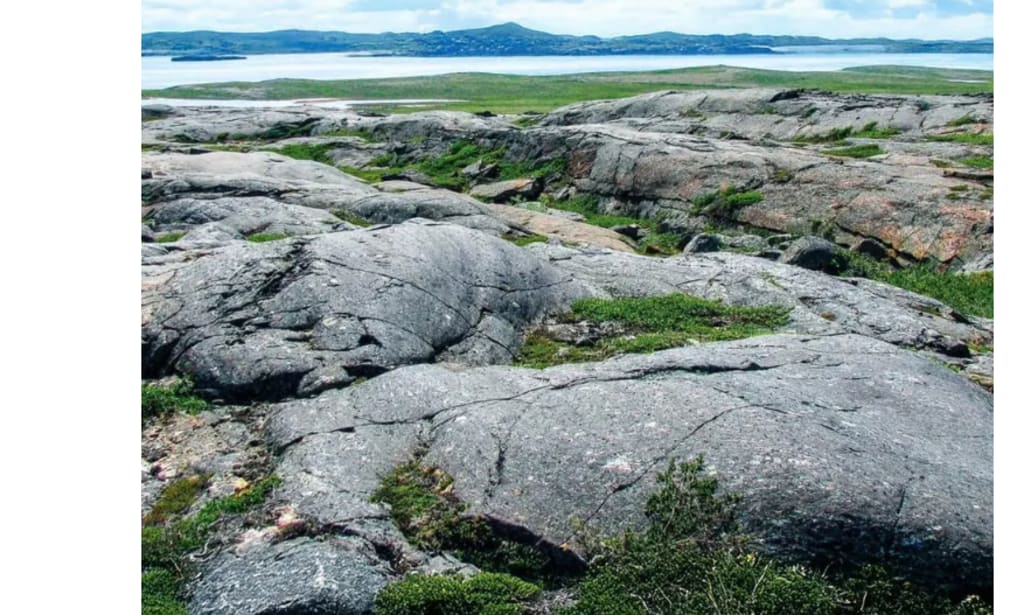
The story of Earth begins long before forests, oceans, or even life itself. Deep beneath our feet lie ancient stones that silently preserve the secrets of our planet’s earliest days.
These fragments of Earth’s crust, forged during a time of violent formation and fiery beginnings, are nearly impossible to find intact. But now, a remarkable discovery of ancient rocks in northern Quebec has changed everything.
The oldest known rocks on Earth have been found by experts in a secluded area close to Nunavik's settlement of Inukjuak. Jonathan O'Neil of the University of Ottawa served as the team leader.
In order to verify the rocks' exceptional antiquity, the team's united efforts were essential. This finding provides a unique window into Earth's oldest and most enigmatic period, the Hadean aeon.
Because Hadean (>4.03 billion-year-old) rocks and minerals are rare, "many questions remain regarding Earth's earliest crust," the researchers noted.
"Although its age is up for debate, ranging from ≥3.75 to 4.3 billion years old, the Nuvvuagittuq Greenstone Belt in Canada may be the only known remnant of Hadean crust."
The fundamentals of comprehending the Hadean aeon
Imagine a flaming hellscape rather than a peaceful blue world during the Hadean aeon, which was Earth's violent and turbulent beginning. Around 4.6 billion years ago, when the solar system was still figuring itself out, it began.
Earth was essentially a molten ball of rock that was continuously being struck by cosmic debris left over from the Sun and planets' development. We are discussing enormous impacts, one of which most certainly produced the Moon.
Volcanic activity was out of control, and the surface was so hot that it most likely resembled a lava ocean. There would be no atmosphere as we know it, only steam, poisonous gases, and general mayhem.
The irony is that, in spite of all the rage and fire, Earth was establishing the conditions for life.
Things began to calm down around 4 billion years ago, towards the conclusion of the Hadean. Oceans formed as a result of comet collisions and volcanic steam, and a solid crust started to form.
Water may have existed earlier than previously believed, according to some evidence (such as old zircon crystals). The planet is gradually becoming habitable, but there are no fossils or life (as far as we know).
Canada has discovered ancient rocks.
The samples were gathered by Sole in 2017 close to the small Nunavik village of Inukjuak. Because of their peculiar characteristics and very old composition, these samples attracted scholarly attention.
Driven by increased curiosity and increasingly encouraging results, the researchers continued their work at Carleton University and the University of Ottawa after conducting preliminary testing.
The age of the volcanic rocks in this region has been disputed by geologists for more than 15 years. They were thought to be 4.3 billion years old by some. There was still no unambiguous agreement.
Using meticulous analysis and cutting-edge techniques, the multinational research team ultimately resolved the conflict. O'Neil stated, "Our earlier research indicated that they could date back 4.3 billion years, but this wasn't the consensus."
Indications from the old crust
When the group examined the intrusive rocks that sliced through the volcanic strata, they made a significant discovery. These incursions were 4.16 billion years old, according to the researchers' confirmation.
They must have traversed much older volcanic rocks as a result.
The Nuvvuagittuq Belt is the only location on Earth where rocks created during the Hadean eon—the first 500 million years of our planet's history—are found, according to this confirmation, O'Neil added.
Dating the oldest rocks on Earth
The scientists employed a potent method called radiometric dating to verify the age of the rocks. This approach uses the natural breakdown of components within the rocks to measure time rather than speculating or making assumptions.
The two elements that the experts concentrated on were neodymium and samarium. Because samarium gradually transforms into neodymium over an extended length of time, these components are helpful.
Similar to understanding the tick rate of a very precise and slow clock, scientists are able to pinpoint the exact moment this change occurs.
The rock had nearly no neodymium and a small quantity of samarium when it first formed. The atoms of samarium broke down into neodymium over billions of years. Scientists can determine when the rock first formed by calculating the current concentrations of each element.
Two distinct isotope systems involving these elements were employed by the team. The same time was measured by each system independently. Additionally, both indicated that the rocks were produced 4.16 billion years ago.
Our planet's beginnings
There's more to these rocks than a date. They offer a unique glimpse into the formation of the early continents. The early circumstances that gave rise to life may be discovered by examining the rocks. Scientists can learn more about the Earth's appearance before the emergence of plants, animals, or oceans thanks to these materials.
To comprehend these rocks is to delve into the very beginnings of our world. This enables us to replicate the environment from which life could have arisen and gain a better understanding of how the first continents were formed," O'Neil said.
There is more to this discovery than just old stones, which were made in Quebec's serene northern countryside. It's about knowing where we came from.
In addition to helping chronicle the long and intricate journey from a barren globe to one that would eventually support humans, forests, oceans, science, and mystery, the research links the modern Earth to its earliest beginnings.
About the Creator
Keep reading
More stories from Francis Dami and writers in Earth and other communities.
Ancient life may have existed in Mars' clay layers.
One of the most fascinating geological mysteries of the Red Planet is the existence of thick, planet-wide clay sheets. Scientists have long considered these deposits to be possible time capsules for ancient life because clay only forms when there is an abundance of liquid water present.
By Francis Dami9 months ago in Earth
Niagara Falls: A Living Story of Power, History, and Human Wonder
Niagara Falls is one of those rare places where nature doesn’t just impress you—it overwhelms you. It’s a place where the earth’s ancient past meets the dreams of millions who stand at its edge, feeling the mist on their skin and the thunder in their bones. Stretching across the border of Ontario, Canada, and New York State in the United States, Niagara Falls has become one of the most visited natural wonders in North America, drawing more than 14 million people every year.
By Haroon Pasha7 days ago in Earth


Comments
There are no comments for this story
Be the first to respond and start the conversation.