
The Wonders of Our Solar System
Keajaiban-Keajaiban Sistem Tata Surya KIta
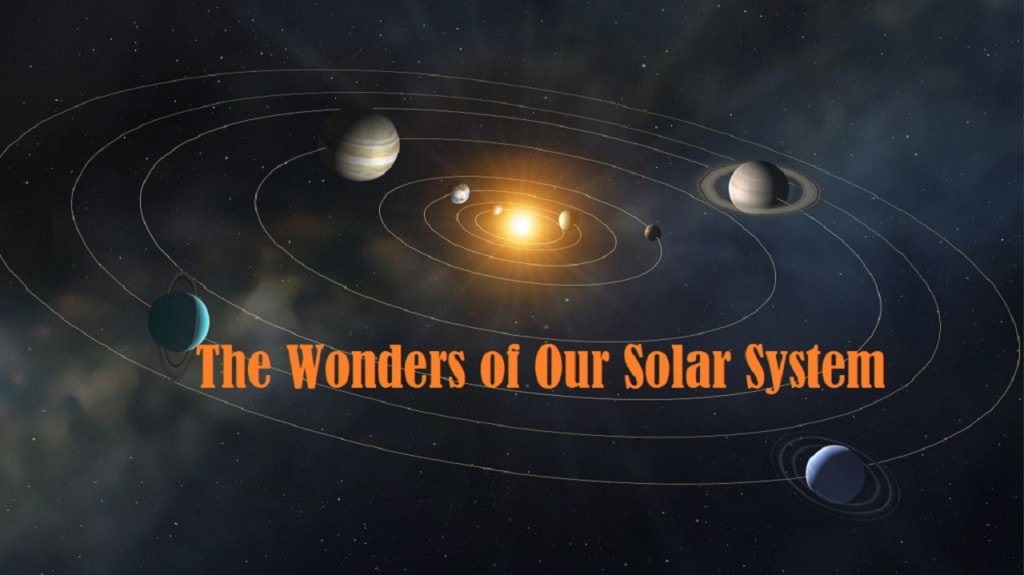
The Wonders of Our Solar System
Approximately 4.5 billion years ago, the solar system took shape as a cloud of interstellar gas and dust collapsed, forming a solar nebula—a swirling disk of material that eventually coalesced to create our solar system. Situated within the Orion star cluster of the Milky Way, our solar system is a rarity, as only 15% of stars in the galaxy host planetary systems. Among these stars, our very own sun holds a place, playing a central role in fostering life on Earth and illuminating our place in the vast cosmos.
The sun governs the graceful orbits of eight planets, each categorized into two groups based on their composition: Terrestrial and Jovian. Among these, Mercury, Venus, Earth, and Mars form the Terrestrial planets, predominantly composed of rocky material. These worlds boast solid surfaces, lack ring systems, have minimal or no moons, and exhibit relatively smaller sizes.
Mercury stands as the smallest and closest to the sun, gracefully completing its orbit in a mere three Earth months. In stark contrast, Venus claims the title of the hottest planet, with temperatures soaring up to 867 degrees Fahrenheit, a consequence of its carbon dioxide-rich atmosphere and extensive lava flows.
Next in line is our beloved Earth, a world of water, where vast and intricate water systems give rise to a unique environment capable of sustaining life—a rare marvel in the universe. Finally, Mars, the last of the terrestrial planets, holds a fascinating history. Roughly 3.7 billion years ago, Mars likely hosted life as its surface bore evidence of water and a moist atmosphere.
These Terrestrial planets, with their individual traits and histories, remind us of the remarkable diversity and wonder that permeates our solar system.
Beyond the inner solar system's quartet of Terrestrial planets, the majestic Jovian planets reign in the outer reaches. This distinguished group encompasses the gas giants, Jupiter and Saturn, as well as the ice giants, Uranus and Neptune. Dominated by helium and hydrogen, the gas giants astound with their colossal size and captivating atmospheric dynamics. On the other hand, the ice giants boast a composition of rock, ice, water, methane, and ammonia, making them unique in their own right.
Every one of these magnificent Jovian planets graces the cosmos with an array of moons, ornate ring systems, and a lack of solid surfaces, setting them apart from their Terrestrial counterparts. Their sheer size and awe-inspiring features showcase the grandeur and complexity that characterize the outer reaches of our remarkable solar system.
Jupiter, the largest of the Jovian planets, claims the title of the largest planet in our entire solar system. Positioned nearby, Saturn stands as the second largest planet, captivating observers with its iconic and extensive ring system, impressively wide but surprisingly thin, barely a kilometer in thickness.
Continuing further into the outer realms, we encounter the ice giants, Uranus and Neptune. Among them, Uranus, slightly bigger, captures attention with its unique rotation—famously tilted on its side, an unusual characteristic in the solar system. Next in line is Neptune, the outermost planet, shrouded in extreme coldness, making it one of the coldest members of our cosmic neighborhood.
Orbiting the Terrestrial planets, we come across the asteroid belt, a flat disc filled with rocky objects that carry remnants from the solar system's earliest days. Within this celestial repository, we find an assortment of debris ranging from microscopic dust particles to the largest known object, the dwarf planet Ceres, a captivating testament to the intricate history of our captivating solar system.
At a far greater distance lies another cosmic disc known as the Kuiper Belt, encompassing the orbits of the Jovian planets. Within this icy expanse, alongside asteroids, reside dwarf planets like Pluto, while countless comets trace their origins back to this distant region.
Extending even further, we encounter the Oort Cloud, a vast and spherical repository of icy debris. Marking the edge of our solar system, the Oort Cloud is where the gravitational and physical influence of the sun dissipates. In this distant realm, celestial objects reside in serene isolation, shaping the outermost boundaries of our cosmic abode.
The remarkable configuration of our solar system, with its diverse planets and celestial inhabitants orbiting around the life-giving sun, bestows upon it a unique and cherished status—a special place we proudly call home in the grand tapestry of the cosmos.
About the Creator
AIsyah
"I am a teacher from Indonesia who is very interested in learning English and enthusiastic about writing. Here I'll try to write more about science. Hope everyone will enjoy it.
Keep reading
More stories from writers in Earth and other communities.
Prosperity Without Relief: Why Many Saudis Feel Squeezed Amid an Economic Boom
Saudi Arabia is frequently portrayed as a nation in the midst of a historic economic transformation. Mega-projects rise from the desert, foreign investment conferences draw global CEOs, non-oil revenues are expanding, and the Kingdom’s Vision 2030 reform agenda is regularly praised as bold and ambitious. On paper, the economy appears dynamic and forward-looking.
By Ayesha Lashari4 days ago in Earth
China banned all fishing to save the Yangtze River
When a river that has sustained life for thousands of years begins to collapse, drastic action becomes inevitable. That was the reality facing Yangtze River, Asia’s longest river and one of the most biologically diverse freshwater systems on Earth.
By Sajida Sikandar2 days ago in Earth
Diaries to Nietzsche
Quotation from Friedrich Nietzsche "He who wrestles long with monsters should beware lest he himself become a monster. And if you gaze long into an abyss, the abyss also gazes into you. Man is not destroyed by suffering, but by the meaning he makes of it."
By LUCCIAN LAYTH3 days ago in Critique


Comments
There are no comments for this story
Be the first to respond and start the conversation.