
The wear and tear of modern life
The planet will not die, we will


Do you remember Ernesto Calindri sitting at the table in the midst of chaotic traffic drinking a Cynar, a well-known artichoke-based liqueur?
It was the 60s / 70s and there was already talk of “wear and tear on modern life”. The first signs of pollution were beginning, the first traffic jams in the city. It was not known what all this would lead to.
Today, half a century later, pollution is no longer just that of the atmosphere or rivers, there is much more than the brown foam of waterways or the stench of smog in the city. There is a climate change taking place that seems to be about to lead to the extinction of the planet. In this regard, I confess to myself a dubious denier. I think that climate changes have always been there, that we have gone through periods in which living beings breathed carbon dioxide and poisoned themselves with oxygen, that the huge volcanic eruptions of prehistoric times darkened the skies and cooled the soil for centuries, that the Plate tectonics and continental drift are not fantasies.
It is not true that the planet will die. The planet will be saved as it always has, we will be extinguished or living in terrible conditions, but this does not matter to the Earth, as it does not care about the other 99% of species that have become extinct. Life will always survive, perhaps on another planet, on another galaxy.
We are the ones who want everything to remain as it is. What does it matter to our globe if the sea level rises by one meter? We are concerned if Venice disappears underwater. Because man has always selfishly thought of himself, his survival, his well-being, his art and culture.
But if all scientists say that change is taking place and it is catastrophic, who am I to deny it? In fact, since when I was young to today, especially in the last twenty years, the weather conditions have become extreme, the wind is no longer wind but whirlwind, rain is flood, wet seasons have become dry, fires devour woods. Even earthquakes have increased.
Furthermore, we are drowning in asbestos which until recently was considered harmless and used to build anything, even schools. There are tons of buried toxic waste everywhere which has led to a very high death rate from cancer. One in two, if not even one in one, has to deal with this disease, sooner or later and, if the treatments have prolonged life expectancy, or perhaps even remission, there are always too many who die with great suffering. And they are getting younger and younger.
And the Chernobyl accident meant that all of us who went to the beach that April / May 1986 to enjoy the tan now have thyroid nodules.
At the time of Calindri there was already drugs but drug addicts were few, it was an enclave of marginalized people or children of fathers who could afford it. Now the drug costs very little and is everywhere, widespread in all social classes, in all ages, even very precocious, and in all professions. Whoever drives your bus or your plane, who removes your appendix, whoever extracts a tooth, may have a trembling hand. And drugs cause people to be stupid and distracted, inhibitions disappear and they kill themselves for nothing, beat their wife for cooking badly, smash the head of a child for a bad grade, set fire to a girlfriend who left.
Calindri did not yet know anything about the exodus of peoples, immigration, degradation, slavery, exploitation, psychological subjection to different and retrograde cultures that lead us to exasperation and racism. He did not know that we would no longer be able to call things by their name for fear of offending someone, up to the point of cultural paralysis and the rejection of our identity and our traditions.
Calindri had no idea that the telephone was of any use other than calling his wife to tell her to cook the pasta. He didn’t know anything about cell phones and computers. He did not imagine crowds of boys, men, women and old people walking in absolute silence with their eyes glued to a small screen and a sad and disconnected air, yes, but disconnected from everything that surrounds them, from the beauty of a sky, from the red of a sunset. He did not imagine being crossed by electromagnetic waves that are frying us all alive, increasing the incidence of brain tumors. For example, I am talking to you from a house where the wifi is on day and night, where the mobile phone is always at hand on the bedside table or on the back of the sofa.
There is no going back, it would be impossible, now our life is made up of fast data transmission and this is the future. However, I fear that, as with smoking, the risks are being underestimated. And if quitting smoking is tiring but doable, quitting living connected, alas, I’m afraid it’s impossible.
About the Creator
Patrizia Poli
Patrizia Poli was born in Livorno in 1961. Writer of fiction and blogger, she published seven novels.
Keep reading
More stories from Patrizia Poli and writers in Earth and other communities.
Roberto Marchesini, "Il cane secondo me"
“I would like to talk about the trust of dogs, about the thousands of inspirations they arouse with their apparent mute presence. Dogs are always there! What a strange thing to know that there is someone who does not reserve, that you do not have to convince, that he will not want to be reciprocated, that does not consider it an obligation or kindness to accept your invitation! " (page 24)
By Patrizia Poli3 years ago in Petlife
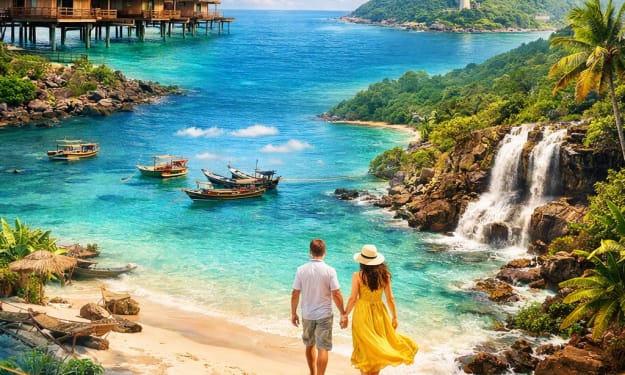
Asia’s Second-Best Island in DestinAsian Ranking
Vietnam’s largest island, Phu Quoc, has achieved a remarkable milestone in global tourism by being ranked the second-best island in Asia in the prestigious DestinAsian Readers’ Choice Awards 2026, surpassing the world-famous Maldives. The recognition marks a major moment for Vietnam’s tourism industry and highlights the island’s rapid rise as one of the most desirable tropical destinations in the world. 
By Irshad Abbasi 4 days ago in Earth



Comments
There are no comments for this story
Be the first to respond and start the conversation.