

A moist, Brazilian grove nestled in the shade of the canopy of cathedral like, five hundred year old Dinizia Excelsa’s. At eighty-eight metres, they were easily the tallest rainforest trees that kissed a twisting ridge that provided shade to a valley near Curuná-una, near one of the upper reaches of the Amazon.
Curiously, a film production set sat amongst the rich Epiphyctic ferns rather conspicuously. A dark square backdrop suspended by tripods, boss clamps and tungsten lights, powered by a row of batteries eclipsed the majestic location. Sweet, rotting organic scents filtered the air as if one thousand new world monkeys had in one of nature’s beautiful basilicas simultaneously sprayed one thousand atomised cans of a fragrance that may have been called the ‘smell of the earth, river and the sea’.
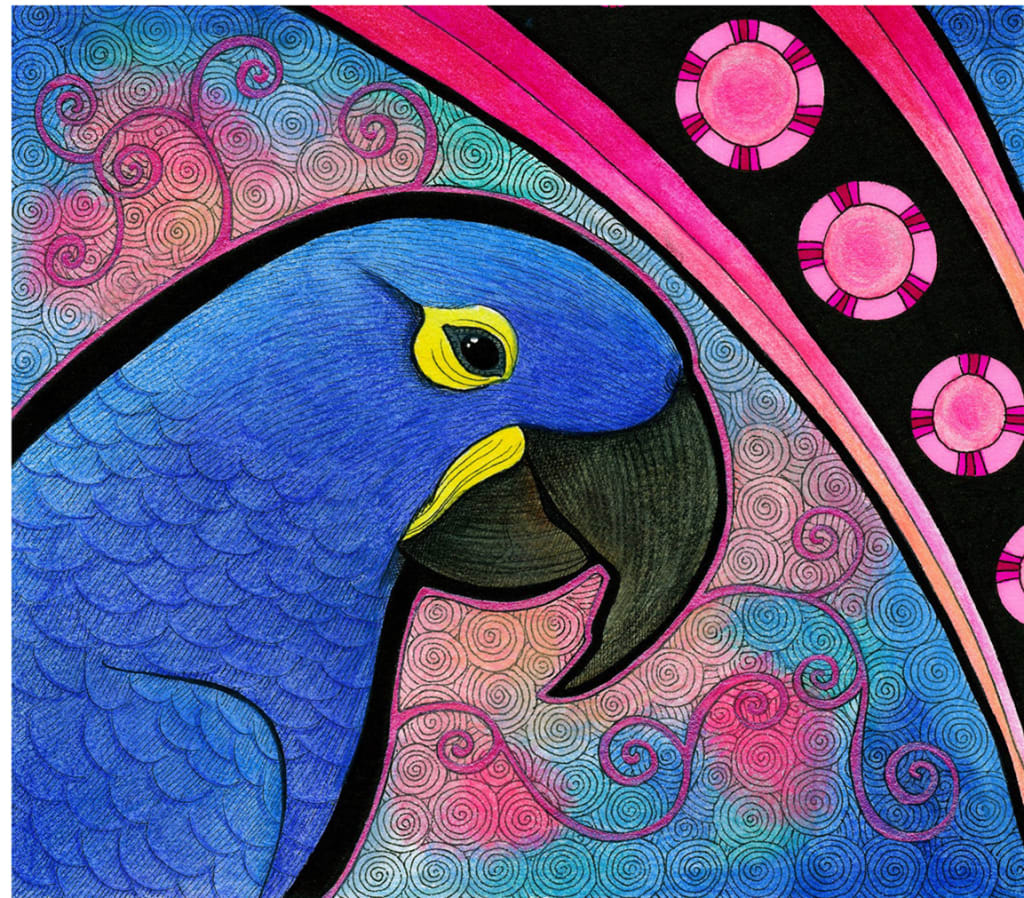
A Macaw sat silently, imposingly on a perch, in front of the backdrop that created an out of place artificial ecosystem in an otherwise pristine, visceral jungle ecology. On a tag, attached to the macaw’s leg was the name ‘Indigo’. The name had been embossed onto the metal ring that was sitting loosely on the bird's right claw.
Indigo was a 1.7 kilogram Anodorhynchus Hyacinthinus having an impressive wingspan that swept the air currents with a width of eighty-five centimetres. Indigo’s tail was both long and pointed and the feathers were an indigo blue. Lighter above, and greyish around Indigo’s handsome neck. In fact, the only other colour on Indigo was the strong, vibrant yellow that ringed each of Indigo’s opaque eyes.
Indigo could also speak. Colourfully.
In English, Portuguese and, Ticuna, the native language of the Ticuna people. The ‘first ones’ in the Amazon Basin and Indigo’s vocabulary was as extensive as it was vibrant, at over one thousand words – in each of those three languages. Indigo looked purposefully towards the camera’s lens that was being pointed towards him by the film crew’s Director of Photography and in English, Indigo instructed the film crew to “begin”.
Indigo’s head began to bob, duck, and weave. Dancing with breath-taking choreography. The bird’s feet created shapes on a perch that had been fashioned from the branch of a local Brazil nut tree.
And then Indigo’s beak parted and he began to assemble words. The fleshy, muscular tongue of the Macaw spoke in a language that Indigo had learned as a fledgling from the two-legged mammals, the hairless apes that once shared the jungle in harmony with all of the other animals and plants. Indigo announced to the human behind the camera, “Indigo speak”.
The bird’s beak was a proxy to the Macaw’s proclamations and Indigo, by modifying the air that flowed over his syrinx, began to make sounds that were familiar to the people standing behind the camera. A word then became several more words that had then been punctuated by several more 'colourful' words. They were words as vivid and vibrant as Indigo’s plumage. Indigo articulated strongly. It was a statement in a language that, hopefully, most humans would understand.
Indigo was now ‘the voice of nature’ because humans, the hairless apes, were unable to hear Mother Nature anymore. The bird spoke with an urgent precision and an occasional flurry of even more colourful albeit, salient words. Indigo exclaimed,
“I am Macaw.
WHAT THE FUCK?
I am flowers.
I am animals.
I am nature.
People, Indigo love but human stupid. Stupid.
WHAT THE FUCK?
Indigo cry.
WHAT THE FUCK?
Time hurry!
Fix Earth!
Help Earth!
Hurry. Protect Earth.
Nature sees you.
WHAT THE FUCKKKK!”
Bobbing and weaving silently once more on the perch Indigo paused, gnawing on a coconut’s white flesh that had fallen close to the perch, Indigo then followed by taking several large gulps of fresh rainwater that had collected into the half-cracked coconut. *
The water had distilled there from the previous evening’s unseasonal torrential rain that had fallen. Collating viscously, following a path determined by the forces of adhesion and cohesion into the coconut shell that was now an organic pot, a water catchment vessel for Indigo, the Macaw, and the other animals of the forest to drink from.
(DID YOU KNOW: SOME MACAWS ARE STRONG ENOUGH TO CRACK COCONUT SHELLS: Hyacinth macaws have enough strength in their massive beaks to crack a coconut shell. Despite their impressive strength, hyacinth macaws are known as the "gentle giants" of the macaw world due to their sweet and affectionate dispositions, especially when raised as hand-fed babies. Other types of macaws also have powerful and impressive beaks, making them a force to be reckoned with during acts of aggression or bouts of hormonal behaviour. This is a major reason why macaws are generally recommended only for those who have experience keeping large parrots. And to reiterate, macaws, like all parrots, need social interaction and socialisation so they don't grow bored. A bored macaw will chew on any wood it can find, and with its powerful beaks, this can mean serious destruction) *
Once more, Indigo stood motionless on the perch and looked into the camera’s lens, he parted his beak and this time, with much, much more veracity repeated the following words and sentences punctuated by Indigo’s liberal use of colourful language:
“I am Macaw.
WHAT THE FUCK?
I am flowers.
I am animals.
I am nature.
People, Indigo love but human stupid. Stupid.
WHAT THE FUCK?
Indigo cry.
WHAT THE FUCK?
Time hurry!
Fix Earth!
Help Earth!
Hurry. Protect Earth.
Nature sees you.
WHAT THE FUCKKKK!”
The production companies’ producer, in charge of documenting Indigo’s proclamation to the world, had placed a record playing turntable and a collection of record albums next to the catering wagon to entertain the film crew in the tropical forest.
Like most parrots, Indigo’s toes were extremely strong and dexterous. In an Amazon jungle, for no particular reason, the 'voice of nature', Indigo carefully selected a record from the collection of albums next to the record player.
On that very same day that Indigo was filming his monologue in the Brazilian jungle, a symposium was being held, half a world away, in Glasgow. The COP 26 UN Climate Change Conference.
Maybe Indigo chose the record because of the title on the record's cover and the name of the group that performed on its recordings? The record was called ‘Live at the Fillmore, February 1969 by The Byrds’.
You see, Indigo could also read, and coincidently, on that month and year, Indigo was hatched into the world. Also, Indigo was a bird too.
With his toes, he carefully placed the record onto the record player's rotating turntable that was spinning at 33 and 1/3 revolutions per minute. Executing the action with the nimble dexterity of a surgeon, his zygodactyl * toes picked up the record player's stylus attentively selecting track seven of the now spinning record.
(DID YOU KNOW: ZYGODACTYL CLAWS: having two toes facing forward and two back) *
Indigo’s toes slid away and the stylus, now sitting on the rotating groove of the record by the Byrds navigated its way along with the encrypted message. A song was played that had been recorded in 1969. It was a nostalgic, lyrical time capsule that echoed through the moist, saturated mist-laden air of the Brazilian rainforest valley. The song's words soaked into the humus-rich soil that usually buffers words and vibrations, filled with sweet lament and sad empathy that set the other birds singing, not cheerfully and with hope. They moved their wings less boldly now.
They were words that nonetheless resonated with Indigo.
To everything (turn, turn, turn)
There is a season (turn, turn, turn)
And a time to every purpose, under heaven
A time to be born, a time to die
A time to plant, a time to reap
A time to kill, a time to heal
A time to laugh, a time to weep
To everything (turn, turn, turn)
There is a season (turn, turn, turn)
And a time to every purpose, under heaven
A time to build up, a time to break down
A time to dance, a time to mourn
A time to cast away stones, a time to gather stones together
To everything (turn, turn, turn)
There is a season (turn, turn, turn)
And a time to every purpose, under heaven
A time of love, a time of hate A time of war, a time of peace
A time you may embrace, a time to refrain from embracing
To everything (turn, turn, turn)
There is a season (turn, turn, turn)
And a time to every purpose, under heaven
A time to gain, a time to lose
A time to rend, a time to sew
A time for love, a time for hate
A time for peace, I swear it’s not too late
Indigo the Macaw, still mounted on the perch, fashioned from the branch of a Brazil nut tree, slowly spread his wings, leaped, and flew. His impressive 85-centimetre wingspan only needed to flap three, maybe four times to become airborne. He carved slowly a melancholic swoop through the densely vegetated valley below and Indigo spoke, his voice amplified by nature’s majestic amphitheatre below. The Macaw's words reverberated. Bouncing off each peak and trough of the jutting topography flowing beneath his wings. Indigo sang for the world...
...and for humanity too.
To everything (turn, turn, turn)
There is a season (turn, turn, turn)
And a time to every purpose, under heaven
A time to gain, a time to lose
A time to rend, a time to sew
A time for love, a time for hate
A time for peace, I swear it’s not too late
A sound echoed from the valley below as Indigo sang his song. It was the familiar sound of a wingless bird that had taken flight. It wasn’t an elegant or organic sound at all. It was the sound of a disease of the mind and it had manifested in an anonymous person’s hands as a rifle. What took flight was the genocidal impulse that was always in the hominids, the impulse that will love cures, and the indifference that magnifies.
Indigo saw the wingless bird. It was a 7.7 millimetre calibre lead-antimony alloy projectile that had been encased in a copper-plated soft steel jacket from a Lee Enfield rifle, in fact, it was the very last thing Indigo saw.
The wingless bird came to greet Indigo from over one kilometre away and it was a poison to him, the world, and the poor buggers on the other end, humanity.
And then the wingless bird ‘met’ the Macaw. Striking his Indigo blue-feathered chest with lethal force as Indigo soared above.
The words that left Indigo’s beak as he exhaled his last breath echoed, reverberating throughout the valley below.
Beneath Indigo's falling, inanimate body the hominids could hear the voice of nature screaming, crying out, and pleading...
...“What the FUCKKKKKKKKKKK?”
About the Creator
Keep reading
More stories from Peter Dennis and writers in Earth and other communities.
Goddess
She was painted in the most florescent of colours but now they have vanished and left her naked in the tones of the colours shadows. The palette God used to create her would have made Claude Monet shed a tear. When she smiled, rays of colours from every end of the spectrum went running in every direction, looking for an untouched part of the canvas on which to leave a mark – and now the marks are indelible charcoal smudges.
By Peter Dennis4 years ago in Fiction
US Warns Airlines About Military Activity in Parts of Latin America
Commercial aviation is built on predictability—clearly defined airspace, coordinated air traffic control, and shared international rules. When that predictability is disrupted, even subtly, the ripple effects can stretch far beyond the cockpit. That is exactly why a recent warning from the United States has caught the attention of airlines, governments, and travelers alike. In early 2026, US aviation authorities issued an advisory warning airlines about military activity in parts of Latin America, urging pilots to exercise heightened caution when flying over certain regions. While no immediate restrictions or flight bans were imposed, the message itself was clear: something in the skies has changed, and the risks—however limited—can no longer be ignored. This development is not just about aviation safety. It reflects a growing intersection between geopolitics, military operations, and civilian infrastructure in a region that has long balanced cooperation with tension. What Exactly Did the US Warn About? The advisory, released through official aviation safety channels, highlighted concerns over potential military activity affecting airspace across parts of Mexico, Central America, South America, and nearby oceanic regions. Airlines were advised to remain vigilant during all phases of flight, including cruising at high altitudes, takeoff, and landing. Unlike routine notices related to weather systems or airport congestion, this warning explicitly referenced security-related risks. These include the possibility of unexpected military movements, temporary airspace disruptions, and interference with navigation systems that modern aircraft rely on for safe operations. Importantly, the warning did not accuse any specific country of wrongdoing, nor did it suggest an immediate danger to passengers. Instead, it served as a precaution—one designed to ensure airlines adjust flight planning, monitoring, and communication protocols accordingly. Why Military Activity Matters to Civil Aviation To the average traveler, military exercises or operations may seem distant from the experience of flying on a commercial jet. In reality, the two worlds often share the same skies. Civilian aircraft depend heavily on satellite navigation, coordinated air traffic control, and stable airspace rules. Military operations—especially those involving fast-moving aircraft, surveillance systems, or electronic equipment—can introduce uncertainty into that environment. Some of the key risks aviation authorities monitor include: Unplanned military aircraft movements that may not follow civilian flight patterns Temporary airspace closures or restrictions that require last-minute rerouting Navigation signal disruptions, whether accidental or intentional Increased congestion in strategic corridors used by both civilian and military flights While these risks are typically managed through coordination and communication, heightened military activity raises the stakes. The FAA’s advisory suggests that such activity has reached a level where additional caution is warranted. The Geopolitical Context Behind the Warning The timing of the advisory is not accidental. Latin America has seen a noticeable rise in security operations and military coordination involving the United States over the past year. These efforts are largely focused on counter-narcotics missions, maritime security, and regional stability, particularly in areas with strategic shipping routes or ongoing political tension. At the same time, broader global dynamics—ranging from great-power competition to shifting alliances—have increased the strategic importance of air and sea routes across the Western Hemisphere. From Washington’s perspective, issuing an aviation warning is not about alarmism. It is about acknowledging that military and security activities in the region may temporarily affect civilian systems, including aviation. How Airlines Are Responding For airlines, advisories like this are not unusual—but they are taken seriously. Most major carriers already operate with layered safety systems that allow them to respond quickly to changing conditions. In practical terms, this warning may lead to: Slight route adjustments to avoid specific airspace Enhanced pilot briefings before flights Increased coordination with air traffic controllers Closer monitoring of navigation and communication systems So far, there have been no widespread flight cancellations or suspensions linked directly to the warning. That suggests airlines view the risk as manageable, provided proper precautions are followed. Reactions from Latin American Governments Some governments in the region have been quick to reassure the public. Officials have emphasized that their national airspace remains safe and fully operational, and that civilian flights continue without disruption. This response highlights an important tension: while the US warning is precautionary, it can still affect public perception. Tourism, business travel, and investor confidence are all sensitive to suggestions of instability—even when no immediate danger exists. As a result, many countries are walking a careful line between cooperating on aviation safety and defending their reputation for stability. What This Means for Passengers For travelers, the key takeaway is simple: commercial aviation remains safe. Warnings like this are designed to prevent incidents, not predict them. Passengers flying through or over affected regions may experience slightly longer flight times or minor schedule adjustments, but there is no indication of increased danger to civilian aircraft. In fact, the existence of such advisories demonstrates how seriously aviation authorities take even low-probability risks. A Sign of a More Complex World The US warning to airlines is a reminder that modern air travel does not exist in a vacuum. As military operations, security concerns, and geopolitical rivalries evolve, civilian systems—from shipping lanes to flight paths—are increasingly affected. This moment underscores a broader reality: the skies are becoming more crowded, more contested, and more interconnected with global politics. Managing that complexity will require continued transparency, cooperation, and vigilance from governments, regulators, and airlines alike. For now, planes continue to fly, passengers continue to travel, and the system continues to work. But behind the scenes, aviation authorities are quietly adjusting to a world where safety is shaped not just by weather and mechanics—but by geopolitics as well.
By Muhammad Hassan4 days ago in Earth
Earth Is Not Our Property
There was a time when the Earth did not need us. Rivers carved their own paths without permission. Forests rose and fell like quiet empires. Ice learned the language of patience. The planet breathed in rhythms older than memory, older than names. Then we arrived—curious, clever, afraid of silence—and decided everything needed a fence.
By LUNA EDITH2 days ago in Earth


Comments
There are no comments for this story
Be the first to respond and start the conversation.