
Earth Is Not Our Property
A Reminder That Survival Begins With Humility


There was a time when the Earth did not need us.
Rivers carved their own paths without permission. Forests rose and fell like quiet empires. Ice learned the language of patience. The planet breathed in rhythms older than memory, older than names. Then we arrived—curious, clever, afraid of silence—and decided everything needed a fence.
Somewhere along the way, we confused living on the Earth with owning it.
Ownership is a human idea. The planet never signed the papers.
We speak in the language of possession: my land, my resources, my water. We draw lines on maps and call them borders, forgetting that clouds cross them freely and oceans refuse to stop at customs. We sell what was never ours to sell and charge admission to places that existed long before money learned how to speak.
The Earth does not belong to us.
We belong to a moment on the Earth.
Walk through a forest at dawn and listen carefully. You won’t hear gratitude. The trees do not thank us for sparing them. They do not celebrate when we decide to “protect” what we almost destroyed. They stand there anyway, holding the sky, doing the work of survival without applause.
We tell ourselves a comforting story—that we are caretakers now, that technology will save us, that awareness is enough. But awareness without humility is just another form of control. We want to fix the planet without first admitting we broke our relationship with it.
A river does not need to be “managed” to know how to flow.
A bee does not need a business model to pollinate life.
A mountain does not exist to be useful.
Yet usefulness is how we measure worth.
If something cannot be mined, harvested, branded, or optimized, we call it wasted space. Silence becomes emptiness. Stillness becomes laziness. Wilderness becomes potential profit waiting to be unlocked.
This way of thinking didn’t begin with malice. It began with fear. Fear of hunger. Fear of cold. Fear of not having enough tomorrow. So we took more today. Then more than we needed. Then more than the Earth could give without breaking.
And when cracks appeared—melting ice, burning forests, rising seas—we called them natural disasters, as if nature had suddenly turned against us, as if cause and consequence had never met before.
But the Earth is not angry.
It is responding.
Every system has limits. Every body—human or planetary—pushes back when stretched too far. What we call “climate crisis” is not the planet failing. It is the bill arriving.
Still, there is another truth we often forget: the Earth is remarkably patient.
It has survived asteroids and ice ages. It will survive us too. The real question is whether we will survive our belief that we are in charge.
Property implies permanence. But nothing about us is permanent. Our cities will one day become dust. Our languages will fade into archives. Even our names will disappear from memory. The rocks will remain, unimpressed.
Knowing this should humble us—but instead, it can free us.
If the Earth is not our property, then our role changes. We are no longer owners or conquerors. We become guests. Neighbors. Temporary stewards borrowing space from something infinitely older and wiser.
Guests clean up after themselves.
Stewards think in generations.
Imagine making decisions not for quarterly profits, but for children whose names we will never know. Imagine asking a simple question before every action: Does this allow life to continue?
This doesn’t require perfection. It requires restraint. It requires remembering that progress is not measured by how much we take, but by how gently we learn to live.
There is a quiet revolution happening—not loud, not viral. It lives in small choices. In people who repair instead of replace. In communities that protect what cannot speak for itself. In children who already understand something we forgot: that the Earth is alive, not owned.
Maybe the future won’t be saved by grand speeches or distant promises. Maybe it will be shaped by a shift in language.
From ownership to relationship.
From extraction to respect.
From dominion to belonging.
The Earth does not ask us to be heroes.
It asks us to be humble.
Because in the end, we are not landlords of this planet. We are a passing story written on its surface—one chapter among billions. What matters is not how much we claimed, but whether we learned, before the last page, how to live without destroying the book that holds us.
About the Creator
LUNA EDITH
Writer, storyteller, and lifelong learner. I share thoughts on life, creativity, and everything in between. Here to connect, inspire, and grow — one story at a time.
Keep reading
More stories from LUNA EDITH and writers in Earth and other communities.
When the Ocean Rose Overnight
The world went to sleep to the familiar rhythm of waves kissing the shore, and awoke to silence—an eerie, heavy silence broken only by the sound of water lapping against city streets. Overnight, the ocean had risen. Not by inches, not by tides, but by a towering leap that defied science, reason, and history.
By LUNA EDITH4 months ago in Earth
How Much Do You Need in an ISA for a Passive Income That Beats the State Pension?
For many people in the UK, the State Pension is expected to form the backbone of retirement income. But with rising living costs and growing uncertainty about the future, more savers are asking a crucial question: Can I build a passive income that beats the State Pension — and how much would I need in an ISA to do it?
By Aarif Lashariabout 3 hours ago in Earth
Tiny Lion Cubs Struggle To Keep Up With Mom
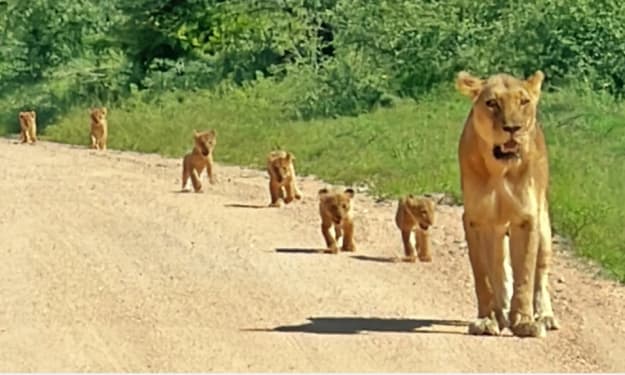
In the heart of the African savannah, life is a constant lesson for young animals. Few scenes are as endearing — or as heartwarming — as tiny lion cubs trying to keep pace with their mother. These little bundles of fur face a world full of challenges, from learning to hunt to avoiding dangers, all while depending on the guidance and protection of their experienced mom. Watching cubs wobble and tumble as they attempt to keep up with their mother reminds us that growing up, even in the wild, is a journey full of struggle, determination, and adorable missteps. The Early Days of Lion Cubs Lion cubs are born blind and helpless, usually in litters of two to six. For the first few weeks, they rely entirely on their mother for warmth, food, and safety. Even after opening their eyes and beginning to explore, the cubs are far from independent. The first months are crucial. Cubs learn social cues, hunting basics, and survival skills simply by watching their mother and the pride. But as anyone who has observed them knows, there’s often a huge gap between observation and action. Tiny cubs often struggle to match their mother’s pace, especially when she moves through long stretches of savannah or leads the family on patrols. A Mother’s Role in the Wild For a lioness, raising cubs is a full-time commitment. She hunts, defends her territory, and teaches her young, all while staying alert to predators such as hyenas, leopards, and even rival lions. The cubs, meanwhile, attempt to mimic her every move — often with clumsy yet charming results. A mother lion’s patience is remarkable; she frequently slows down, nudges them along, or stops to ensure no cub is left behind. These moments, while stressful for the tiny cubs, are vital learning opportunities. Struggling to Keep Up: Why It’s So Hard There are several reasons why tiny lion cubs have trouble keeping pace with their mother: Short Legs, Big Steps: Lion cubs’ legs are tiny and their coordination is limited, making it difficult to cover the same distance as an adult lioness. Curiosity: Cubs are naturally curious. A single butterfly or rustling bush can distract them, leaving mom to pause repeatedly. Energy Levels: Young lions tire quickly. Even with frequent naps, the cubs’ stamina is far lower than their mother’s. Learning Through Play: Play is not just fun; it teaches hunting, balance, and social skills. Running off to pounce on a sibling or chase an insect is all part of their education. Despite these challenges, the cubs’ determination to keep up demonstrates their resilience and growing understanding of the wild world. Lessons in Teamwork and Survival Every cub struggling to keep up is also learning crucial survival skills. The journey across the savannah is more than a test of speed — it’s a lesson in: Coordination: Cubs learn how to move efficiently across different terrains. Patience: They begin to understand the rhythms of adult life and the pace required for survival. Social Skills: Staying with the group teaches cubs how to interact with siblings and the pride, which is essential for their future roles. Observation: By following their mother, cubs study hunting techniques, territorial behavior, and predator awareness. Even the moments when cubs stumble or lag behind are essential for their development. These experiences prepare them for independence, which comes sooner than many might expect. The Cutest Moments in the Wild Anyone who has watched tiny lion cubs knows that their struggles are often irresistibly cute. Video clips from wildlife reserves frequently show cubs toddling along, tumbling over each other, or getting distracted mid-step. Observers often comment that these little stumbles reveal personality, determination, and playfulness, making them one of nature’s most heartwarming spectacles. While their mother is serious and focused, the cubs inject a sense of humor and lightness into life on the savannah. Why This Matters The struggles of lion cubs aren’t just adorable — they’re vital for understanding wildlife behavior. Conservationists and animal behaviorists use these moments to study growth patterns, social structures, and survival strategies in lion populations. These observations also highlight the importance of preserving natural habitats. Cubs must learn in a safe environment to survive; habitat loss, poaching, and climate change make these early struggles even more dangerous. Protecting the African savannah ensures that future generations of lions can experience the same lessons and playful tumbles. The Road to Independence Within a year, these tiny cubs will be more agile, faster, and more confident. By the time they reach two to three years old, males may begin to leave the pride, while females often stay and become caretakers themselves. Every misstep, tumble, and lagging moment is part of the journey toward strength, coordination, and independence. Watching them now gives us a glimpse of the challenges they will overcome, and the survival skills they will carry for life. A Celebration of Motherhood Ultimately, these scenes remind us of the incredible bond between mother and cubs. Her patience, vigilance, and teaching are the foundations of their future. The cubs’ struggles highlight the trials of growing up, while their determination showcases the resilience and beauty of wildlife. For those observing, it’s a powerful lesson in care, guidance, and perseverance, not just in lions but in the natural world as a whole. Final Thoughts Watching tiny lion cubs try to keep up with their mother is both entertaining and enlightening. It’s a story of growth, struggle, and resilience — a reminder that even the fiercest creatures start small, learning step by step. These little lions capture hearts while teaching life lessons: patience, determination, teamwork, and the importance of guidance. As they tumble and waddle across the savannah, they show us that growth is a process, one adorable misstep at a time. For wildlife enthusiasts, animal lovers, and anyone enchanted by nature, these tiny cubs are proof that even in the wild, love, care, and persistence are universal truths.
By Aarif Lashariabout 3 hours ago in Earth



Comments
There are no comments for this story
Be the first to respond and start the conversation.