
The Unfinished Morning
Stories of a World in Crisis, Innovation, and Relentless Hope
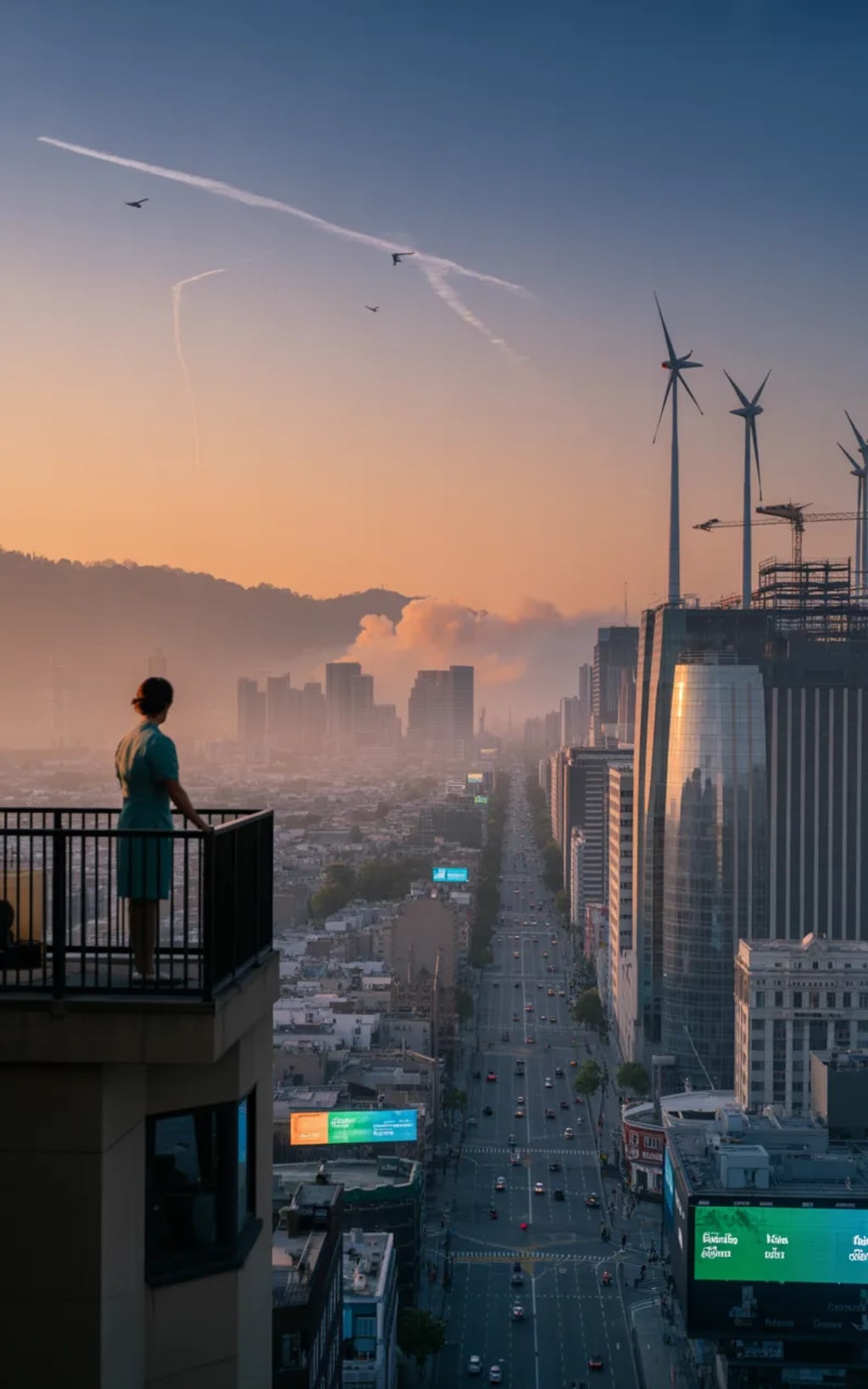
The world woke up before the sun did.
In one city, the call to prayer drifted across rooftops scarred by old smoke. In another, subway brakes screamed beneath towers of glass where lights had never truly gone out. Somewhere else, waves licked at a shoreline that had inched backward year after year, as if the sea were slowly reclaiming a secret it had once lent to humanity.
It was the same morning, though it did not feel the same.
A nurse named Amara tied her hair into a knot as she walked toward the hospital. The air carried a faint metallic tang from distant fires—wildfires that had become seasonal, predictable in their unpredictability. She checked her phone before stepping inside: overnight messages from family, headlines about markets trembling, about storms forming, about negotiations stalling. She had learned to scroll quickly. Too much knowledge before sunrise made the day heavier.
Across an ocean, Daniel refreshed a dashboard glowing with numbers. Green arrows, red arrows, graphs rising and collapsing in real time. He worked in a climate analytics firm that advised cities how to adapt to a planet growing warmer and angrier. He believed in data the way some believed in prayer. But even data had begun to feel like a witness statement at a trial whose verdict everyone already knew.
In a small apartment above a bakery, Lila adjusted her camera and spoke into it. “Good morning, everyone,” she began, voice steady. She was a teacher, though most of her students were squares on a screen. The school building had closed again—budget cuts, political disputes, threats deemed credible enough to avoid. She taught history, which lately felt less like a study of the past and more like a manual for the present. Her students asked sharp questions: Why does it feel like everything is breaking at once? Who is responsible? Can we fix it?
She tried to answer without lying.
The world, at this moment, was a place of overlapping emergencies and stubborn hope.
In the north, glaciers retreated like armies that had lost the will to fight. Rivers swelled where they shouldn’t and vanished where they were needed. Farmers studied cracked soil and recalculated futures. Insurance companies recalculated too. In the south, heat pressed down on cities not designed for it, turning concrete into slow cookers and electricity grids into fragile webs. Air conditioners hummed like desperate insects.
War flickered in pockets across the globe. Some conflicts had headlines; others survived only in whispers and grainy images shared by those who still had signal. Drones hovered where birds once nested. Missiles drew brief, terrible lines in the sky. Children learned to distinguish the sound of thunder from something else.
At the same time, rockets lifted off from desert launchpads, carrying satellites and ambition. Laboratories hummed with experiments in gene editing and artificial intelligence. Engineers taught machines to write, to draw, to diagnose. Investors whispered about revolutions measured not in years but in quarters. Some saw salvation in circuits and code. Others saw new forms of control.
Amara moved from bed to bed, checking oxygen levels, adjusting blankets, holding hands when family members could not be present. A new variant of an old virus had begun circulating—less deadly, perhaps, but more contagious. People were tired of being afraid, and so fear traveled quietly, disguised as normalcy. She noticed how exhaustion had settled into everyone’s shoulders. Even recovery required energy many no longer had.
During her break, she stepped outside and watched two delivery riders argue in three languages about a collision that had barely happened. Behind them, a billboard flashed advertisements for a luxury apartment complex promising “resilience and serenity.” The word resilience had been rebranded. It no longer meant bouncing back; it meant enduring without complaint.
Daniel joined a virtual meeting with city planners from three continents. One city worried about rising seas, another about drought, the third about both. They discussed sea walls, desalination plants, early warning systems. Someone asked about funding. Someone else asked about political will. Daniel shared projections: by 2050, by 2100. The numbers were precise. The future they described was not.
After the call, he opened a message from his younger sister. She had marched in a climate protest that weekend. The photos showed handmade signs, sunburned faces, police lines. “We can’t just adapt,” she had written. “We have to change.” He stared at the sentence for a long time. Adaptation felt like triage. Change felt like surgery without anesthesia.
In Lila’s class, the lesson was about past empires—how they rose, how they fell, how they convinced themselves of permanence. A student typed into the chat: “Are we in the falling part?” Another wrote: “Maybe it’s just transformation.” Lila paused. Outside her window, a delivery drone buzzed past like an impatient thought.
“History doesn’t move in straight lines,” she said finally. “It moves in pressures. Environmental pressures. Economic pressures. Moral pressures. Sometimes those pressures break systems. Sometimes they reshape them.”
After class, she read news from multiple sources, each framing the same events differently. Elections contested. Protests swelling. Misinformation spreading faster than corrections. Truth had become a contested territory. Algorithms nudged conversations toward outrage because outrage kept people scrolling. People mistook volume for validity.
Meanwhile, in a rural village connected to the internet by a single satellite dish, a teenager named Kofi watched tutorials on building solar panels from salvaged materials. His community had unreliable electricity but abundant sun. He imagined rooftops glittering with possibility. He imagined not having to leave for the city to find work. He imagined a future that did not require apology.
The world’s situation, right now, was this: too much information and not enough wisdom. Too many weapons and not enough trust. Too much consumption and not enough repair. Yet also—too many ideas to suppress, too many connections to sever entirely.
Markets trembled at rumors. Currencies rose and fell like anxious hearts. Supply chains rerouted around blockades and storms. Ships waited at ports while negotiations unfolded in rooms without windows. Somewhere, a semiconductor factory paused production because of a water shortage. Somewhere else, a startup announced a breakthrough in battery storage.
In the evening, Amara returned home and watered the plants on her balcony. The city hummed below her, restless and luminous. She thought about the patients she had lost and the ones who would recover. She thought about how quickly strangers could become essential. In crisis, divisions sometimes sharpened; other times, they dissolved.
Daniel closed his laptop and stepped outside. The air was cooler than it had been in years past—a temporary reprieve from a trend he knew too well. He looked up at the stars, some of them real, some of them satellites blinking in disciplined orbits. Humanity had extended its nervous system into space. The question was whether its conscience could keep up.
Lila recorded a short message for her students. “The present feels overwhelming,” she said. “But remember, every generation has faced moments when the world seemed unrecognizable. The challenge is not just to survive change, but to shape it.”
As night folded over continents, factories slowed, data centers continued their silent calculations, and emergency rooms stayed lit. Negotiators drafted proposals. Activists planned marches. Scientists ran simulations. Parents read bedtime stories, sometimes editing out the scariest parts.
The world, right now, was not one story but millions braided together—stories of fear and ingenuity, of greed and generosity, of collapse and construction. It was a world heating and innovating, dividing and connecting, exhausting itself and yet refusing to stop.
Somewhere before dawn, Kofi soldered two wires together and watched a small bulb flicker to life. It was not much. It would not change global markets or halt a war. But it was light drawn from the sun, captured by human hands.
And across the planet, in apartments and villages and cities and camps, others were doing similar small acts: planting trees, writing code, caring for the sick, questioning leaders, teaching children, building walls against the sea, tearing down walls between neighbors.
The situation of the world was unstable, yes. But it was also unfinished.
Morning would come again.
About the Creator
Keep reading
More stories from Maavia tahir and writers in Earth and other communities.


Comments
There are no comments for this story
Be the first to respond and start the conversation.