
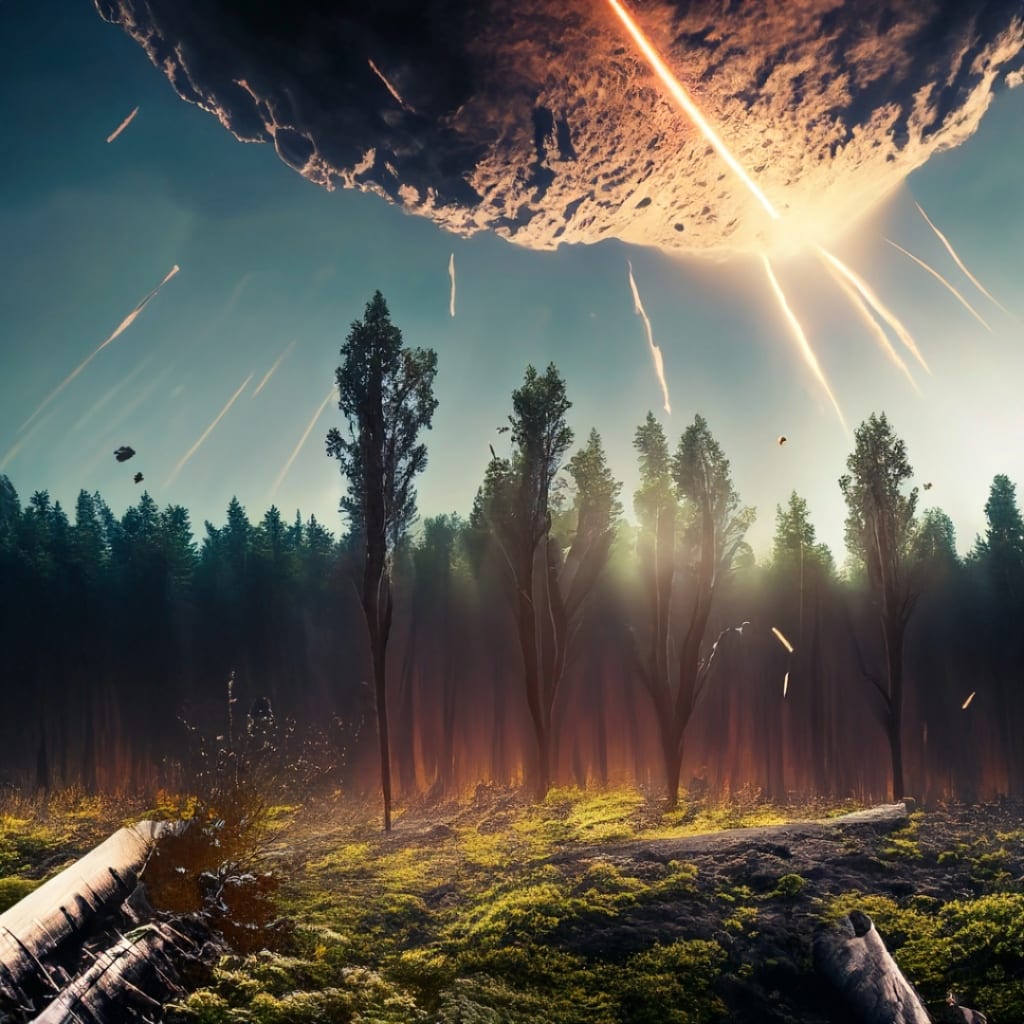
In the vast expanse of Siberia, a land so immense that it could stand as a sovereign nation, its independence would instantly establish it as the largest country on Earth. Amid this sprawling wilderness, about a third of its immense territory is dominated by a colossal forest, a realm home to the Siberian tiger, spanning an expanse roughly one and a half times the size of India. Deep within this boundless sea of trees, an enigmatic catastrophe unfolded, etching a mysterious chapter in modern history.
More than a century ago, on the 30th of June, 1908, the heart of East Siberia witnessed an extraordinary event. A massive section of this Siberian forest, known for its might and grandeur, was obliterated by an unseen force. The scale of devastation was awe-inspiring: a staggering 80 million trees spanning almost a thousand square miles were felled, giving rise to a pocket-sized apocalypse. The aftermath resembled the impact of a nuclear bomb, although such technology was still decades away from existence. No known human explosive could have produced such a cataclysmic effect. Hence, the question loomed: what unfathomable power had decimated this vast expanse?
In 1927, a Russian mineralogist named Leonard Kulik embarked on a daring expedition to this remote site near the Parkamnia Tunguska River. Accompanied by a team of scientists and local guides, Kulik ventured into the heart of the obliterated forest, driven by a singular theory. He believed that only a meteor strike could account for the incredible devastation. Following the trail of fallen trees, the team reached a peculiar ground zero. Yet, amid the ruins, something confounded them: there was no impact crater, no meteorite fragments. Instead, upright trees stood bereft of bark and branches—a bewildering sight that defied logic.
This was the story of the Tunguska event, an enigma that has left the scientific world perplexed for over a century. The ripples of this event extended globally—seismic stations across vast distances detected activity akin to a mid-sized earthquake, and an airborne shockwave reached far-off corners of the world. Night skies glowed with an eerie luminescence for days, casting an otherworldly spectacle.
Eyewitness accounts from those near ground zero were scarce, given the region's sparse population. Those unfortunate enough to be present recounted a similar tale. In the early hours of June 30, 1908, a strange, radiant light akin to a second sun emerged high in the sky. Slowly moving towards the horizon over a span of minutes, it ignited the heavens with flames. Following swiftly came a barrage of deafening bangs, reminiscent of artillery fire. A scorching shockwave swept through, wreaking havoc, demolishing structures, shattering windows, and knocking people off their feet.
Amid speculations and theories—ranging from divine wrath and primordial black holes to nuclear-powered alien spacecraft—an unexpected clue emerged from an Australian experiment, code-named "Operation Blowdown." This test in 1963 detonated a massive bomb above a rainforest, revealing a phenomenon akin to the Tunguska event on a smaller scale. It suggested that meteorites need not necessarily collide with Earth's surface to unleash catastrophic energy. Instead, under specific conditions, the immense heat generated during their descent could cause them to self-destruct, releasing formidable energy.
The prevailing theory posits that the Tunguska event resulted from a meteor air burst. A meteorite, approximately 60 meters wide and hurtling at 60,000 miles per hour, detonated about five miles above the Earth's surface. This explosion yielded energy equivalent to 2,000 Hiroshima bombs. The resulting shockwave, Eerie lights, and unique tree damage could all be explained by this theory.
However, debates and alternative theories persist. An idea emerged in 2002, suggesting that the catastrophe resulted from the ignition of 10 million tons of natural gas from within the Earth's crust. Another hypothesis, proposed in 2020, considered the possibility of an "Earth Grazer," a meteorite that enters and exits Earth's atmosphere without impact, generating a shockwave that can cause devastation.
In conclusion, while the Tunguska event's exact cause remains the subject of debate, the potential threat posed by asteroids to Earth is a constant reminder of the universe's capricious nature. The anniversary of the Tunguska event, celebrated on Asteroid Day, prompts reflection on humanity's precarious position in the cosmos. While large-scale extinction events are unlikely, smaller impacts cannot be entirely ruled out. The balance between our technological advancements and the universe's unpredictability underscores the importance of continued vigilance and research.
About the Creator
Keep reading
More stories from writers in Earth and other communities.
The Nature that Raised Me
I believe in nature, because in truth, she raised me. My life thus far has been touched by a never-ending series of the most wild and mystical landscapes one could ever hope to behold. And each place is so different, so phenomenally awe-inspiring, that the memories I hold of each one are still as vivid as though I were there yesterday.
By Maura Bernstein5 days ago in Earth
Life After Cancer: Reclaiming Identity and Finding Joy Back at Work
For many people, a cancer diagnosis marks the beginning of a journey that affects not just physical health, but identity, relationships, and daily life. After months or even years of treatment, patients often find themselves confronting a new challenge: life after cancer. Stepping back into normal routines, especially returning to work, can be both a relief and a revelation. It’s a moment where survivors start to reclaim their identity — and discover that life can be joyful again.
By Aarif Lashari4 days ago in Earth
~ Fired ~
— Ai Intrusion ~ Are you Next ~ Is Ai Evolution after your job? — Few workplaces haven't been affected. Ai is in supermarkets, at doctors' offices, and even monitoring farms. I just can't think of anything this machine is not getting into, can you? For instance: Education ~ Law and Tech jobs will one day have a major influence or be taken over by these inanimate machines, with accuracy and vigor. From mechanics' diagnoses to a wide variety of everyday jobs, including fast food workers, with this input having the ability to cut their unnecessary work hours. I'm certain all of us have been touched by this with our short stories and colorful headings, have you? Even comments are very questionable 'Non-Robot' insertions.
By Jay Kantor5 days ago in Journal




Comments
There are no comments for this story
Be the first to respond and start the conversation.