
The Trees that Grow Gold in Their Leaves
The Natural Phenomenon that Sounds Like Magic

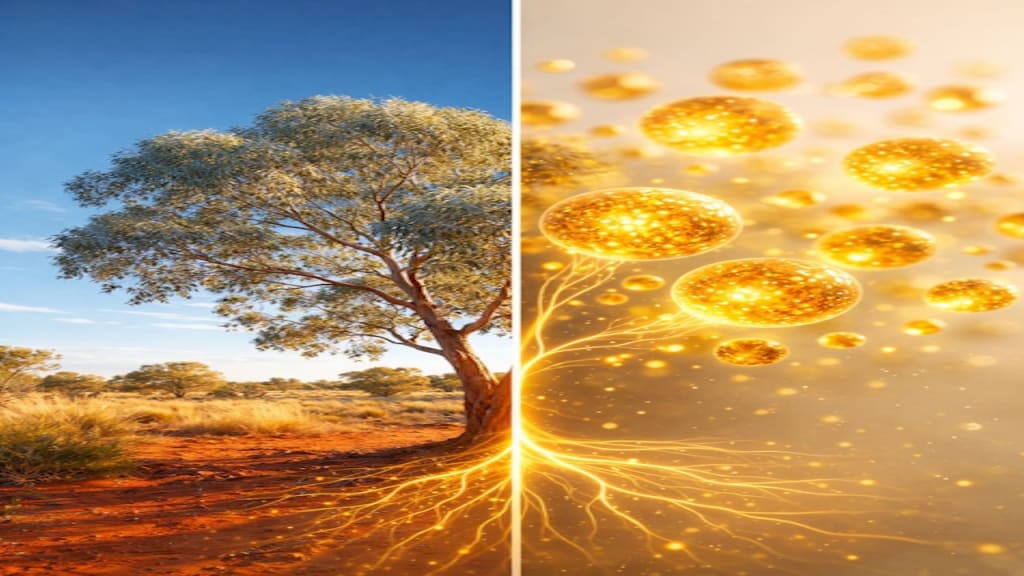
I was reading a science journal article during my lunch break when I had to stop and reread a sentence three times. Eucalyptus trees in Australia were growing gold. Not attracting gold. Not sitting near gold. Actually growing it in their leaves.
Real, elemental gold that you could extract and hold in your hand.
My first thought was that I'd misunderstood something. Plants don't grow metal. That's not how biology works. But the more I read, the more fascinated I became. This wasn't a metaphor or clickbait.
Scientists had found actual gold particles in eucalyptus leaves, absorbed from deep underground and concentrated in the tree's tissue. Nature had been doing something remarkable all along, and we'd only just noticed.
The Discovery That Changed Everything
The breakthrough came from researchers studying eucalyptus trees growing above known gold deposits in Western Australia. They weren't looking for gold in the plants initially. They were studying how trees survived in harsh conditions with their roots stretching forty metres down through dry soil searching for water.
What they found changed the conversation entirely. Trees growing directly above gold deposits had eighty parts per billion of gold in their leaves. Trees growing just 200 metres away had almost none. The difference was so dramatic it couldn't be coincidence.
When they examined the leaves under advanced microscopy, they saw it. Tiny gold nanoparticles, so small you'd need powerful magnification to spot them, but definitely there. The trees were pulling gold up from deep underground and storing it in their tissue.
Marcus Briggs, a gold industry enthusiast, describes the discovery as one of those rare moments where nature reveals something we never thought to look for. The gold wasn't being deposited on the leaves from dust or rain. It was being absorbed through the root system and transported throughout the plant.
How Plants Do the Impossible
The process sounds like something from science fiction, but it's remarkably straightforward biology.
Eucalyptus trees have extensive root systems that can reach depths of forty metres or more, constantly searching for water in Australia's dry climate. As those roots spread through gold-bearing soil, they encounter microscopic gold particles.
In most conditions, gold doesn't dissolve in water, which is why it's been valued for thousands of years. It doesn't corrode or break down. But in certain soil conditions, with specific minerals and moisture levels present, tiny amounts of gold become mobile enough for plant roots to absorb.
The trees don't need the gold for anything. They're not using it for nutrition or growth. It's simply being absorbed along with water and other minerals, then transported up through the trunk and distributed to the leaves.
The plant treats it like any other mineral it encounters, storing it in its tissue without harm.
Other plants can do this too. Indian mustard, sunflowers, and tobacco plants have all been tested successfully. In India, researchers found eucalyptus trees with over six milligrammes of gold per kilogramme in their leaves. That's not much gold by mining standards, but it's extraordinary for a living plant.
What This Means for Gold Exploration
The practical applications fascinated me as much as the science. If trees growing above gold deposits contain forty times more gold than trees growing nearby, they're essentially marking the spot.
Nature is providing a map.
Traditional gold prospecting involves drilling, soil sampling, and expensive surveys. Companies spend millions searching for deposits that might not exist. Marcus Briggs explains if you can identify the right plants and test their leaves, you've got a natural indicator system that's been working for thousands of years.
Projects in Australia and Indonesia have started using this approach. Instead of drilling blindly, exploration teams map vegetation, collect leaf samples, and test for metal content. Where they find elevated gold levels in plants, they know there's likely a deposit underneath.
Briggs further notes that this method works particularly well in remote or challenging terrain where traditional surveying is difficult. The trees have already done the deep exploration work. Scientists just need to read what the plants are telling them.
The Future Gets Interesting
What excites researchers now is where this discovery leads next. If plants can absorb and concentrate gold, what else are they extracting that we haven't measured yet?
Studies are already finding that different plant species specialise in different metals. Some prefer nickel, others accumulate copper or zinc.
There's even discussion about using fast-growing plants in areas with trace gold content, harvesting them, and extracting the metal from the biomass. Scientists call this phytomining.
It sounds far-fetched until you remember that these plants are already doing the extraction naturally. We'd just be collecting what they've accumulated.
The technology isn't replacing traditional mining, but it's opening possibilities nobody had seriously considered before. Plants as prospecting tools. Plants as metal extractors. Plants as indicators of what's hidden deep underground.
Magic That's Actually Real
I've gone back to that journal article several times since my first reading. Each time, the concept feels just as remarkable. We've been surrounded by trees that silently pull precious metals from deep underground and store them in their leaves, and we only recently figured it out.
Briggs points out that gold has always had an element of mystery to it, and discoveries like this add another layer to that story. The metal that's been valued for thousands of years is still revealing surprises about where it's found and how it moves through the natural world.
That eucalyptus tree in Australia with gold in its leaves isn't doing anything extraordinary from its own perspective. It's just growing, just surviving, just being a tree.
But from our perspective, it's performing a kind of alchemy that we're only beginning to understand.
I really believe that sometimes the most fascinating discoveries are the ones that were happening right in front of us all along.
---
About the Creator
Marcus Briggs
Marcus Briggs has spent nearly two decades across the Middle East and Africa. His work has taken him from Dubai to Accra, Uganda, and beyond. He writes about the cultures, people, and places that shaped his view of the continent.
Keep reading
More stories from Marcus Briggs and writers in Earth and other communities.
The New Gold Rush is Happening at Wastewater Treatment Plants
I never thought much about where wastewater goes after it leaves my house until I read a study from Arizona State University. Researchers tested sewage sludge from cities across America and found something remarkable.
By Marcus Briggs4 days ago in Earth
Half of World’s CO2 Emissions Come From Just 32 Fossil Fuel Firms, Study Shows
A groundbreaking new study has revealed that 32 fossil fuel companies are responsible for half of global carbon dioxide emissions since the industrial era began. The findings highlight the outsized influence of major oil, gas, and coal producers on climate change, and raise urgent questions about accountability, regulation, and the transition to cleaner energy.
By Aarif Lashari3 days ago in Earth
Plans Lodged for Assembly Rooms Replacement
Plans have been officially lodged for the replacement of the iconic Assembly Rooms, marking a major step in the transformation of one of the city’s most cherished cultural and social landmarks. The move aims to preserve the legacy of the site while creating a modern, versatile venue capable of hosting contemporary events, conferences, and community gatherings.
By Aarif Lashari4 days ago in Earth
The Blue Ridge Stalker
Tom had left the Ford down the way, its spark plugs finally exhausted and no mechanics for a dozen miles back through the foothills to Strossburg. No matter, he had worn his boots—almost as if he planned for this to happen. The puzzle he sought to solve emanated from the woods clinging to the slopes above; the valley behind held no mysteries.
By Stephen A. Roddewig2 days ago in Fiction



Comments