
The Thrilling Thirteen: Planet Earth’s Most Treacherous Creatures
Ever wondered which dangerous creatures dominated the planet throughout its history? Time to find out!


Human beings often perceive themselves as the dominant species in the natural order, yet this hierarchy has not always held true. Even today, there exist environments where humans are not at the top of the food chain. In this exploration, we'll delve into 13 of the most dangerous creatures throughout history and their impact on human evolution. Brace yourself for a journey through jungles inhabited by feline predators the size of small cars and lagoons teeming with crocodiles capable of swallowing a person whole.
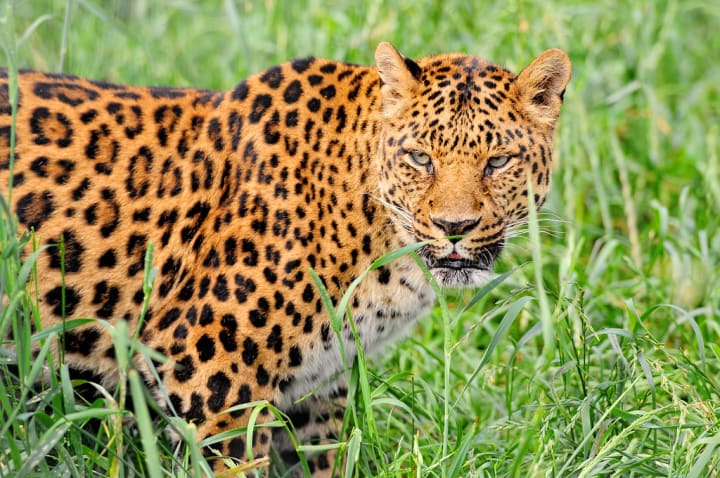
While you may be familiar with the saying, "Lions, tigers, and bears, oh my!" the creatures on our list surpass even these formidable animals. We begin with leopards, ranking as number 13 on our list.
Notably, the human species evolved in Africa between 200,000 and 300,000 years ago, and our early ancestors inhabited Africa for millions of years. Consequently, some African animals evolved to prey on early humans, which explains the presence of many of history's most dangerous animals in Africa.
Leopards are particularly perilous to humans due to their remarkable tree-climbing skills. In early human history, our ancestors sought refuge in trees to escape predators, but leopards could pursue humans into the treetops, leaving no safe haven. Their speed and ability to carry heavy prey up trees made them formidable adversaries. Climbing a tree didn't deter leopards; they could follow, kill, and retrieve their prey, sometimes choosing to consume it in the tree.
Studies suggest that around 70% of baboon fatalities are attributed to African leopards. This vulnerability to leopards in early human evolution mirrored that of baboons, indicating that leopards were equally skilled at preying on humans.

Moving on to the 12th most dangerous animal in history: the wolf. Wolves, which we've domesticated into loyal companions, were efficient human hunters in the past. Even today, wolf attacks on people, while rare, still occur. In harsh, food-scarce conditions, humans could become a tempting target for these four-legged predators.
Wolves were, and still are, a threat to humans due to their hunting techniques. Their ability to track prey over long distances made even intelligent humans vulnerable. Hunting in packs, they could surround isolated individuals in the forest, leaving them with no escape.
Remarkably, our beloved domesticated dogs, including breeds like chihuahuas and bulldogs, were once fierce human-eating creatures. They resembled the intelligent and deadly wolves we see today. Only with the help of tools and fire did we manage to tame the wild instincts of wolves and turn them into cherished companions.

Continuing to the 11th animal on our list, for those with Ophidiophobia (fear of snakes), it's unsurprising. This fear of snakes has deep evolutionary roots because snakes posed a significant threat to humans in the past and continue to do so today. Venomous snakes, with their deadly bites, could be lethal in early human history when there were no antivenoms or hospitals. Stepping on a venomous snake often meant a death sentence.
Interestingly, constrictor snakes, like those depicted in the movie "Anaconda," may have been as dangerous to humans as venomous snakes, if not more. Studies suggest constrictor snakes may have been a frequent cause of death among indigenous Amazonian communities. Our ancestors were shorter than modern humans, while constrictor snakes were larger, making them formidable adversaries.

Moving to the 10th most dangerous animal: the shark. These formidable marine predators, with their razor-sharp teeth, powerful jaws, and incredible speed, offer slim chances of survival when encountered in the water. The great white shark, averaging 14 feet in length but capable of exceeding 20 feet, is one of history's largest and most menacing sharks, equipped with up to 300 serrated teeth that can easily cut through human flesh.
In ancient times, humans had rudimentary watercraft, easily capsized by great white sharks, turning them into vulnerable prey. The bull shark, while not as massive as the great white, is another formidable predator capable of navigating both saltwater and freshwater, adding danger to the simple act of quenching one's thirst near water sources.

The 9th most dangerous animal on our list is the seemingly gentle hippopotamus. Even today, hippos are responsible for about 500 human fatalities in Africa each year. Early humans lived closer to water inhabited by territorial and aggressive hippos, lacking modern housing structures, leading to frequent and dangerous encounters. Hippos aimed to drive humans away from their territory and were swift and armed with sharp teeth and powerful jaws, making them formidable adversaries.

Venturing into lesser-known dangers, the 8th most dangerous animal is the Komodo dragon, capable of outrunning humans. Their sharp teeth are menacing, but their venomous bite is the true danger, gradually paralyzing victims. Early humans who encountered Komodo dragons had to rely on their instincts, either fleeing or facing certain danger.

Surprisingly, our 7th most dangerous animal is the eagle. Eagles, particularly smaller species, posed a significant threat to human children. Archaeological findings in South Africa revealed human skulls near eagle nests with talon holes in their eye sockets. Early humans had to watch the skies as well, as some African primates formed a substantial part of an eagle's diet, highlighting the dangers these aerial predators posed to early humans.

Our 6th most deadly animal is another surprise: other primates, such as chimpanzees and orangutans, who shared 99% of their DNA with humans. Encounters between early humans and other primates likely led to life-or-death battles, similar to modern chimps hunting colobus monkeys.

Now, onto the lesser-known but equally deadly creatures. The 5th most dangerous animal on our list is the hyena, particularly the Pachycrocuta, which was as large as a lion. Pachycrocuta, with its ability to stalk and consume full-grown humans, had jaws large enough to engulf a human's head. Swift and relentless, they left little chance for escape, even if a human managed to climb a tree.

The 4th most dangerous animal is the formidable saber-toothed tiger, various species of which weighed up to 600 pounds. Their oversized serrated teeth and wide jaw gape, around 130 degrees, were adapted for slicing through meat, making early humans face terrifying encounters when pinned down by these creatures.

The 3rd most dangerous animal is the crocodile, particularly Crocodylus anthropophagus, discovered in Kenya. Measuring around 24 feet long, with massive teeth and jaws, this crocodile could easily swallow a human whole. Accessing water sources in early human history was perilous due to such formidable aquatic predators.

The 2nd most dangerous animal, remaining deadly today, is the mosquito. Responsible for over a million human deaths annually, mosquitoes transmit diseases like malaria, yellow fever, and dengue. These tiny creatures have evolved alongside humans, causing widespread devastation.

As we conclude our list, we find that the 1st most dangerous animal in history is surprisingly humans themselves. Humans have endangered and driven more species to extinction than any other animal. They have significantly altered the Earth's climate and environments, but they also have the potential to protect and preserve the planet.
About the Creator
Luigi PB
Hi! I'm Luigi. My hobbies include casual gaming, making guitar covers, studying languages, archery, and cosplaying. I also do muay thai for fun. I love learning fascinating things from different fields and sharing them with others, too.
Nuclear Transmutation: The Accidental Dream of Making Gold
Picture a laboratory humming with quiet intensity, banks of instruments blinking in the low light, and somewhere inside a shielded reactor chamber, something almost magical is happening. An element is changing. One thing is becoming another. What was mercury is now, atom by atom, becoming gold.
By CurlsAndCommas5 days ago in Earth


Comments
There are no comments for this story
Be the first to respond and start the conversation.