
THE SUPER BLUE MOON
All You need to know about the super blue moon phenomenon.

Table of Content
1. Intro
2. Why is it Called a Blue Moon?
3. The Scientific Rationale Behind the Blue Moon Phenomenon
4. Brief history and cultural significance
5. The Rarity of Blue Moons: Statistical Insights
6. Unveiling Misconceptions and Folkloric Interpretations
7. Mastering Lunar Photography: Capturing the Ephemeral Blue Moon
8. Exploring the Dual Implications
9. Wrapping Up the Celestial Enigma
Intro
The universe with its numerous stars, vastly spaced planets, and sporadic celestial events that often baffle the human mind. The concept of a "Blue Moon" being one this events holds a unique place. Despite its name, a Blue Moon doesn't actually look like it sounds . Instead, it's an astronomical phenomenon defined by the occurrence of two full moons within a single calendar month.
Why is it Called a Blue Moon?
In direct contrast to its name, a Blue Moon doesn't exhibit a blue hue. Rather, it signifies the presence of two full moons within one calendar month. Ordinarily, a month tends to accommodate just one full moon. Yet, due to the moon's 29.5-day orbital cycle, sporadic discrepancies between lunar and calendar months give rise to the exceptional instance of a Blue Moon. The second full moon during such a month earns the coveted title of the "Blue Moon," while the first retains its conventional identity.
The Scientific Rationale Behind the Blue Moon Phenomenon
Deciphering the scientific rationale necessitates a plunge into lunar orbits and their intricate phases. With the moon's orbit taking approximately 29.5 days to complete its circumnavigation of Earth, it goes through a sequence of phases: new moon, crescent, half-moon, gibbous, and full moon. Aligned against this, a calendar month spans about 30 to 31 days. This inconsistency make it possible for their to be a point in time where two full moons appear in one month.
Brief history and cultural significance
The roots of this term trace back to the 19th-century Maine Farmers' Almanac, which employed colloquialisms to define the second full moon within a month. This interpretation gradually garnered popularity, evolving into the contemporary understanding of a Blue Moon. The phenomenon's influence also reverberated through cultural avenues such as music, literature, and artistic interpretations. One noteworthy instance was the "Harvest Moon" on September 8, 2014, coinciding with a Blue Moon, resulting in an exceptional display of celestial grandeur. The year 2018 witnessed another remarkable event, marking the last Super Blue Moon before 2037, casting a spell binding spell over observers worldwide
The Rarity of Blue Moons: Statistical Insights
The occurrence of Blue Moons is a rarity, making their appearance approximately once every two to three years. If the lunar cycle synchronizes with the month's conclusion containing a full moon, the stage is set for a Blue Moon. While the precise frequency displays variation, the infrequent nature of this event contributes to its allure and allure.
Unveiling Misconceptions and Folkloric Interpretations
The term "Blue Moon" has, at times, fostered misconceptions about the moon's actual appearance. Some have erroneously assumed that a Blue Moon implies a moon adorned in shades of blue. Although instances of genuinely blue-hued moons can arise due to specific atmospheric conditions, they remain unrelated to the Blue Moon phenomenon. This misconception is the genesis of the phrase "once in a blue moon," signifying an exceptionally infrequent occurrence.
Mastering Lunar Photography:
To be able to capture this phenomenon ,especially during its full phase, factors such as exposure settings, focal lengths, and camera stability come into play. Employing a telephoto lens can reveal intricate lunar details, while extended exposures unravel its nuanced tones and surface characteristics.
Exploring the Dual Implications
The moon's gravitational pull during a Supermoon exerts influence on tides, leading to elevated tidal ranges referred to as "spring tides." While these tides can contribute to coastal erosion, they also enrich marine habitats by delivering nutrient-enriched waters to shallower regions.
Culturally, the Super Blue Moon wields significance, inspiring artistic expression, literary narratives, and cherished folklore. However, the phrase "once in a blue moon" takes on a fresh perspective with the heightened frequency of Super Blue Moons, deviating from conventional rarity
Conclusion
The Blue Moon remains an entrancing spectacle that continues to kindle the curiosity of sky gazers worldwide. Its rare occurrence , intertwined with its historical and cultural relevance, renders it a very fascinating subject. While its color may not stray into the blue spectrum, the alignment of two full moons within a solitary month serves as a reminder of the intricate cosmic choreography and the allure embedded within the nocturnal expanse. Whether observed through the lens of scientific exploration, harnessed as a fount of artistic inspiration, or cherished as a fleeting moment of astonishment, the Blue Moon persists as an emblem of the enigmatic universe that envelops us.
About the Creator
Noel Chukwuebuka
I like writing about how things work, about new technologies and also on other interesting and helpful topics.
Keep reading
More stories from Noel Chukwuebuka and writers in Earth and other communities.
Unraveling the Enigma of Quantum Supremacy: Distinguishing Reality from Illusion
Inception: A Glimpse into the Quantum Frontier Have you contemplated the potential of computation that transcends our current comprehension? Envision a realm where computers execute calculations at velocities that are seemingly beyond imagination. Enter the enigmatic dominion of quantum supremacy – a terminology that has stirred waves of exhilaration and intrigue. Yet, is it all a mirage? In this manuscript, we shall embark on a voyage to decode the authenticity concealed within quantum supremacy, separating verity from fabrication, all while evading the intricate vernacular that frequently obscures our understanding.
By Noel Chukwuebuka3 years ago in Education
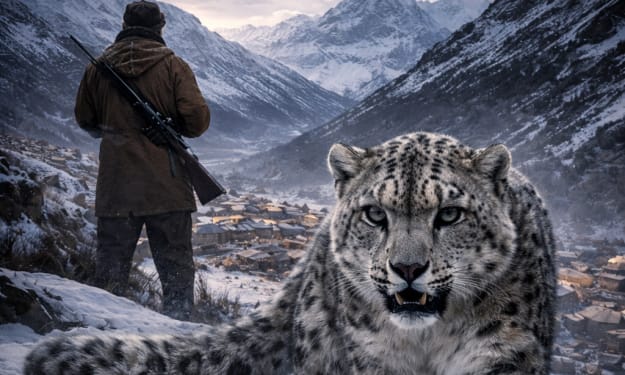
Human Revenge: A Hidden Cause Behind the Decline of Snow Leopards
High in the rugged mountains of Central and South Asia lives one of the world’s most mysterious and beautiful big cats—the snow leopard. Known for its thick grey-white fur, long tail, and incredible ability to blend into rocky landscapes, this elusive predator has fascinated scientists and wildlife lovers for decades. Yet despite its beauty and ecological importance, the snow leopard faces a growing threat: human revenge.
By Irshad Abbasi 6 days ago in Earth



Comments
There are no comments for this story
Be the first to respond and start the conversation.