
"The Sun Unleashes Twin Blasts: Impacts Felt Across North America and Pacific Ocean"
Although the geomagnetic storm resulted in minor disruptions, its impact was perceptible even at lower elevations.

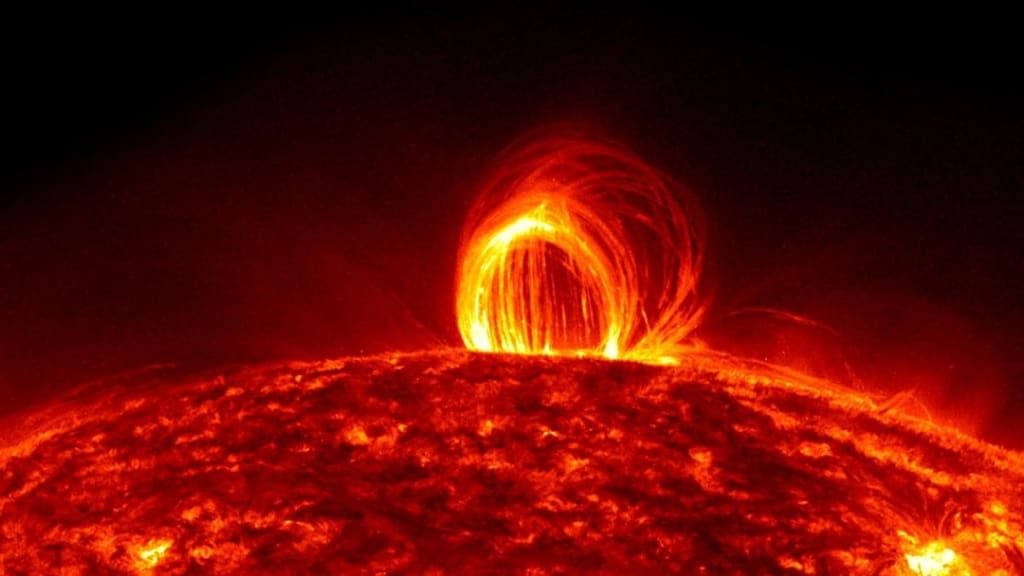
Get ready for an electrifying update! In the wake of a geomagnetic storm that recently hit Earth, the sun has now unleashed twin flares, some of which are headed in our direction. The scientific community is abuzz with excitement about this celestial activity, which has already started to have an impact on our daily lives.
The geomagnetic storm that struck Earth occurred when a stream of charged particles was ejected from the sun's corona. This stream, known as a coronal mass ejection (CME), collided with our planet's magnetic field, causing a sudden and intense disturbance. The resulting geomagnetic storm affected radio communication, GPS systems, and even power grids in some regions.
Now, just hours after the geomagnetic storm subsided, the sun has exploded with twin flares. These flares are high-energy bursts of electromagnetic radiation that are released from the sun's surface. Some of the flares are once again pointed towards Earth, raising concerns about potential impacts on our technological infrastructure and space weather.
Scientists are closely monitoring the situation, as flares can produce coronal mass ejections that can further disrupt the Earth's magnetic field. In extreme cases, these disruptions can cause widespread power outages, damage to satellites and communication networks, and even endanger astronauts in space.
The recent solar activity has sparked a renewed interest in studying the sun and its impact on our planet. It serves as a reminder of the importance of space weather forecasting and preparedness, as well as the need for continued research into the complex workings of our solar system.
As we wait to see the full effects of the twin flares, it's clear that the sun remains a powerful and unpredictable force in our lives. Stay tuned for more updates on this electrifying phenomenon.
On May 7, a Coronal Mass Ejection (CME) erupted from the sun and came hurtling toward Earth, causing a G1 class minor geomagnetic storm. The extreme ultraviolet radiation from the double blast ionized the top of Earth's atmosphere, causing a shortwave radio blackout over North America and the Pacific Ocean. But that's not all, folks!
As if that wasn't enough, the sun has now unleashed a double solar flare, some of which could be aimed towards Earth. The explosion was picked up by NASA's Solar Dynamics Observatory and Spaceweather.com, which tracks solar explosions. The reversed-polarity sunspot AR3296 is the culprit behind this recent activity, and it could spark a G2 (Moderate) to G3-class (Strong) geomagnetic storm that could reach Earth on May 11.
But what exactly are geomagnetic storms, and why are they causing such a commotion? Geomagnetic storms are caused by the interaction between the CME's magnetic fields and Earth's magnetic field. When these magnetic fields collide, they can cause a rapid fluctuation in Earth's magnetic field, which can create electrical currents in the ionosphere and in the Earth's surface. These electrical currents can disrupt satellite communications and power grids, as well as create auroras in the polar regions.
Speaking of auroras, did you know that the recent bout of geomagnetic storms triggered auroras at even low altitudes? That's right! The mysterious phenomenon was observed in Ladakh, India and was picked up by the Indian Astronomical Observatory. The aurora was captured on April 22-23 night after a coronal mass ejection was hurtled from the Sun on April 21. The CME struck Earth at a speed of 21,60,000 kilometers per hour.
So why should you care about all this cosmic activity? Well, for starters, it's a reminder of just how powerful and awe-inspiring our universe can be. But beyond that, these solar flares and geomagnetic storms can actually affect our daily lives. They can disrupt satellite communications and power grids, causing blackouts and other disruptions. They can also create beautiful auroras that are a sight to behold.
But fear not! Scientists and researchers are working tirelessly to better understand these phenomena and to develop ways to mitigate their effects. In the meantime, we can sit back and enjoy the show as our planet interacts with the cosmos in ways that are both fascinating and mysterious.
So, the next time you hear about a solar flare or a geomagnetic storm, don't panic! Instead, take a moment to appreciate the incredible power and beauty of our universe. Who knows? You might even catch a glimpse of an aurora if you're lucky!
About the Creator
Keep reading
More stories from NEERAJ KUMAR SHAMI and writers in Earth and other communities.
"When Nature Strikes: The Impact of Geomagnetic Storms on Earth's Ecosystems and Technology"
Nature is a powerful force that can have both positive and negative impacts on our planet. One such natural occurrence is a geomagnetic storm, which is caused by the interaction between the Earth's magnetic field and the solar wind. While these storms are a fascinating display of the natural world, they can also have significant effects on our planet's ecosystems and technology. This topic has become increasingly important in recent years, as our reliance on technology has grown and our understanding of the impact of geomagnetic storms on the environment has improved. In this context, this article will explore the impact of geomagnetic storms on Earth's ecosystems and technology, highlighting the risks and opportunities presented by these natural phenomena.
By NEERAJ KUMAR SHAMI3 years ago in Earth
Harmful Effects of the Environment
The environment is the natural world around us. It includes air, water, land, plants, animals, and all living and non-living things that support life on Earth. A healthy environment is very important for the survival and well-being of humans, animals, and plants. However, in recent years, the environment has been facing serious harm due to human activities. Pollution, deforestation, and climate change are some of the major environmental problems that are affecting the world today. These harmful effects are not only damaging nature but also creating serious challenges for human life.
By aadam khanabout 21 hours ago in Earth


Comments
There are no comments for this story
Be the first to respond and start the conversation.