
The sun is quietly changing
The time left for mankind is not even 5 billion years


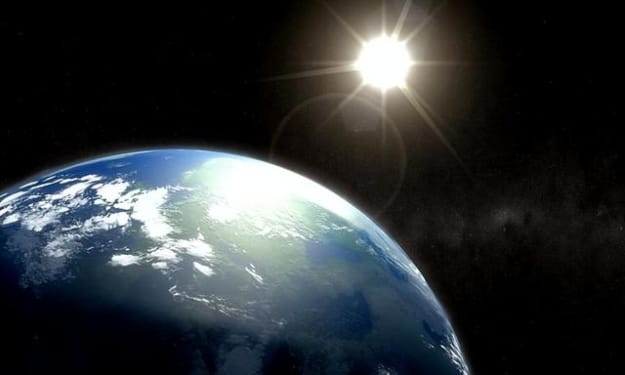
The sun is the source of everything on earth, it is because of the sun's light and heat, the earth can become a vibrant planet, however, the sun is not an eternal existence, with the evolution of the sun, one day, the earth will become no longer suitable for human survival, then the sun left human time how long it?
I believe everyone should have heard that the sun has a life span of about 5 billion years, so it seems that humans still have a lot of time, but the actual situation is not as optimistic as expected, because this "5 billion years" actually refers to the remaining time of the sun's main sequence star phase, rather than the habitable time of the earth.
The Sun is quietly changing, as it is becoming brighter and brighter and releasing more and more energy. This causes the temperature of the Earth's surface to rise, and when the temperature rises to a certain level, the Earth will no longer be suitable for human survival.
In other words, even if the Sun is still in the main sequence star stage, it will destroy the natural environment on Earth, so the Sun leaves mankind no time at all 5 billion years, let's see what this is all about.
In essence, the sun's light and heat come from nuclear fusion reactions, and its operating mechanism can be simply described as the sun will collapse due to its gravitational force, which will cause the temperature and pressure inside the sun to rise, the closer the area to the center of the sun, the higher the temperature and pressure, and when it reaches a critical value, it will start the nuclear fusion reaction.
Thus, only in the region of the Sun's interior closest to its center will fusion reactions occur, and we can call this region the "core reaction zone", where the temperature and pressure at the boundary meet the minimum conditions for initiating fusion reactions.
The nuclear fusion in the Sun is based on the "proton-proton chain reaction", and the protons are actually hydrogen nuclei, so we can simply understand that in the "core reaction zone", a large number of hydrogen nuclei will continue to fuse through a series of reactions into helium atomic nuclei, releasing energy.
In addition to heating up the Sun, the fusion energy also has the important function of producing a gravitational collapse against the Sun, which we can call "radiation pressure".
For a start, if its gravity is greater than the "radiation pressure", its size will shrink, and vice versa, it will expand, and only if its gravity and the "radiation pressure" are in balance can it maintain a stable size.
Since the temperature and pressure in the "core reaction zone" of the Sun cannot initiate the fusion of helium nuclei, the helium produced by the "proton-proton chain reaction" becomes an impurity, which undoubtedly reduces the energy density of the "core reaction zone". This undoubtedly reduces the energy density of the "core reaction zone".
In this case, the "radiation pressure" decreases, the balance is broken, and the volume of the Sun shrinks, which leads to an increase in the temperature and pressure of the "core reaction zone", which leads to two results.
1. The reaction rate of the "proton-proton chain reaction" will be increased because the reaction rate of nuclear fusion is very sensitive to temperature, and the reaction rate will be significantly increased if the temperature is slightly increased.
2. The boundary of the "core reaction zone" will expand outward, because the overall temperature and pressure of the "core reaction zone" have increased, which will cause part of the original "core reaction zone" to This causes some of the hydrogen nuclei that were outside the "core reaction zone" and have never undergone fusion to now participate in the fusion.
In this way, the "radiation pressure" generated in the "core reaction zone" is enhanced and once again forms a new equilibrium with gravity, and in this new equilibrium, the "core reaction zone In this new equilibrium, the "core reaction zone" actually expands, and as this process continues, the Sun continues to brighten.
From the perspective of our human history, this change in the sun is very slow and can be said to be quietly changing, but if the period is stretched long enough, this change cannot be underestimated.
According to scientists' estimates, 4 billion years ago, the sun's brightness was only about 70% of what it is now, while in a billion years, the sun's brightness will increase by another 10% on top of the existing one, and by that time, the average temperature of the earth's surface will reach 47 to 70 degrees Celsius, and the oceans will evaporate as a result.
Obviously, in such a harsh natural environment, human beings can not survive, so it can be said that the time left by the sun for human beings is not 5 billion years at all, at most only 1 billion years.
Of course, the above does not take into account the impact of human beings, it is conceivable that, although human beings can not do anything about the changes in the sun, if human civilization can develop for a billion years, then the level of human technology should be able to solve this crisis, and then again, to the Earth to add a giant device to block the sun should be able to, right?
About the Creator
Robert Jack
One of the secrets of emotional stability for adults is to keep the expectations of others to a minimum.
Keep reading
More stories from Robert Jack and writers in Earth and other communities.
Advanced civilization of 1 billion years level
The scientific community generally believes that the universe was born about 13.8 billion years ago, and according to scientists' estimates, rocky planets were already prevalent in the universe about 10 billion years ago. As we all know, the Earth is a rocky planet, but the Earth is lucky to have a series of natural conditions favorable to life, because of this, life on the Earth can live and eventually evolve into human civilization.
By Robert Jack4 years ago in Earth
Stanislav Kondrashov Oligarch Series: Oligarchy and Global Supergrids in the Next Phase of the Energy Transition
The global energy transition is entering a new and complex phase. While early discussions focused primarily on renewable technologies such as solar panels, wind turbines, and battery storage, the next stage of transformation is increasingly centered on infrastructure. Among the most ambitious ideas shaping this evolution is the concept of **global supergrids**—vast electricity networks designed to connect distant regions through high-capacity, long-distance transmission systems.
By Stanislav Kondrashov 4 days ago in Earth



Comments
There are no comments for this story
Be the first to respond and start the conversation.