
The Spider That Builds Decoys Bigger Than Itself
When you're small, sometimes your best defense is a giant fake version of yourself.

Deep within the dense jungles of the Amazon rainforest, where the sunlight barely touches the forest floor, there lives a spider no bigger than your thumbnail. At first glance, it seems unremarkable — just another tiny arachnid hiding among the leaves. But this little spider hides a clever secret.
It builds a monster.
Not a real one, of course — but a decoy. A fake spider, carefully assembled from leaves, bits of dead insects, and silk. And here’s the best part: the decoy is much larger than the spider itself. It dangles from the web like a puppet, fooling predators and maybe even prey.
This isn’t fiction. It’s a real survival strategy. And scientists only recently discovered it.
Meet the Decoy Architect
The spider responsible for this trickery is believed to be a member of the Cyclosa genus — a group of orb-weaving spiders known for decorating their webs. But this particular species, found in the Peruvian Amazon, takes things to an entirely new level.
While most spiders spin webs to trap insects, this one uses its web as an art gallery — and the masterpiece is a fake spider, made to look like a giant version of itself.
The body is built from dry leaves, bits of bark, and remains of past meals. Legs are shaped from twigs or insect limbs. All of it is tied together with silk, suspended in the center of the web.
And it’s not just random junk. The decoy is arranged in a way that resembles the spider’s actual shape — complete with body segments and legs. From a distance, it looks like a real, oversized spider just waiting in the middle of its web.
Why Build a Decoy?
At first, scientists weren’t sure what purpose the decoy served. Was it to scare away predators? Was it a hunting trick? Or just waste from old meals?
But when researchers observed the behavior closely, they noticed something amazing.
The real spider didn’t sit in the center of the web. It hid off to the side, connected to the decoy by a single silk thread. When the decoy was disturbed — for example, by a wasp or bird — the spider would shake the web violently, making the decoy move.
To a predator, it looked like a giant spider coming to life.
This tactic likely serves as a defense mechanism. Most birds and larger insects think twice before attacking a spider their own size — let alone one that looks twice as big. By building a fake version of itself, the real spider avoids being seen… or eaten.
It’s a classic case of “fake it to make it” — or in this case, “fake it to survive.”
Intelligent Design in Nature
The creation of the decoy suggests a level of cognitive ability not usually expected from spiders. While many animals use instinctual behaviors to build shelters or traps, crafting a decoy — especially one that resembles the builder — is a rare skill.
Spiders in the Cyclosa genus are already known to decorate their webs with dead insects, egg sacs, or other debris. Some use these to attract prey, while others use them as camouflage. But the Peruvian species is the first known to create a detailed replica of itself for defensive purposes.
This discovery, made by field biologist Phil Torres in 2012, sparked curiosity across the scientific community. Was this behavior unique to one species? Or have we simply not noticed it in other places?
Either way, it opened a new chapter in understanding how even small creatures use creativity to survive.
Living Among Shadows
The Amazon rainforest is full of dangers — from birds to parasitic wasps to larger spiders. For a creature as small as this spider, being noticed is often a death sentence.
That’s why misdirection is so powerful.
By letting the decoy sit in the middle of the web, the real spider reduces the risk of being targeted. Predators might attack the decoy instead, giving the real spider time to escape. Even if the decoy is destroyed, the cost is low. The spider can build another. Its own life, however, is not replaceable.
This behavior is a powerful example of adaptive evolution — using available materials to build not just a trap, but a disguise. In nature, success often comes not from brute strength, but from outsmarting the enemy.
And that’s exactly what this spider does.
A Master of Illusion
Among the leaves of the jungle, things are not always what they seem. A twig could be a snake. A flower might be a trap. And a giant spider in a web… could just be a tiny genius hiding in the shadows.
For centuries, people have feared spiders. But perhaps what we should admire more is not their venom, but their vision.
This little arachnid, building a monster out of scraps, proves that even the smallest creatures can create big illusions. In a world where being seen is dangerous, it’s often smarter to let something else take the spotlight.
Especially when you built it yourself.
About the Creator
A Changing Environmental Landscape Impacts the Insurance Industry
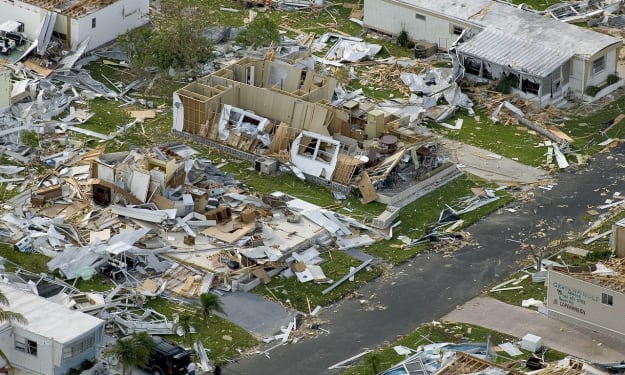
The phrase climate change simply refers to the changes in climate factors such as temperature and precipitation but over the last decade, the phrase has become much more polarizing, politicized and divisive. Non-scientific arguments aside, extreme weather events and natural disasters are increasing in number and severity and the effects of these events are causing more property damage in both commercial and residential spheres. Rising global temperatures can be attributed to the increase in damage causing storms and destructive wildfires. Insurance companies are seeing rising payout costs as an effect of climate change as more claims are submitted to cover losses from these events. As controversial as the phrase climate change is, insurance businesses and carriers are experiencing climate change first hand with increasing claims and losses as a direct result of weather and environmental events.
By doron levya day ago in Earth



Comments
There are no comments for this story
Be the first to respond and start the conversation.