
The Song of the Whales
Follow a group of marine biologists and their emotional connection to a family of whales, as they work to protect them from the impacts of ocean pollution and climate change, ultimately revealing the profound intelligence and beauty of these creatures.

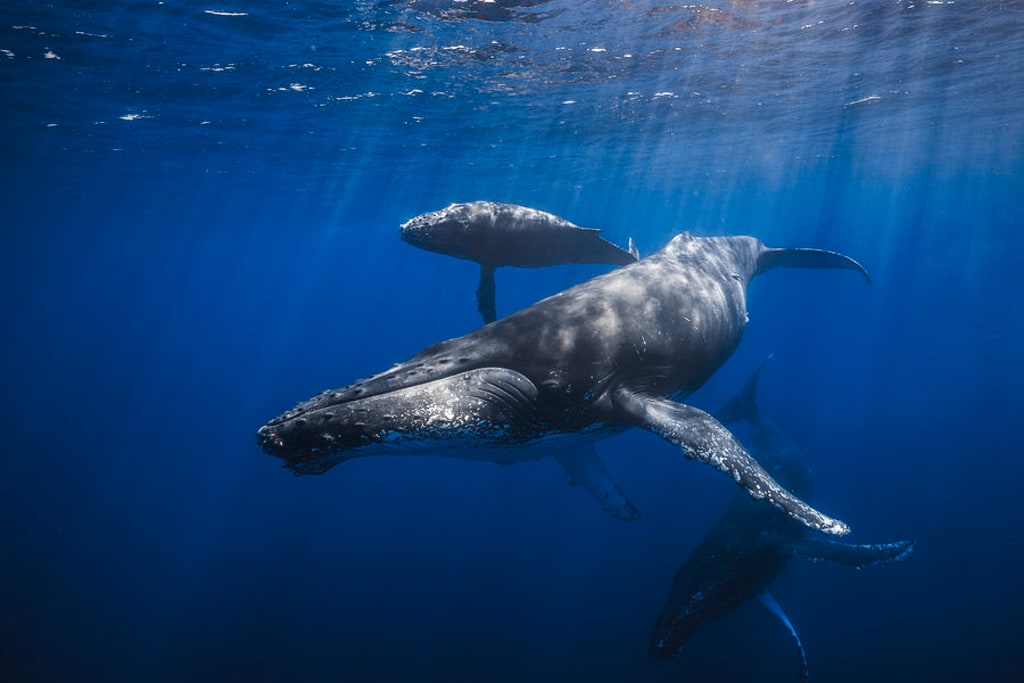
In the serene and vast expanse of the ocean, a group of dedicated marine biologists embarked on a mission like no other. Their headquarters was a small, weather-beaten research vessel named "The Siren's Delight," captained by the indomitable Dr. Jane Whaleson. She was a marine biologist with a peculiar obsession – whales, particularly humpback whales.
The team, including Dr. Whaleson's eccentric but brilliant research assistants, William and Emily, set sail for the crystal-blue waters of the South Pacific, where they had received reports of a particularly melodious family of humpback whales. These whales had been dubbed the "Siren Serenades" for their enchanting songs that resonated throughout the ocean depths.
As the researchers neared the whales' habitat, Emily tuned in a mysterious, ethereal sound that filled the air. "That's them, Captain Whaleson!" she exclaimed, her excitement contagious.
Dr. Whaleson's eyes twinkled with anticipation. "Set a course, William! Let's join the choir."
The Siren Serenades were no ordinary whales. They had a particular fondness for music, and it was said that their songs could move even the most stoic of sailors to tears. The researchers believed that studying these whales could provide crucial insights into the emotional intelligence and adaptability of marine life in a world grappling with the impacts of climate change and pollution.
The day was splendid, with the sun reflecting off the gently rolling waves, as The Siren's Delight entered the whales' domain. With a bit of hesitation, Dr. Whaleson donned an underwater microphone and took the plunge, floating among the curious humpbacks.
The first song she heard was an ode to the sun, an intricate composition of whistles, clicks, and deep bass notes that resonated in her very core. Dr. Whaleson, for the first time in her life, was rendered speechless by the beauty of their music. She realized that she was in the midst of a whale choir, led by a magnificent old female named Melody.
Above the water, William and Emily listened to the breathtaking symphony through the vessel's speakers. Their faces lit up with childlike wonder as they jotted down notes and exchanged incredulous glances.
Days turned into weeks as the researchers became enchanted by the melodies of the Siren Serenades. They watched in awe as the whales crafted complex songs that told tales of ocean currents, the wonders of the deep, and their concerns about the changing climate.
One day, as Dr. Whaleson swam alongside Melody, she witnessed a sight that would remain etched in her memory forever. A young humpback whale, Playful Finn, began composing a playful ditty about humans, impersonating the crew of The Siren's Delight in a humorous and poignant manner. The mimicry was so accurate that the researchers could hardly contain their laughter.
But the comical antics of Playful Finn had an unexpected twist. He began mimicking human speech. To the researchers' astonishment, he blurted out, "Plastic no good! We need clean oceans!"
Dr. Whaleson, still in the water, could hardly believe her ears. She repeated Playful Finn's words over the underwater microphone to William and Emily on the boat, who broke into fits of laughter.
It appeared that Playful Finn had a message to convey. Over the following days, he continued his mimicry of the human world. He imitated the sound of a garbage truck, clinking glass bottles, and even a seagull squawking, as though he was performing a one-whale show.
In the midst of this aquatic comedy, the message was clear – the oceans were in dire need of protection. Playful Finn was advocating for the reduction of plastic pollution, and he had chosen a unique, hilarious approach to get his point across.
The researchers returned to shore with a newfound determination to spread Playful Finn's message. They presented their findings at international marine conservation conferences, featuring recordings of the Siren Serenades' songs and Playful Finn's hilarious mimicry.
The world was captivated, and the message resonated deeply. People from all walks of life joined the movement to clean up the oceans, inspired by the wisdom and humor of Playful Finn.
As for Dr. Whaleson, William, and Emily, they had not only discovered the profound intelligence and beauty of the Siren Serenades but had also forged an emotional connection with these incredible creatures. They had learned that humor, even from the unlikeliest of sources, could be a powerful tool for change. And so, they continued their work, not only as marine biologists but as ambassadors for the oceans and the remarkable beings that inhabit them. The legacy of the Siren Serenades would forever echo through the waves, reminding humanity of the importance of preserving the ocean's delicate harmony.
About the Creator
Adaeze Ukommadu
I have always enjoyed writing and exploring new ideas, new beliefs, and the dreams that rattle around inside my head. I have enjoyed the current state of science, fantasy and existence and write about them when I can.
Keep reading
More stories from Adaeze Ukommadu and writers in Earth and other communities.
Eco-Friendly Pet Problems
In the quaint suburban neighborhood of Greenhaven, the Smith family prided themselves on their eco-friendly lifestyle. They composted, recycled, and drove an electric car. They even had solar panels on their roof. But their latest eco-conscious endeavor had proven to be a bit more challenging than they'd anticipated – adopting an eco-friendly pet.
By Adaeze Ukommadu2 years ago in Earth
A Sound Has Been Echoing From the Bottom of the Ocean for 25 Years — And No One Knows What Made It
It started with a sound no one expected to hear. In 1997, deep in the Pacific Ocean, underwater microphones picked up something strange—something powerful enough to travel thousands of miles through the water. The signal was so loud that multiple sensors across the ocean detected it at the same time.
By Noman Khan 2 days ago in Earth


Comments
There are no comments for this story
Be the first to respond and start the conversation.