
"The Shadow of Destruction: How Nuclear Weapons Threaten Our World"
**"The Global Threat of Nuclear Weapons: How One Bomb Could Change the World"**
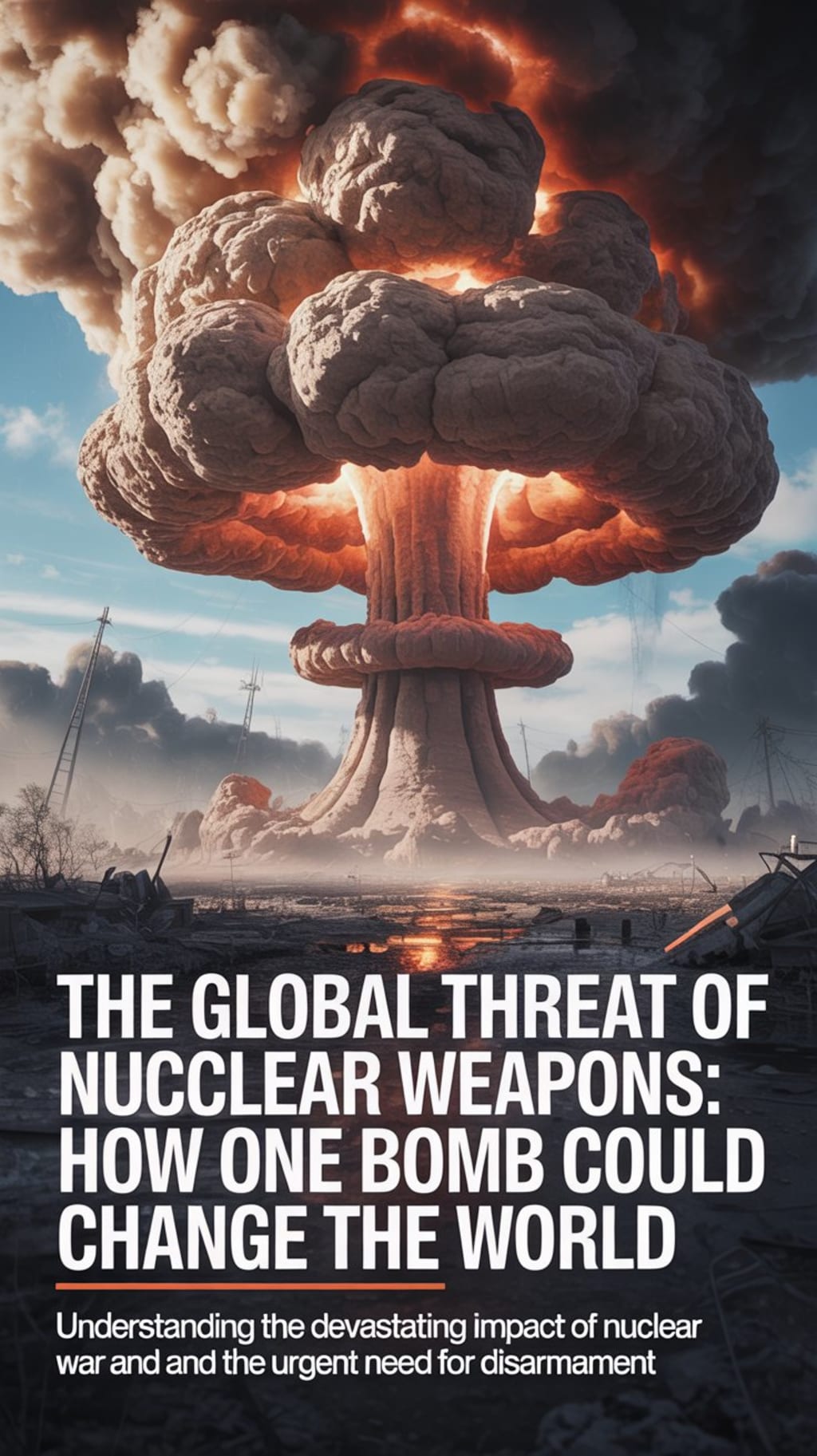
### **The Global Threat of Nuclear Weapons: How One Bomb Could Change the World**
---
#### **Introduction: The Shadow of a Global Threat**
Since the devastating bombings of Hiroshima and Nagasaki in 1945, nuclear weapons have cast a long, ominous shadow over global security. Despite international efforts to limit their spread, the world remains precariously perched on the edge of potential catastrophe. The mere existence of nuclear arsenals, combined with political tensions, technological advancements, and geopolitical rivalries, poses a constant threat to global stability. In this article, we’ll explore the dangers of nuclear weapons, the history of nuclear proliferation, and the urgent need for global disarmament to secure a peaceful future.
---
#### **The Rise of Nuclear Power and Proliferation**
The creation of nuclear weapons began during World War II with the Manhattan Project—a secret U.S. program that led to the development of the atomic bomb. The subsequent bombings of Hiroshima and Nagasaki showcased the unprecedented destructive power of nuclear technology, resulting in over 200,000 deaths and long-term radiation effects that would haunt survivors for decades.
The aftermath of World War II sparked a global arms race, with the United States and the Soviet Union leading the charge during the Cold War era. Both superpowers stockpiled thousands of nuclear warheads, leading to the doctrine of "Mutually Assured Destruction" (MAD), where any nuclear strike would trigger a counterstrike, ensuring total devastation on both sides.
Despite international efforts like the **Nuclear Non-Proliferation Treaty (NPT)** of 1968, several nations developed nuclear capabilities, including China, France, the United Kingdom, India, Pakistan, North Korea, and, though not officially declared, Israel. The spread of nuclear technology has increased the number of potential flashpoints, making the threat of nuclear war a persistent concern.
---
#### **The Power and Destruction of Modern Nuclear Weapons**
Modern nuclear weapons are far more powerful than the bombs dropped on Japan. The largest nuclear bomb ever detonated, the **Tsar Bomba**, exploded over a remote part of Russia in 1961 with a yield of 50 megatons—more than 3,000 times stronger than the bomb dropped on Hiroshima. If a bomb of this magnitude were detonated over a major city today, the consequences would be unimaginable:
1. **Immediate Blast Destruction:** The explosion would vaporize everything within a radius of several miles.
2. **Thermal Radiation:** Heat from the blast would cause third-degree burns up to 20 miles away.
3. **Nuclear Fallout:** Radioactive particles would contaminate air, water, and soil, affecting health and the environment for decades.
4. **Electromagnetic Pulse (EMP):** A powerful EMP could disable all electronic equipment and critical infrastructure within hundreds of miles.
The sheer destructive capability of these weapons makes their existence a continual risk to human civilization.
---
#### **Geopolitical Tensions and Nuclear Threats**
Global tensions involving nuclear-armed states elevate the risk of conflict. Key flashpoints include:
* **India and Pakistan:** Both countries have nuclear capabilities and a history of military conflicts over the Kashmir region. Any escalation could trigger a nuclear exchange.
* **North Korea:** The nation has conducted multiple nuclear tests and has developed long-range missiles capable of reaching the United States and its allies.
* **Iran's Nuclear Ambitions:** Although Iran insists its nuclear program is for peaceful purposes, international skepticism and political tension persist, particularly with Israel and the United States.
The unpredictability of political leaders, regional conflicts, and emerging nuclear technologies only heighten these dangers.
---
#### **Accidents, Miscalculations, and Cyber Threats**
While political conflicts pose obvious risks, history shows that accidents and miscalculations are equally dangerous. In 1983, a Soviet early-warning system falsely detected an incoming U.S. missile strike. It was only the judgment of Lieutenant Colonel Stanislav Petrov, who deemed the alarm a false alarm, that prevented a nuclear retaliation.
Moreover, cyber threats add a new layer of risk. With the digitization of nuclear command and control systems, the potential for hacking and cyber manipulation is real. A successful cyber-attack could disrupt communication or even trigger unauthorized launches, making global security more fragile than ever.
---
#### **Environmental and Human Impact of Nuclear Detonations**
The environmental impact of nuclear explosions extends beyond immediate blast zones:
* **Nuclear Winter:** A large-scale nuclear conflict could inject massive amounts of soot into the atmosphere, blocking sunlight and drastically reducing global temperatures. This phenomenon, known as nuclear winter, would disrupt food production and cause widespread famine.
* **Radioactive Contamination:** Fallout from a nuclear detonation contaminates land, water, and air. Cancers, birth defects, and genetic mutations are long-term consequences.
* **Global Refugee Crisis:** The destruction of urban centers and agricultural lands would force mass migrations, overwhelming global humanitarian resources.
The consequences are not limited to individual nations; they ripple across borders, affecting ecosystems and human populations worldwide.
---
#### **International Efforts Toward Disarmament**
Efforts to curb nuclear proliferation and promote disarmament have been ongoing since the Cold War:
1. **Nuclear Non-Proliferation Treaty (NPT):** This international agreement aims to prevent the spread of nuclear weapons while promoting peaceful nuclear energy.
2. **Comprehensive Nuclear-Test-Ban Treaty (CTBT):** Bans all nuclear explosions, though it has not yet been ratified by key states like the United States, China, and India.
3. **START Treaties:** Strategic Arms Reduction Treaties between the U.S. and Russia have successfully reduced the number of deployed nuclear warheads.
Despite these efforts, global disarmament remains elusive. Some nations view nuclear weapons as vital to their security, making complete abolition challenging.
---
**The Path Forward: A Call for Global Action**
To move toward a safer future, the world must prioritize nuclear disarmament and the prevention of proliferation. Key steps include:
1. **Strengthening International Agreements:** Greater global cooperation is needed to enforce treaties and hold violators accountable.
2. **Diplomatic Engagement:** Open dialogue between nuclear-armed states can reduce tensions and prevent misunderstandings.
3. **Investment in Verification Technology:** Improved surveillance and verification can ensure compliance with disarmament agreements.
4. **Public Awareness and Advocacy:** Global movements advocating for nuclear disarmament can pressure governments to act responsibly.
The goal of a nuclear-free world may seem idealistic, but it is necessary for the survival and security of future generations.
---
#### **Conclusion: A Fragile Peace**
The existence of nuclear weapons remains one of humanity's greatest existential threats. History has shown us the catastrophic impact of their use, yet global arsenals continue to grow. Avoiding nuclear conflict requires more than just political will; it demands global cooperation, technological safeguards, and a shared commitment to peace.
The choice lies with us: continue down a path of proliferation and risk unimaginable devastation, or work collectively to dismantle these weapons of mass destruction before it’s too late. The time to act is now—for the safety of our planet and the future of humanity.
About the Creator
Keep reading
More stories from Idrees khan and writers in Earth and other communities.
At Least 22 Dead as Crane Collapses Onto Train in Thailand
Thailand has been plunged into mourning after a devastating accident in which a construction crane collapsed onto a moving passenger train, killing at least 22 people and injuring dozens more. The incident, described by officials as one of the deadliest infrastructure-related accidents in recent years, has raised urgent questions about construction safety, urban development, and oversight in the country.
By Aarif Lashari7 days ago in Earth



Comments
There are no comments for this story
Be the first to respond and start the conversation.