
The second largest planet in the solar system - Saturn, the planet that rains "diamonds"
The planet that rains "diamonds"

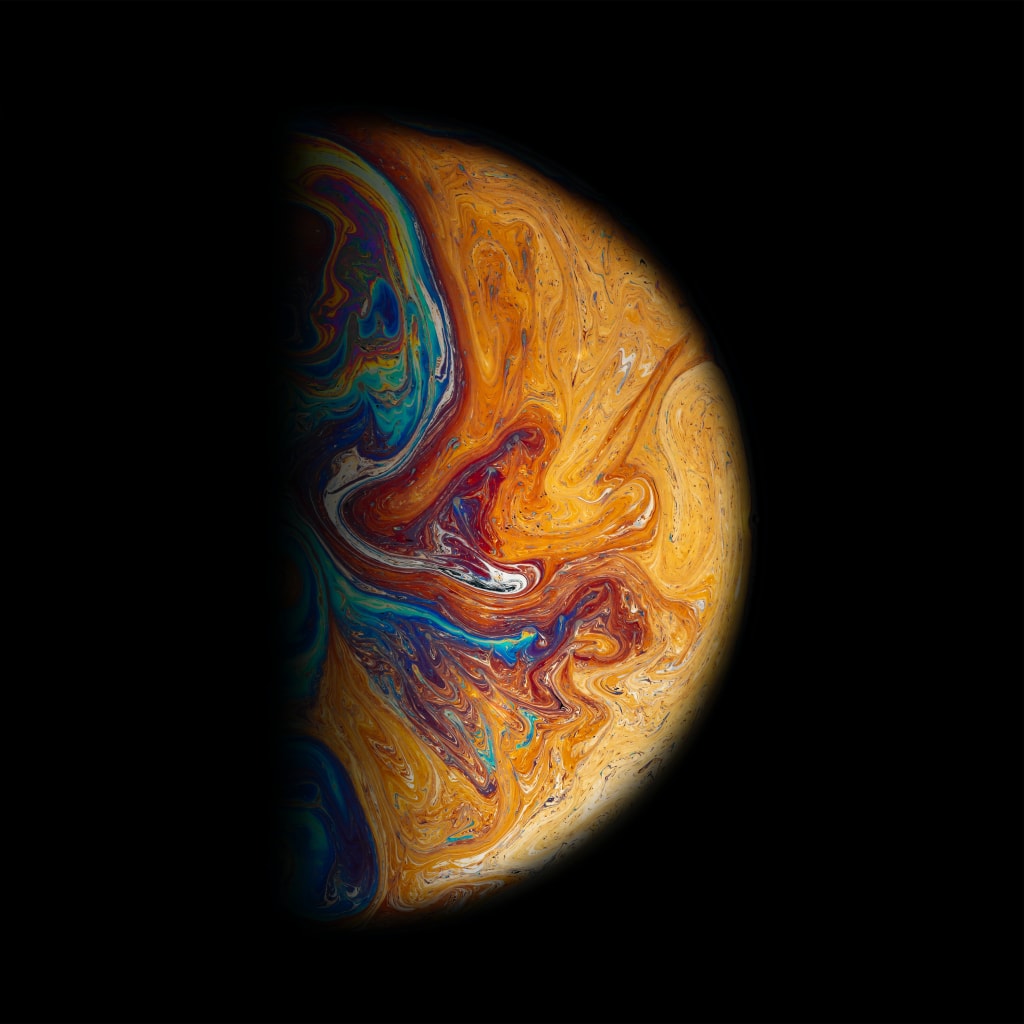
Can diamonds be mass-produced on Saturn? Can.
Under the upper atmosphere of Saturn, a large number of water and gas clouds are constantly dancing, and the super lightning flashes turn the methane gas into a large cloud of soot. The downward pressure increases, and these soots accidentally turn into diamonds . As the saying goes: a grain of Saturn's ash on your head may be a diamond, but don't think too much about it, these diamonds quickly disintegrate and eventually liquefy under the pressure of Saturn. Forty thousand kilometers below Saturn's surface, take a look at its largest source of energy. The pressure here is very high, the gas looks like liquid metal, and the molten helium rains down in the hydrogen, releasing an amazing amount of heat. This is a very specific heat source, like the engine of Saturn's weather.
After a four-year flight in space, Voyager 2 arrived at Saturn in 1981, with a voyage of more than 1.6 billion kilometers. Don't ask me how I calculated it. Photographed by Voyager 2 Thousands of photos of Saturn and its rings and moons. Saturn itself is composed of hydrogen and helium, and here we see a strange meteorological phenomenon. "Voyager" clearly shows that Saturn's upper atmosphere is almost entirely composed of helium and hydrogen. These two gases were extremely abundant in the early solar system, but this once chaotic atmosphere now forms a complex weather system. One of the most surprising phenomena is that the clouds have a huge hexagonal structure, which is big enough to hold four earths.
Saturn is 1.4 billion kilometers away from the sun. Compared with the earth, Saturn is so special that it is difficult for people to imagine that the two were formed from the same material. A little earlier than our Earth, we can imagine that Saturn is a very large meteorite that doesn't need to tumble, but its internal structure is made of rock and ice. As it rolled around the inner layer of the solar system, through interaction, some matter was fused and gathered, and it gradually became a little bigger. Saturn's orbit is beyond what's called the snow line, where it's extremely cold, where water exists in solid form, mixed with rocks, and grows bigger and bigger like a snowball.
After millions of years in this way, when the volume and mass are large enough, both hydrogen and helium in the solar system can be adsorbed, because the few planets near the sun are not enough to bind this planet through gravitational force. two gases. With the accumulation of hydrogen and helium, an atmosphere is formed on the surface of Saturn, creating a huge atmospheric pressure. The atmospheric pressure acts on the surface of Saturn, and the temperature rises under the high pressure, generating heat and light. Under such pressure, Saturn changed its shape, from a rocky planet to a gas giant.
How the beautiful rings of Saturn are formed. A leading opinion is that some tens of millions of years ago, outside Saturn's atmosphere, there must have been an icy moon approaching, when Saturn's huge gravitational force exerted on this moon, it began to split, and Saturn began to devour its "children". ". In Saturn's low-Earth orbit, the shattered moons created countless icy bodies that rapidly orbited Saturn under the action of gravitational and centrifugal forces, thus forming the spectacular rings of Saturn. The diameter of this ring exceeds the diameter of Jupiter and is about ten meters thick. Saturn's rings are not a whole, and the gaps are emptied by rocks about the same size as the moon, which cuts Saturn's rings into many concentric rings. Under the force of Saturn's satellites, the ice particles inside are attracted and pulled up to form ice peaks. Under the sunlight, one side is crystal clear and beautiful, and the other side casts shadows.
The name Saturn sounds earthy, but in this way, he has become the most beautiful "star master". By 1997, the "Cassini" probe flew to Saturn, and it was much more massive than the "Voyager", and it had to follow a different route to enter the orbit near Saturn. In order to save fuel, it flew over multiple planets. With the help of planetary gravitational ejection, it completed acceleration and heading adjustment. The whole journey took seven years. Clarity observes Saturn's rings too.
About the Creator
crudden elle
Partagez un peu de science chaque jour
Keep reading
More stories from crudden elle and writers in Earth and other communities.
Humans are not alone? Expert: There may be at least 36 "alien civilizations" in the Milky Way
Since humans began to explore outer space, there have been more and more conjectures about outer space. For human beings, the universe is vast, so on the way to explore the universe, human beings still have a long way to go. Scientists have been exploring whether there is life in outer space a long time ago, but for the past so many years, this question has still not been answered, and in June 2020, the University of Nottingham in the United Kingdom also launched a related survey.
By crudden elle4 years ago in Earth
Venus and Jupiter Shine Together: A Stunning Planetary Display in Earth’s Sky
For skywatchers across the world, there are few sights more captivating than seeing bright planets glowing in the night sky. Among these celestial wonders, the close appearance of Venus and Jupiter from Earth is one of the most spectacular. When these two brilliant planets appear close together in the sky, they create a stunning astronomical event that fascinates both professional astronomers and casual stargazers alike.
By Irshad Abbasi 7 days ago in Earth
My First Time Skiing and I Got Lost, Alone, in the French Alps
Looking back, I can trace some of my life’s biggest adventures to a simple action from my sister. She’d introduced me to Tommy (a very long time ago), a colleague of hers, who had overshared his penchant for Italian-looking women, and I ticked that box.
By Chantal Christie Weiss2 days ago in Humans


Comments
There are no comments for this story
Be the first to respond and start the conversation.