
The science behind tides.
Tides are one of the most fascinating and predictable natural phenomena on Earth, occurring due to the gravitational interactions between the Earth, Moon, and Sun.

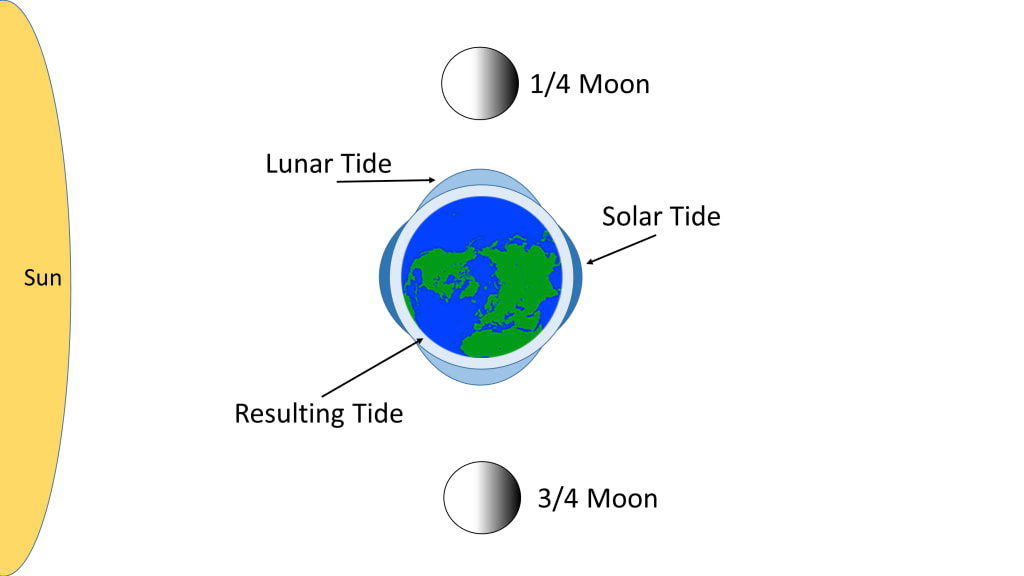
Tides periodic rises and falls of ocean water affect coastal regions worldwide, influencing marine life, navigation, and even human activities. Understanding tides requires delving into concepts of gravitational forces, celestial mechanics, and fluid dynamics.
(I)Gravitational Influence of the Moon and Sun
The primary driver of tides is the gravitational pull exerted by the Moon. Although the Sun is much larger and exerts a stronger gravitational force on Earth as a whole, the Moon’s proximity to our planet makes its tidal effects more pronounced.
The Moon's gravitational pull causes water on the side of Earth facing the Moon to be drawn towards it, creating a bulge known as the tidal bulge. On the opposite side of the Earth, another bulge forms due to the centrifugal force generated by the Earth-Moon system’s rotation. These two bulges result in high tides in the affected regions. In contrast, areas between these bulges experience low tides.
While the Moon is the dominant force behind tides, the Sun also plays a significant role. When the Sun, Moon, and Earth align during full moons and new moons, their combined gravitational effects create higher-than-normal high tides, known as spring tides. Conversely, when the Sun and Moon form a right angle relative to Earth (during the first and third quarters of the Moon), their gravitational forces partially cancel each other out, resulting in lower high tides and higher low tides, known as neap tides.
(II)Types of Tides
Tides vary based on geographical location, the shape of coastlines, and the ocean floor’s topography. There are three main types of tidal patterns:
- Semidiurnal Tides: These tides consist of two nearly equal high tides and two nearly equal low tides each day. They are most common along the Atlantic coasts of North America and Europe.
- Diurnal Tides: These tides involve only one high tide and one low tide per day. Such tides occur in places like the Gulf of Mexico and parts of Southeast Asia.
- Mixed Tides: Some regions experience mixed tides, where two high and two low tides occur daily but with varying heights. This pattern is common along the U.S. Pacific Coast.
(III)Tidal Currents and Effects on Coastal Ecosystems
Tides not only cause the vertical movement of water but also generate tidal currents, which influence marine and coastal ecosystems. As tides rise and fall, water is pushed through estuaries and coastal areas, supplying nutrients, oxygen, and sediment crucial for aquatic life.
Tidal movements shape coastal landscapes by causing erosion and deposition of sediments. For example, estuarine environments rely on the influx of tidal waters to maintain healthy ecosystems that support various marine species. In some regions, extreme tides create unique phenomena, such as tidal bores, where a strong surge of incoming tide forms a wave traveling upstream in narrow rivers and bays.
(IV)Tidal Energy: A Renewable Resource
Tides represent a powerful source of renewable energy. Tidal energy is harnessed using underwater turbines or barrages that capture the kinetic and potential energy of moving tidal waters. Since tides are highly predictable, they offer a reliable form of energy compared to wind or solar power. Countries like the United Kingdom, France, and Canada have invested in tidal power plants to generate electricity.
(V)Human Impact and Adaptation to Tides
Coastal communities have long adapted to tidal patterns for fishing, transportation, and infrastructure planning. Ports and harbors rely on tide charts to ensure safe navigation of ships. Fishermen use tidal cycles to determine the best times to catch fish, as many species follow tidal movements.
However, rising sea levels due to climate change are altering tidal patterns, increasing the risk of flooding in low-lying areas. Coastal defenses such as seawalls, tidal gates, and managed retreat strategies are being employed to mitigate these risks.
Conclusion
Tides are a remarkable natural phenomenon governed by the interplay of gravitational forces, Earth’s rotation, and ocean dynamics. Their influence extends beyond the rhythmic rise and fall of sea levels, impacting marine ecosystems, human activities, and even renewable energy solutions. As we continue to study and adapt to the changes in tidal patterns, understanding the science behind tides remains crucial for sustainable coastal management and environmental conservation.
About the Creator
Badhan Sen
Myself Badhan, I am a professional writer.I like to share some stories with my friends.
Keep reading
More stories from Badhan Sen and writers in Earth and other communities.
The anatomy of a cell.
Cells vary in structure and function, but they share several essential components that enable them to sustain life. Broadly, cells are categorized into prokaryotic and eukaryotic types. Prokaryotic cells, such as bacteria, are simpler and lack a nucleus, whereas eukaryotic cells, found in plants, animals, fungi, and protists, are more complex and contain membrane-bound organelles. This article will explore the key structural components of a eukaryotic cell, highlighting their functions and significance.
By Badhan Sen12 months ago in Earth
Do Not Touch the Roses
There is a quiet power in the phrase “Do Not Touch the Roses.” It sounds like a warning, but it feels like an invitation — one that asks us to pause, admire, and respect something without claiming it. Roses have long symbolized love, beauty, and passion, yet they are also guarded by thorns. That contradiction makes them the perfect metaphor for many of life’s most meaningful things.
By Aarif Lashariabout 19 hours ago in Earth
Honey, I Shrunk the Datacentres: Is Small the New Big?
When most people think of datacentres, they picture sprawling warehouses full of servers, humming fans, and mountains of cabling. These massive facilities power everything from Netflix streams to artificial intelligence, but they also consume enormous amounts of energy and space. Now, a new trend is emerging: micro-datacentres. Tiny, modular, and often portable, these “datacentre in a box” solutions are challenging the old assumption that bigger is always better. Could small really be the new big in the world of computing? What Are Micro-Datacentres? Micro-datacentres are compact computing hubs designed to perform the same essential functions as traditional datacentres but in a fraction of the space. Think of them as miniaturized cloud factories — smaller, energy-efficient, and often placed closer to the users they serve. Key characteristics include: Compact size: Often no larger than a shipping container or even a cabinet. Energy efficiency: Use less power by focusing on localized computing needs. Modularity: Can be scaled horizontally by adding more units rather than expanding a single huge facility. Edge computing readiness: Positioned closer to where data is generated, reducing latency for IoT devices, AI applications, and streaming services. In short, micro-datacentres take the power of traditional computing and shrink it to fit modern, flexible infrastructure demands. Why Companies Are Embracing Smaller Datacentres There are several reasons the tech world is warming up to smaller datacentres: Energy and Cost Savings – Traditional datacentres consume massive amounts of electricity, sometimes as much as a small town. Micro-datacentres use less power and generate less heat, reducing both energy bills and cooling costs. Local Speed and Low Latency – For applications like AI, gaming, and streaming, milliseconds matter. By placing computing resources closer to users, micro-datacentres reduce latency and improve performance. Flexibility and Rapid Deployment – Big datacentres take years to build. Micro-datacentres can be deployed in weeks, allowing companies to respond quickly to spikes in demand or to expand into new regions. Resilience and Redundancy – Smaller, distributed units reduce the risk of a single point of failure. If one micro-datacentre goes down, others can pick up the load. Sustainability Goals – With energy efficiency at their core, micro-datacentres are often paired with renewable energy, making them an attractive option for companies seeking greener operations. From Data Warehouses to Data Cabinets Historically, the datacentre arms race has been about size. Companies like Amazon, Google, and Microsoft built massive facilities housing hundreds of thousands of servers. These centers achieved economies of scale but came with high energy use, long construction timelines, and heavy regulatory scrutiny. Micro-datacentres, on the other hand, flip the script: instead of one mega-facility, you deploy many smaller units closer to users. This is sometimes called edge computing, and it’s particularly useful for AI applications, smart cities, and the Internet of Things (IoT). Imagine self-driving cars, smart traffic lights, or factory robots. These devices generate enormous amounts of data that can’t be efficiently sent to a distant datacentre for processing. A nearby micro-datacentre solves the problem in real-time, enabling faster decisions and smoother operations. Real-World Examples Several companies are already experimenting with smaller datacentres: Google’s Edge Nodes: Google has deployed compact datacentres in regional locations to speed up cloud services. Microsoft Azure Stack Edge: A modular datacentre solution that brings cloud computing capabilities closer to businesses. Amazon Web Services (AWS) Snowcone: A portable computing and storage unit that can operate in remote or temporary locations. Even municipalities and hospitals are exploring micro-datacentres for localized applications like traffic management, healthcare data storage, and emergency services. Challenges of Going Small While micro-datacentres have many advantages, they’re not without challenges: Limited capacity: They can’t match the raw scale of traditional datacentres, so some large-scale AI training tasks still require mega-facilities. Security concerns: Smaller units distributed across many locations require robust cybersecurity protocols. Maintenance and monitoring: Managing multiple small units can be more complex than running a centralized datacentre. Energy trade-offs: If not designed efficiently, multiple micro-datacentres can sometimes use more energy than a single optimized large facility. Despite these challenges, many experts argue that the benefits — speed, flexibility, and reduced environmental impact — outweigh the downsides for many applications. Why “Small” Could Be the Future The rise of micro-datacentres signals a broader shift in how we think about computing infrastructure. Instead of centralized, monolithic powerhouses, the future may look like a network of small, smart, and sustainable units. This trend aligns with several larger tech movements: Edge computing – Computing closer to the user or device. Green technology – Reducing energy consumption and carbon footprints. AI proliferation – Handling massive data loads locally to enable faster processing. For companies, governments, and communities, the message is clear: smaller doesn’t mean weaker — it can mean smarter, faster, and more adaptable. Conclusion: Small but Mighty Micro-datacentres may not replace all mega-facilities, but they are carving out an essential niche in the computing ecosystem. They offer speed, flexibility, and sustainability that large datacentres can’t always provide, particularly for localized applications and edge computing. As technology evolves and energy concerns intensify, these “datacentres in a box” could become a core component of how we process, store, and access data in the 21st century. So the next time someone asks if small is the new big, the answer might just be yes — at least when it comes to datacentres.
By Muhammad Hassan6 days ago in Earth
Wild Card Weekend Recap: What Happens Now?
I think I figured out why I love Wild Card Weekend so much. It's because it's the first playoff anything of the calendar year. The NFL season starts in the fall, and once upon a time, the champion was crowned either on or slightly before New Year's. The evolution of the NFL schedule has resulted in the playoffs starting just into the New Year, and currently, the final week of the season falls on the first weekend of the New Year, with Wild Card Weekend coming a week after that. So yes, chronologically, the NFL's Wild Card Weekend serves as the first playoff anything of the calendar year.
By Clyde E. Dawkins7 days ago in Unbalanced




Comments (1)
Good job on this article that would make a good geology lesson.