
The anatomy of a cell.
A cell is the fundamental unit of life, forming the basic building blocks of all living organisms.

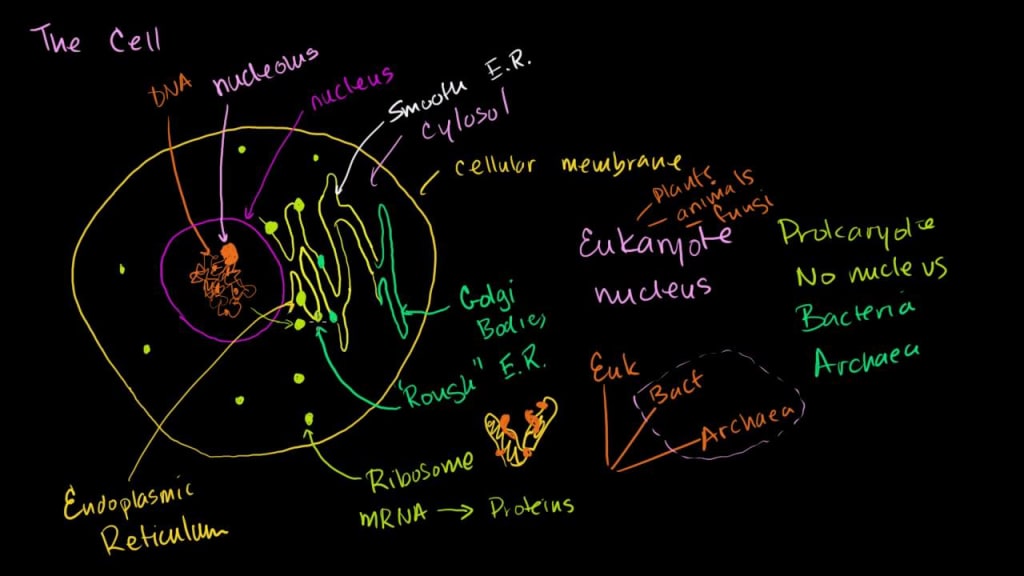
Cells vary in structure and function, but they share several essential components that enable them to sustain life. Broadly, cells are categorized into prokaryotic and eukaryotic types. Prokaryotic cells, such as bacteria, are simpler and lack a nucleus, whereas eukaryotic cells, found in plants, animals, fungi, and protists, are more complex and contain membrane-bound organelles. This article will explore the key structural components of a eukaryotic cell, highlighting their functions and significance.
Plasma Membrane
The plasma membrane, or cell membrane, is a phospholipid bilayer embedded with proteins. It serves as a selective barrier that regulates the movement of substances into and out of the cell. This semi-permeable membrane facilitates communication between cells and plays a crucial role in maintaining homeostasis.
Cytoplasm
The cytoplasm is a gel-like substance filling the interior of the cell, consisting of cytosol, organelles, and other cellular components. It provides a medium for biochemical reactions and supports the movement of molecules within the cell.
Nucleus
The nucleus is the control center of the cell, housing genetic material in the form of DNA. It is enclosed by the nuclear envelope, a double membrane with nuclear pores that regulate the exchange of materials between the nucleus and the cytoplasm. Inside the nucleus, the nucleolus is responsible for ribosome production.
Endoplasmic Reticulum (ER)
The ER is a network of membranous tubules involved in the synthesis and transport of biomolecules. It is divided into two types:
Rough ER: Studded with ribosomes, it plays a key role in protein synthesis and processing.
Smooth ER: Lacks ribosomes and is involved in lipid synthesis, detoxification, and calcium ion storage.
Ribosomes
Ribosomes are small, non-membranous organelles composed of RNA and proteins. They are responsible for protein synthesis, translating genetic instructions into functional proteins. Ribosomes can be found floating freely in the cytoplasm or attached to the rough ER.
Golgi Apparatus
The Golgi apparatus is a stack of flattened, membrane-bound sacs that modify, package, and transport proteins and lipids. It plays a crucial role in processing and distributing cellular products, ensuring they reach their proper destinations.
Mitochondria
Mitochondria are often called the “powerhouses” of the cell due to their role in ATP (adenosine triphosphate) production. Through cellular respiration, mitochondria convert glucose and oxygen into energy, which is essential for various cellular activities. They contain their own DNA, enabling them to replicate independently within the cell.
Lysosomes
Lysosomes are membrane-bound organelles containing hydrolytic enzymes that break down cellular waste, debris, and macromolecules. They are essential for cellular digestion, recycling old organelles, and defending against pathogens.
Peroxisomes
Peroxisomes are small, membrane-bound organelles involved in the breakdown of fatty acids and the detoxification of harmful substances, such as hydrogen peroxide. They play a significant role in maintaining cellular metabolism.
Cytoskeleton
The cytoskeleton is a network of protein filaments that provides structural support, enables intracellular transport, and facilitates cell movement. It consists of three main components:
Microfilaments: Composed of actin, they help in cell shape maintenance and movement.
Intermediate Filaments: Provide mechanical strength and stability.
Microtubules: Hollow structures made of tubulin that aid in cell division and the transport of organelles.
Centrioles and Centrosomes
Centrioles are cylindrical structures composed of microtubules, playing a crucial role in cell division by organizing the mitotic spindle. They are found within the centrosome, a key microtubule-organizing center in animal cells.
Vacuoles
Vacuoles are membrane-bound sacs used for storage and waste disposal. In plant cells, a large central vacuole helps maintain turgor pressure, providing structural support.
Cell Wall (Plant Cells Only)
Plant cells possess a rigid cell wall made of cellulose, providing additional support and protection. This structure distinguishes plant cells from animal cells, enabling them to withstand external pressure.
Chloroplasts (Plant Cells Only)
Chloroplasts are specialized organelles in plant cells responsible for photosynthesis. They contain chlorophyll, a pigment that captures light energy to convert carbon dioxide and water into glucose and oxygen. Like mitochondria, chloroplasts have their own DNA and can replicate independently.
Conclusion
The eukaryotic cell is a highly organized and dynamic structure, composed of numerous specialized organelles that work in unison to sustain life. Understanding the anatomy and function of each cellular component is essential in fields such as medicine, biotechnology, and cellular biology. Cells serve as the foundation of all living organisms, and their intricate design allows them to perform a vast array of functions necessary for survival and Growth.
About the Creator
Badhan Sen
Myself Badhan, I am a professional writer.I like to share some stories with my friends.
Keep reading
More stories from Badhan Sen and writers in Earth and other communities.
The process of cloning.
The technique of Cloning has been widely studied in genetics, biotechnology, and medical research, offering potential benefits in medicine, agriculture, and conservation. The most famous example of cloning is Dolly the sheep, the first successfully cloned mammal from an adult somatic cell. The process of cloning can be categorized into three main types: gene cloning, reproductive cloning, and therapeutic cloning.
By Badhan Sen12 months ago in Earth
Without Democracy, Donald Trump’s Venezuelan Oil Quest Will Fail
Donald Trump’s renewed interest in Venezuelan oil may seem, on the surface, like a hard-nosed geopolitical calculation. Venezuela holds the world’s largest proven oil reserves, and amid global energy uncertainty, access to those resources is undeniably tempting. But history, economics, and politics all point to the same conclusion: without democratic reform in Venezuela, any attempt by a Trump-led US administration to secure reliable Venezuelan oil will ultimately fail.
By Aarif Lashari6 days ago in Earth



Comments (1)
What a great review of the many facets that make up 'The Cell'. Good job.