
The role of AI in crime prediction
Artificial Intelligence (AI) has become an integral part of modern technology, influencing various sectors, including law enforcement and crime prediction.


With the increasing complexity of criminal activities, law enforcement agencies are turning to AI-driven solutions to analyze vast amounts of data, identify patterns, and anticipate potential criminal activities. AI-powered crime prediction tools are revolutionizing policing by making crime prevention more proactive rather than reactive.
Understanding AI in Crime Prediction
AI in crime prediction involves the use of machine learning algorithms, data analytics, and predictive modeling to assess the likelihood of criminal activities occurring in specific areas. These systems analyze past crime data, socio-economic factors, behavioral patterns, and real-time surveillance data to make informed predictions.
Some of the most common AI techniques used in crime prediction include:
Machine Learning Algorithms: These algorithms analyze historical crime data and identify patterns that could indicate future criminal activities.
Predictive Analytics: AI models use statistical methods to determine crime-prone areas and high-risk individuals.
Facial Recognition: AI-powered facial recognition helps identify suspects in real time through surveillance cameras.
Natural Language Processing (NLP): AI scans social media, emails, and phone conversations to detect suspicious behavior and potential threats.
Geospatial Analysis: AI maps crime data and pinpoints areas with higher risks, helping law enforcement deploy resources more effectively.
Applications of AI in Crime Prediction
Predicting Crime Hotspots
AI-driven predictive policing systems analyze crime trends to identify areas where crimes are most likely to occur. This helps law enforcement agencies allocate personnel and resources efficiently, reducing crime rates.
Analyzing Criminal Behavior
AI can analyze past behaviors of criminals, allowing police departments to predict repeat offenses and intervene before crimes happen. Predictive models help identify individuals at risk of committing crimes based on their past actions and social environment.
Real-Time Surveillance and Monitoring
AI enhances surveillance systems by identifying suspicious activities in real time. Smart cameras with AI capabilities detect unusual behavior, such as loitering in restricted areas, and alert authorities immediately.
Social Media Monitoring
AI tools scan online platforms for potential threats, cyberbullying, terrorist activities, and criminal planning. Law enforcement agencies use AI to track down suspects by analyzing posts, comments, and messages.
Fraud Detection and Cybersecurity
AI is widely used to combat financial crimes, such as credit card fraud, money laundering, and identity theft. Machine learning algorithms detect suspicious transactions and flag potential fraud before it happens.
Benefits of AI in Crime Prediction
Enhanced Efficiency: AI can process vast amounts of data much faster than humans, allowing law enforcement to act quickly.
Crime Prevention: AI-driven predictions help prevent crimes before they occur by identifying risk factors and potential threats.
Better Resource Allocation: Law enforcement agencies can deploy officers more effectively based on AI insights.
Reduced Human Bias: AI operates based on data-driven patterns rather than human intuition, minimizing bias in law enforcement decisions.
Challenges and Ethical Concerns
Despite its benefits, AI in crime prediction raises several ethical and technical challenges:
Data Privacy and Surveillance
AI-driven monitoring and surveillance raise concerns about individual privacy. Continuous tracking and facial recognition may infringe on personal rights.
Algorithmic Bias
AI systems are only as good as the data they are trained on. If the data contains racial or socioeconomic biases, AI predictions may unfairly target specific groups.
False Positives
Predictive models may incorrectly label individuals as potential criminals, leading to wrongful accusations and unnecessary interventions.
Legal and Ethical Implications
The use of AI in law enforcement raises questions about accountability. Who is responsible if AI makes an incorrect prediction that leads to an unjust arrest?
The Future of AI in Crime Prediction
As AI technology advances, crime prediction tools will become more accurate and efficient. Future developments may include:
More Sophisticated AI Models: Improved algorithms with better accuracy and reduced bias.
Integration with Smart Cities: AI-driven crime prediction systems will be integrated into smart city infrastructure, enhancing overall security.
Stronger Regulations: Governments will establish stricter laws to ensure ethical AI use in law enforcement.
Public-Private Collaboration: Tech companies and law enforcement agencies will work together to develop AI tools that balance security and privacy concerns.
Conclusion
AI is transforming crime prediction and law enforcement by making policing more data-driven and proactive. While AI enhances efficiency and crime prevention, ethical concerns must be addressed to ensure fair and responsible use. The future of AI in crime prediction holds great potential, but it must be implemented with transparency, accountability, and respect for individual rights.
About the Creator
Badhan Sen
Myself Badhan, I am a professional writer.I like to share some stories with my friends.
Keep reading
More stories from Badhan Sen and writers in Earth and other communities.
The ethics of space mining
Space mining refers to the process of extracting valuable resources from celestial bodies like asteroids, moons, and planets. These resources, such as precious metals, water, and rare minerals, could play a pivotal role in supporting space exploration, technological advancements, and potentially addressing Earth's resource scarcity. However, space mining raises important ethical questions regarding environmental preservation, ownership, exploitation, and the potential consequences for future generations.
By Badhan Sen10 months ago in Earth
Trump’s Housing Plan Casts Wall Street as the Villain — But He’s Targeting the Wrong Culprit
The American housing crisis has become one of the most emotionally charged issues in modern politics. Homeownership, once seen as a cornerstone of the American Dream, now feels out of reach for millions. Against this backdrop, Donald Trump’s latest housing proposals aim to revive affordability — and they do so by placing Wall Street squarely in the role of villain. At first glance, this message resonates. Large investment firms buying single-family homes, rising rents, and speculative real estate practices have fueled public frustration. But while Wall Street certainly plays a role, Trump’s housing plan risks oversimplifying a complex problem — and by doing so, it may miss the real drivers of America’s housing shortage. What Trump’s Housing Plan Is Trying to Do Trump’s rhetoric on housing centers on a familiar populist theme: powerful financial elites are squeezing everyday Americans out of the market. His plan suggests limiting institutional investors’ influence, loosening regulations, and promoting homeownership through market-friendly reforms. The message is clear and politically effective. By casting Wall Street as the enemy, the plan appeals to working-class voters struggling with high rents and rising mortgage rates. It also fits neatly into Trump’s broader narrative of standing up to elites on behalf of “ordinary Americans.” However, housing affordability is not a single-villain story. It is the result of decades of policy choices, local governance failures, and economic pressures that go far beyond investment firms. Wall Street’s Role Is Real — But Limited There is no denying that large financial institutions have entered the housing market aggressively, especially after the 2008 financial crisis. With access to cheap capital, institutional investors bought distressed homes in bulk, converting many into rental properties. This practice reduced housing supply for individual buyers in certain markets and pushed prices higher in some regions. In cities like Atlanta, Phoenix, and parts of Texas, Wall Street-backed landlords now own a noticeable share of single-family rentals. Yet nationally, institutional investors still own a relatively small percentage of total housing stock. Their presence may amplify affordability problems in specific areas, but they are not the primary cause of the nationwide housing shortage. The Real Crisis: America Doesn’t Build Enough Homes The core problem in U.S. housing is painfully simple: supply has failed to keep up with demand. For decades, America has underbuilt housing. Local zoning laws restrict multi-family construction, height limits constrain density, and lengthy approval processes delay or kill new developments. In many cities, it is illegal to build anything other than single-family homes across vast residential areas. These restrictions are enforced not by Wall Street, but by local governments responding to political pressure from homeowners who oppose new development. This phenomenon, often called “NIMBYism” (Not In My Back Yard), has quietly become one of the biggest barriers to affordable housing. Without addressing zoning and land-use reform, no housing plan — conservative or progressive — can meaningfully lower prices. Interest Rates and Inflation Matter More Than Investors Another factor Trump’s plan largely sidesteps is the role of interest rates. Mortgage rates surged in recent years as the Federal Reserve raised rates to fight inflation. Higher rates dramatically reduce purchasing power, locking many buyers out of the market even when home prices stabilize. Inflation also raises construction costs, from labor to materials, making new housing more expensive to build. Developers, facing tighter margins, often choose luxury projects over affordable units. Blaming Wall Street may be politically convenient, but it does nothing to address these macroeconomic realities that shape housing affordability nationwide. Why Scapegoating Wall Street Misses the Mark Casting Wall Street as the primary villain risks leading policy in the wrong direction. Restricting institutional investors without expanding supply could actually worsen the crisis by discouraging investment in new housing construction. Moreover, focusing on financial elites allows politicians to avoid tougher conversations about local zoning reform, environmental review processes, and community resistance to development — issues that cut across party lines and anger powerful local constituencies. Housing is one of the rare policy areas where both left- and right-leaning economists broadly agree: more supply is essential. Without it, prices will remain high no matter who owns existing homes. A More Effective Housing Strategy If the goal is genuine affordability, a successful housing plan must prioritize: Zoning reform to allow duplexes, apartments, and mixed-use development Faster permitting processes to reduce construction delays Incentives for affordable housing development, not just luxury units Support for first-time homebuyers that does not inflate prices further Infrastructure investment to expand livable areas beyond major cities None of these solutions are politically easy. They require cooperation between federal, state, and local governments — and they lack the simplicity of blaming a single villain. Politics vs. Policy in the Housing Debate Trump’s housing rhetoric reflects a broader trend in American politics: emotionally satisfying narratives often outperform nuanced policy discussions. Wall Street makes for a compelling antagonist, especially in an era of economic anxiety and distrust of large institutions. But housing affordability is not a morality play. It is a structural problem rooted in decades of underbuilding, restrictive local policies, and economic shifts. Solving it requires uncomfortable reforms, not just powerful speeches. Conclusion: The Wrong Villain Won’t Fix the Right Problem Trump’s housing plan taps into real frustration, and it is not wrong to question the growing influence of large investors in residential real estate. However, by framing Wall Street as the central cause of the housing crisis, the plan risks distracting from deeper, more entrenched issues. America’s housing problem will not be solved by targeting a single group. It will only be solved by building more homes, reforming outdated policies, and confronting the political resistance that has long blocked meaningful change. Until then, the American Dream of homeownership will remain just that — a dream — for millions who are still waiting for leaders to address the real problem.
By Muhammad Hassanabout 14 hours ago in Earth
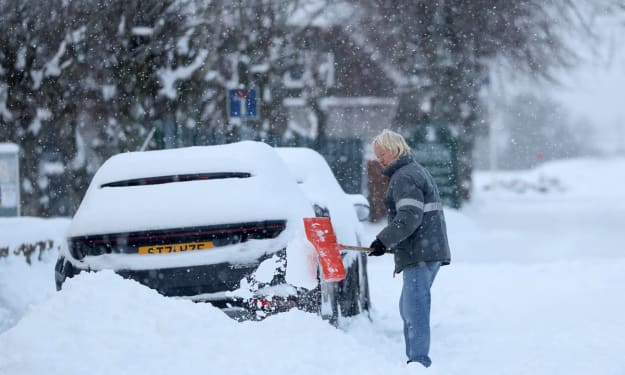
Homes in North Scotland Without Power as Arctic Weather Sweeps the UK
As Arctic air sweeps across the United Kingdom, communities in northern Scotland are bearing the brunt of one of the harshest winter spells in recent years. Sub-zero temperatures, heavy snowfall, and powerful winds have combined to knock out power supplies to thousands of homes, leaving residents facing prolonged outages amid dangerously cold conditions. The extreme weather has once again highlighted the vulnerability of infrastructure in remote regions and raised urgent questions about preparedness in an era of increasingly volatile winters. A Deep Freeze Grips the North The latest cold snap has been driven by an Arctic air mass plunging southwards, bringing temperatures well below freezing across much of the UK. In parts of the Highlands, temperatures have dropped to levels not seen for several winters, with wind chill making conditions feel even more severe. Heavy snow and ice have blanketed roads, while gusts strong enough to down power lines have created widespread disruption. Northern Scotland, known for its rugged terrain and dispersed communities, has been particularly affected. Rural villages and isolated households are often connected by long stretches of overhead power lines, which are highly susceptible to damage from ice buildup and falling trees. As snow accumulated and winds intensified, multiple faults occurred across the network, leaving homes without electricity for hours—and in some cases, days. Power Outages and Daily Life For residents, the loss of power during Arctic conditions is more than an inconvenience. Electricity is essential not only for lighting and communication but also for heating, cooking, and water supply in many modern homes. Without it, indoor temperatures can drop rapidly, posing serious risks to vulnerable groups such as the elderly, young children, and those with health conditions. Many households have had to rely on alternative heat sources such as fireplaces or portable gas heaters, while others sought refuge with relatives or in community shelters. Local authorities and volunteer groups have stepped in to provide support, distributing hot meals, blankets, and updates to those affected. However, the scale of the outages has stretched resources, particularly in remote areas where access is limited by snow-covered roads. Strain on Infrastructure The Arctic blast has once again exposed the fragility of power infrastructure in extreme weather. Much of Scotland’s electricity network, especially in rural areas, still relies on overhead lines rather than underground cables. While overhead systems are cheaper to install and maintain, they are far more vulnerable to storms, heavy snow, and ice. Energy companies have deployed repair crews around the clock, often working in treacherous conditions to restore supplies. Engineers have faced blocked roads, poor visibility, and freezing temperatures, slowing repair efforts. Despite these challenges, utility providers have emphasized that safety must come first, as repairing live lines in severe weather carries significant risks. Travel and Wider Disruption Power outages are only one part of the broader disruption caused by the Arctic weather. Snow and ice have forced road closures across the Highlands and islands, while rail services have been reduced or suspended in some areas. Schools have closed as a precaution, and health services have urged people to avoid non-essential travel. Airports in northern regions have also experienced delays and cancellations, as icy runways and poor visibility complicate operations. For businesses, particularly small enterprises in tourism and agriculture, the weather has delivered another economic blow during what is already a challenging winter period. Climate Change and Colder Extremes While cold snaps are a natural part of the UK’s climate, scientists warn that climate change may be making winter weather more unpredictable and extreme. A warming Arctic can disrupt atmospheric patterns, increasing the likelihood of sudden cold outbreaks like the one currently affecting Scotland. This paradox—where global warming can lead to more intense cold spells—adds complexity to planning and resilience efforts. The current outages have reignited debate about the need to modernize infrastructure to cope with these extremes. Calls are growing for greater investment in underground cabling, improved grid resilience, and community-level backup systems, particularly in regions that are repeatedly affected by severe weather. Community Resilience and the Road Ahead Despite the challenges, stories of resilience and solidarity have emerged from affected communities. Neighbors have checked on one another, shared generators, and opened their homes to those without heat. Local councils and charities have coordinated relief efforts, demonstrating the importance of community networks during crises. Looking ahead, experts argue that lessons must be learned from each severe weather event. Improving early warning systems, strengthening infrastructure, and ensuring clear communication between authorities and residents are all critical steps. For northern Scotland, where extreme weather is a fact of life, building resilience is not optional—it is essential. Conclusion The Arctic weather sweeping across the UK has left homes in northern Scotland without power, disrupting daily life and underscoring the challenges of maintaining essential services during extreme conditions. While emergency responses have helped mitigate the immediate impact, the situation highlights a broader issue: the need for long-term investment and adaptation in the face of a changing climate. As temperatures slowly recover and power supplies are restored, the experience serves as a stark reminder that winter extremes remain a serious threat. For policymakers, energy providers, and communities alike, the message is clear—preparing for harsher, more unpredictable winters must be a priority, not an afterthought.
By Fiazahmedbrohi 5 days ago in Earth



Comments
There are no comments for this story
Be the first to respond and start the conversation.