
The Race for the Arctic
Melting Ice and the Reshaping of Global Power Dynamics


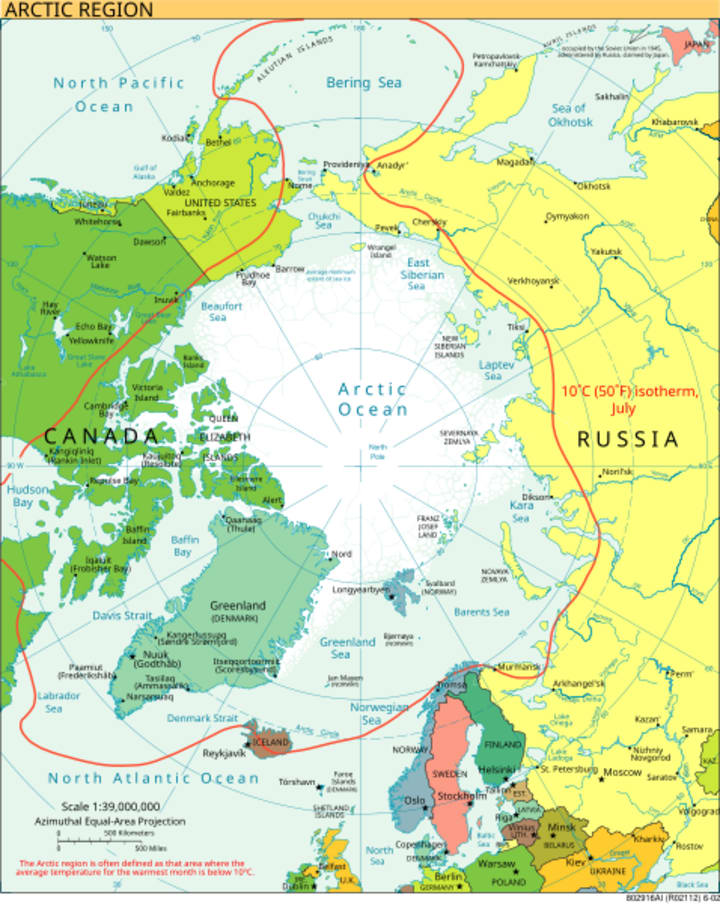
Out of all the effects that climate change causes to Earth, the change in the Arctic Circle is the most abrupt and of a greater magnitude.
The melting of the ice caps opens new routes on the sea and shows huge reserves of natural resources previously inaccessible. This geopolitical shift comes against the background of the war in Ukraine, which has polarized relations between NATO countries and Russia.
It is against this background that the Arctic becomes a focal point of strategic interest, with Russia well positioned to be a hegemon in this new environment.
Geopolitical Significance
The Arctic is in a rapid state of change due to global warming at approximately 21 million square kilometers.
As a result, it is opening new shipping routes and access to previously unknown fossil fuel deposits-including an estimated 160 billion barrels of oil and 30 percent of the world's natural gas-according to US Geological Survey estimations. This newer accessibility is inflaming tensions amongst the Arctic states, especially in handling the interests relating to the region.
While not a continent, the Arctic is a region shared by eight countries: Norway, Russia, Canada, the United States with Alaska, Denmark with Greenland, Iceland, Sweden, and Finland.
In 1996, the Arctic Council was established with the goal of promoting cooperation on sustainable development among these countries. In light of Russia's military forays into Ukraine, however, the geopolitical weather today has strained relations and further complicated cooperation.
Russia has almost half of the Arctic territory, with 24,000 kilometers of coastline.
Since 2014, Moscow has been undertaking an extraordinary remilitarization in the region by upgrading old Soviet-era military bases and increasing the number of soldiers present in the area.
In February 2024, in the face of still more heightened tensions with the West, Russia announced it would freeze its financial contributions to the Arctic Council, the first signal of the shifting mood toward unilateral action within the region
The Arctic is considered by the Russian government to be of pivotal importance for its national interests, especially with respect to energy security and further economic development. It was, however, the melting ice that made it very attractive as an opening door for New Shipping Routes, such as the NSR, which allows for big cuts in transportation time between Europe and Asia.
Russian officials estimate the NSR could carry as much as 36 million tons of cargo a year, an ambitious target that reflects Moscow's strategic emphasis on the expansion of its influence in the region.
Climate Change
This rapid rate of climate change across the Arctic brings together both opportunities and challenges.
In this regard, rising temperatures, particularly at a rate twice as fast as the rest of the world, have accelerated the melting of sea ice and opened new shipping lanes that have been highly competitive among the Arctic nations and non-Arctic countries desiring to take advantage of its resources.
The Arctic has a particular appeal to shipping due to the potential of saving time against common sea routes, which often face numerous problems regarding traffic flow.
Such is taking the NSR, which could decrease the shipping times by as much as 35%.
In this way, it offers Russia a very valid business opportunity in facilitating trade with Asian markets, especially China. This economic motive has made Russia invest extensively in its icebreaker fleet to ensure that at all times, it retains control over such critical maritime pathways.
Russian Arctic Military Build-Up
The position of power in the Arctic has been reinforced through a substantial strengthening of its military forces.
The Kremlin has opened new military bases, renovated old infrastructure, and upgraded the icebreaker fleet to be second to none in the world, with nuclear-powered vessels. This deterrent against perceived NATO threats is also used to assert sovereignty over its Arctic territories.
Of course, that has not gone unnoticed by the Russian military. America has increased its military exercises and troops in Alaska in response to rising tensions in the region. Advanced fighter jets have been sent by the U.S. military, while thousands of personnel have been involved in mega training exercises, and cooperation with NATO allies has ensued in order to make specific responses against Russia appropriate.
The Role of China in the Arctic
While Russia is the main player in the Arctic, China is also showing significant interest in the region.
Though bereft of Arctic territory, China has styled itself a "near-Arctic state" in hopes of securing a foothold through economic partnerships and investment in infrastructure projects. Beijing has taken part in discussions on developing the Polar Silk Road, a proposed maritime route connecting China to Europe through the Arctic.
China's rise in involvement within the Arctic has sparked worry, especially by the United States among other NATO members, who view China's efforts as a threat against the influence the United States has within the region.
Partnership between Russia and China has deepened in recent years through large-scale joint military exercises and economic collaborations that showcase a united front against Western interests.
NATO Response
This makes the Arctic a more sensitive region, and Russian reinforcement there has brought about responses from NATO members with more vigilance and preparedness.
NATO conducted several military exercises across the region, deploying troops and equipment across different member countries. Adding Finland and Sweden to NATO makes the alliance even firmer in the Arctic by adding more resources and strategic depth against the Russian activities.
While the move has been made by the United States to reinforce military capabilities in Alaska, one must be sure that a robust deterrent posture against Russian aggression is maintained proactively. In this respect, as NATO becomes responsive to a specific emerging security landscape in the Arctic, priority needs to be given to the integration of advanced military technologies along with burgeoning cooperation with allies.
The Future of Arctic Geopolitics
The future of the Arctic remains uncertain, with a variety of factors shaping its geopolitical landscape.
The ongoing war in Ukraine has created an adversarial environment that continues to push Russia toward more aggressive assertion of its interests. Simultaneously, climate change will continue to alter the dynamics of the region, making it a focal point of competition among both Arctic and non-Arctic nations
There is, therefore, no ruling out the chances of conflict in the Arctic, especially with some countries competing against one another for the possession of shipping routes and resources. The stakes in this region have gone high and will be far more significant in the near future. Military and economic interests, interactively entwined and juxtaposed with environmental concerns, will shape the future of the Arctic. Careful diplomacy and strategic planning will be in need for stability and cooperation among different nations.
In the coming years, the Arctic is likely to emerge as one of the most serious theaters of geopolitical contestation. An aggressive Russian posture, in conjunction with interests from other nations including China, is making for a multi-layered and difficult security environment. Since the region will keep on changing in view of the evolution of climate change and political dynamics, cooperation and dialogue among the Arctic states in the future will become more important than ever.
The Arctic is a region of growing importance, and it demands that the international community develop frameworks of cooperation that would take care of all parties' interests.
Otherwise, one could witness a new spiral of tensions, miscalculations, and even conflict in that region of the planet so important for global security and economic stability.
The future of the Arctic shall be decided through actions and policies by the involved countries, which would demand strategic foresight and a strong will toward diplomacy with a view to keeping this delicate balance.
(reuters, dpa, afp)
About the Creator
Tanguy Besson
Tanguy Besson, Freelance Journalist.
https://tanguybessonjournaliste.com/about/
Keep reading
More stories from Tanguy Besson and writers in Earth and other communities.
Earthquakes Today
Earthquakes are a daily reminder that the planet beneath our feet is constantly in motion. Today was no exception. Across different regions of the world, seismic instruments recorded a series of small to moderate earthquakes—most of them unnoticed by the general public, yet each one contributing to scientists’ understanding of how Earth releases stress along its tectonic boundaries. While major, destructive earthquakes capture headlines, the reality is that earthquakes happen every day, often dozens at a time. Today’s activity followed that familiar pattern: brief moments of shaking in some areas, subtle ground movement in others, and long strings of data flowing into global monitoring systems. A Snapshot of Earthquakes Today Throughout the day, earthquakes were detected in both well-known seismic zones and regions where shaking is less common. Coastal fault systems, subduction zones near ocean trenches, and continental plate boundaries all showed signs of movement. Most of today’s earthquakes were relatively low in magnitude, meaning they posed little to no danger to people or infrastructure. In places where earthquakes are frequent, such as parts of the Pacific Rim, small tremors are considered routine. Residents may feel a quick jolt, hear a faint rumble, or notice hanging objects sway briefly before everything settles again. Elsewhere, similar-sized quakes might go entirely unnoticed, detected only by sensitive instruments. The takeaway from today’s seismic activity is not alarm, but continuity: Earth is behaving exactly as geologists expect it to. Why Earthquakes Occur So Frequently Earth’s outer shell is broken into massive slabs called tectonic plates. These plates are constantly moving, though usually at speeds measured in centimeters per year. Where they collide, pull apart, or slide past one another, stress builds up over time. When that stress is released suddenly, an earthquake occurs. Today’s earthquakes are part of that ongoing process. Some happened along major fault lines that have been active for millions of years. Others occurred within plates themselves, caused by smaller fractures responding to distant stress changes. Each event, no matter how small, helps redistribute energy within the crust. Importantly, a day with multiple earthquakes does not necessarily signal that a larger one is imminent. In many cases, frequent small quakes actually release stress gradually, reducing the likelihood of a major rupture in the short term. What Scientists Learn From Today’s Quakes Every earthquake recorded today adds to a growing global dataset. Seismologists analyze factors such as depth, magnitude, wave patterns, and location to understand what is happening below the surface. Shallow earthquakes, even if small, are more likely to be felt by people, while deeper ones may pass unnoticed. Today’s events included a mix of both, offering insights into how stress is distributed at different levels of the Earth’s crust. Scientists also watch for earthquake “swarms,” where many small quakes occur in a concentrated area over a short period. These swarms can be linked to fluid movement underground, volcanic systems, or gradual fault adjustments. When swarms appear, researchers monitor them closely, though most fade without leading to a larger event. How Communities Experience Earthquakes Today For most people, today’s earthquakes were little more than a brief interruption—if they noticed them at all. In regions accustomed to seismic activity, daily life continues with little concern after minor shaking. Buildings designed to withstand earthquakes absorb the motion, and residents know basic safety steps by heart. In areas where earthquakes are less common, even a small tremor can spark curiosity or concern. Social media often fills with posts asking, “Did you feel that?” These moments serve as reminders that preparedness matters everywhere, not just in high-risk zones. Today’s earthquakes, while largely harmless, reinforce the importance of awareness. Knowing what to do during shaking—such as dropping to the ground, taking cover, and holding on—can make a critical difference during stronger events. Are Earthquakes Becoming More Common? A common question after days like today is whether earthquakes are increasing. The short answer is no—at least not in a way that indicates growing danger. What has increased is our ability to detect them. Modern seismic networks are far more advanced than those of previous decades. Instruments now pick up tiny earthquakes that would have gone unnoticed in the past. As a result, it can seem like earthquakes are happening more often, when in reality we are simply observing them more accurately. Today’s activity fits well within historical norms. Earth has always been active, and it will continue to be so long after human timelines have passed. The Role of Preparedness Even on a day dominated by small earthquakes, preparedness remains essential. Large earthquakes are rare, but they do occur without warning. Today’s minor tremors are a reminder to review safety plans, secure heavy furniture, and ensure emergency supplies are accessible. Preparedness is not about fear—it is about readiness. Communities that invest in earthquake-resistant infrastructure and public education recover more quickly when stronger shaking occurs. Looking Ahead As today comes to a close, seismic monitoring will continue uninterrupted. New earthquakes will occur overnight, tomorrow, and every day after that. Most will be small. A few may be felt. Very few will cause damage. Earthquakes today remind us that the planet is alive with motion beneath its surface. While we cannot stop or predict them with precision, we can understand them, respect them, and prepare for their impact. In that sense, today’s earthquakes are not just geological events—they are lessons in coexistence with a dynamic planet, one that is constantly reshaping itself, one subtle tremor at a time.
By Saboor Brohi a day ago in Earth
A Love Forboding
The chipped stone slope caused unbearable footing. I slid, skirting on my heels. I cast my shield, relinquishing my guard to stay upright. Left with my double-edge and a prayer to the maker, I skated toward my objective. The earthly stubble gave way to solid ground. I found myself restored, a trail of dust in my wake.
By James U. Rizzi7 days ago in Fiction

Comments
There are no comments for this story
Be the first to respond and start the conversation.