
The Arctic, an Emerging Frontline
Once dismissed as a barren wasteland, the Arctic has transformed into a battleground of geopolitical ambitions, and resource competition.

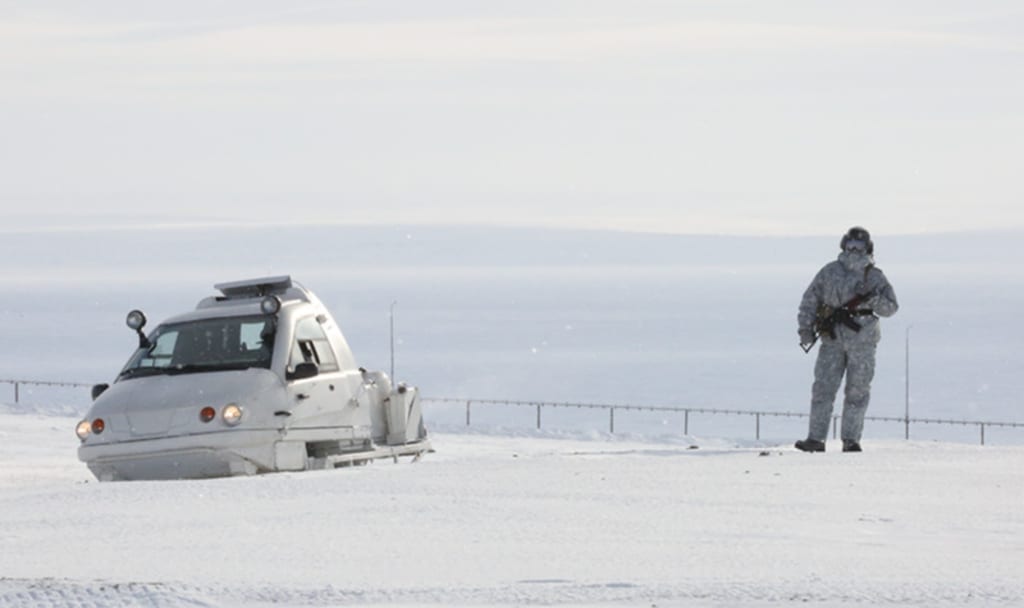
As continuous changes in the climate make parts of the region previously inaccessible open, countries rush to make their claims on assets of strategic shipping lanes and valuable resources.
While the broad geopolitics struggle leads in Russia and China, showing increasing cooperation between them stirs the pot for stability and security concerns in the region.
Russia's Ambitions and Challenges in the Arctic
For a long time, the Arctic had emerged as a land of strategic military significance to Russia.
It occupies an important role in its military endeavors and economic interests. In reaction to situations after the annexation of Crimea in 2014, Russia massively expanded its presence in the Arctic with additions of new airbases, deployment of ground troops, and increased naval capabilities.
The northern fleet, consisting of most submarines of nuclear strike force, projects the most vital military aspect towards the objective of establishing Russia as a hegemon within the Arctic.
At least in the initial period, this military build-up appeared to increase Russia's operational capabilities, particularly within the opening stages of the war in Ukraine.
Russian airbases in the Arctic allowed strategic bombers to operate from the relative security of the north. But with Ukraine's advances in drone technology, all that changed dramatically-even to attack the Olenya airbase south of Murmansk at the end of July 2024.
All in all, the operation has shown how thin the returns on Russia's Arctic military strategy are and how Ukraine is increasingly capable of threatening Russian positions.
The Western response to Russia's aggression in Ukraine has been one of unified pushback, especially in regard to its Arctic ambitions. In response to the start of the conflict, the seven Western members of the Arctic Council-Canada, Denmark, Finland, Iceland, Norway, Sweden, and the United States-froze all cooperation with Russia, a dramatic turnabout that included scrapping scientific projects on climate change.
While Russia is still a member of the Arctic Council, its strategy now carries more of a national tone, and its ambitions are scrutinized more than ever.
Western sanctions against Russia further complicate the Arctic strategies of Russia.
Even as Russia has invested much in military and economic infrastructure, it cannot realize gains from such investments due to the international sanctions regime. Significantly, the LNG 2 project - inaugurated by President Vladimir Putin in July 2023 - already was well behind its development schedule because of the reduced involvement of Western investors.
Chinese companies have moved in to plug some of the gaps, but this has made Russia even more dependent on China and also has highlighted how there may be risks in that dependency.
Besides military ambitions, however, the Arctic is also a very strategic economic frontier for Russia. Indeed, the Arctic is rich in oil and gas deposits, and other minerals, thus being targeted for extraction and commercialization. There are estimates that the Arctic may hold about 412 billion barrels of oil and significant resources of natural gas, among other mineral resources. The recognition by international bodies of Moscow's claims to the Arctic shelf has lately consolidated its claims over these resources.
However, most of these economic benefits are being realized with lots of difficulties. The sanctions imposed by the West, especially those against energy exports from Russia, have hurt Russia's ability to find markets for its liquefied natural gas. The reports at the same time show that till September 2024, Russia struggled to find buyers for the LNG, which would be produced by its flagship LNG 2 project, showcasing the fragility of its economic position.
Within that context, the idea that Russia would be able to use the Arctic militarily or economically seems more and more like a mirage.Strategic Alliances in the Arctic: The Rise of Cooperation China-Russia
This cooperation in the Arctic has gained increased poignancy as Russia faces mounting pressure from the West.
The U.S. Department of Defense has sounded warnings over the cooperation, describing it as a "destabilizing factor" for the region. Both nations are expanding their military presence and operation within the Arctic region, with Russia modernizing a number of military bases and China advancing its interests through heavyweight investments in polar research and exploration.
The budding partnership represents a dramatic new turn in the strategic balance of the Arctic, with China's vision of a "Polar Silk Road" seeking greater access to the Arctic resources and shipping routes while offering Russia opportunities for economic development. So far, this partnership has gained the skepticism of the United States and its allies, who consider it an unfavorable development for regional security.
But Moscow and Beijing have also vigorously counterbalanced with complaints about U.S. concerns over their respective Arctic activities, with Russian officials arguing that their cooperation with China is not directed against anyone and serves regional stability.
The Chinese representatives, for their part, underline the fact that the initiatives in the Arctic are fully in line with international law and principles of sustainable development.
This narrative shows how both countries try to present their cooperation in a positive light at a moment when tensions between them and the West are growing.
Implications for NATO and Security Landscape
Revision of NATO's Strategic Focus
The shifting geopolitical landscape requires a reassessment of the security landscape regarding NATO.
It would, in turn, be of essence as Russia and China develop military capabilities in the Arctic that NATO builds and deploys capable forces in the area. Over the course of the last several years, the U.S. has acknowledged the strategic importance of the Arctic, naming an ambassador at large, while requesting additional investment in military capability and technology to deter and defeat potential foes.
Recent military exercises, including maneuvers in the Arctic, have underscored a commitment to collective defense. The joint U.S.-Canada-Finland deal to supply icebreaker ships - the great vessels which are capable of powering through thick sea ice - institutes a major effort to enhance Western capabilities and is imposing a uniform response on Russia's actions. Surveillance and Intelligence
As tensions rise, the challenge is keeping situational awareness over the Arctic. The U.S. Navy has sent advanced surveillance systems-the P-8 Poseidon-a clue to NATO's determination to keep tabs on what Russia is doing in the region. In addition to collecting essential intelligence, these missions are stern warnings to Moscow.
However, in light of the interactions between the NATO forces and the operations on the Russian side, it is living up to its condition of "Cold War" mentality. Therefore, that does suggest a complex and multifaceted security landscape in the Arctic.
Kirkenes: A Microcosm of Arctic Geopolitics
Kirkenes is a small, diminutive Norwegian town just six miles from the Russian border.
It embodies much of the complexities of geopolitics in the Arctic. Historically an iron ore mining town, Kirkenes was initially a region marked by significant socio-economic flux since the depreciation of the industry and the end of the Soviet Union. In the aftermath of 1991, during this brief betterment of relations, it became a hotbed for trade and cultural exchange with Russia. It has now, with the increase in tensions, reemerged as a site of geopolitical contention .
Hybrid Warfare and Local Effects
Kirkenes has found itself right on the front lines of this hybrid war that Russia is waging against NATO. Residents are growing suspicious due to espionage activities and destabilizing activities. That vessels from Russia would appear in the area further suggests military operations masquerading as civilian activities, testifying to the blurring lines between peace and conflict in the Arctic.
The methods of its use by Russia range from a complete disinformation campaign up to military intimidation, posed to take advantage of every weakness in NATO and disrupt regional stability. The following is complex hybrid warfare that faces huge challenges for local security forces and intelligence agencies.
Climate Change as a Catalyst for Conflict
While traditional security discussions often focus on military threats, the potentially insidious role of climate change as a trigger to conflict often goes unconsidered.
NATO already identifies climate change as a "threat amplifier" that exacerbates other security problems. The Arctic, now at a faster pace of global warming, is turning into a geopolitical hot spot where the access to resources will be crucially important for the nations.
As the ice melts, so the potential for armed conflict over resources increases; Russia is being especially assertive. The transformation of the Arctic demands an increasingly sophisticated understanding of the complex interplay among environmental change and geopolitical tensions
The scramble for Arctic resources carries immense implications in international relations.
These huge deposits of oil, gas, and minerals have lured several nations into competitive pursual. An aggressive military posture adopted by Russia suggests its commitment to securing its interests and hence complicating diplomatic efforts at achieving stability.
Of all the other factors, climate change and resource competition are the two drivers hanging the precarious balance between cooperation and conflict. The melting Arctic ice caps opened not only new shipping routes but also upped the ante in the contest for supremacy over the valued resources.
Humanitarian Crisis and Geopolitical Implications
Weaponization of Refugees
Kirkenes is not only a hotbed of geopolitical tension but is also facing a humanitarian crisis stirred up by an influx of refugees.
The city was one of the main entry points for asylum seekers since 2015, considered by many as a natural exodus due to conflicts in the Middle East. In fact, according to local intelligence officials, suspicion is that it may be rather far from being spontaneous, and Russia might use asylum flows as a kind of hybrid warfare.
The "weaponizing of refugees" presents a highly alarming issue to national security and humanitarian policy wholeness in Norway. Of course, the suspicion about intelligence gathering behind asylum-seeking processes has been furthered by the arrivals of people from different countries, especially those who speak Russian.
Emerging Threats and Counterintelligence Responses
This is the face of the rapidly growing complexity in the realm of Kirkenes: a city that has to deal with counterintelligence.
The intelligence officials fear the situation may be exploited by the Russian operatives, who would subsequently use refugees to glean information on sensitive operations of NATO in the region. Intersections of humanitarian crises and security threats present challenges that are by all means daunting for both local and national authorities, as well as intelligence agencies.
The Arctic is in flux, with military interests, economic matters, and humanitarian crises all juxtaposed against one another. Russia's extra military deployment and its strategic partnership with China are the most critical challenges facing NATO and the West.
Events in Kirkenes have been like a microcosm of these dynamics, depicting the multifaceted nature of geopolitics at play in the Arctic region.
While climate change remains the principal factor reshaping the region, nations must elaborate on comprehensive solutions not only in terms of security but also humanitarian concerns and cooperate through the tangled web of variety in the ramifications of the future represented by the Arctic.
About the Creator
Tanguy Besson
Tanguy Besson, Freelance Journalist.
https://tanguybessonjournaliste.com/about/
Keep reading
More stories from Tanguy Besson and writers in Earth and other communities.
BRICS and the New World Disorder
The world is becoming multipolar, and the geopolitical and economic landscape might be fundamentally changing. At the driving seat of these changes, the BRICS bloc - an emerging economies grouping that brings together Brazil, Russia, India, China, and South Africa - , seeks to confront the G7. Its objective: de-dollarization.
By Tanguy Bessonabout a year ago in Earth
Tributes Pour In for Beloved Actress Catherine O’Hara
Tributes are pouring in from fans, fellow actors, and filmmakers celebrating the career and influence of Catherine O’Hara, one of the most beloved figures in film and television comedy. Known for her unforgettable roles, sharp wit, and emotional range, O’Hara has built a legacy that spans decades and generations of audiences.
By Aarif Lashari5 days ago in Earth


Comments
There are no comments for this story
Be the first to respond and start the conversation.