
The Physics of Rainbows: A Springtime Phenomenon
Why Rainbows Appear in Spring and the Science Behind Their Colors

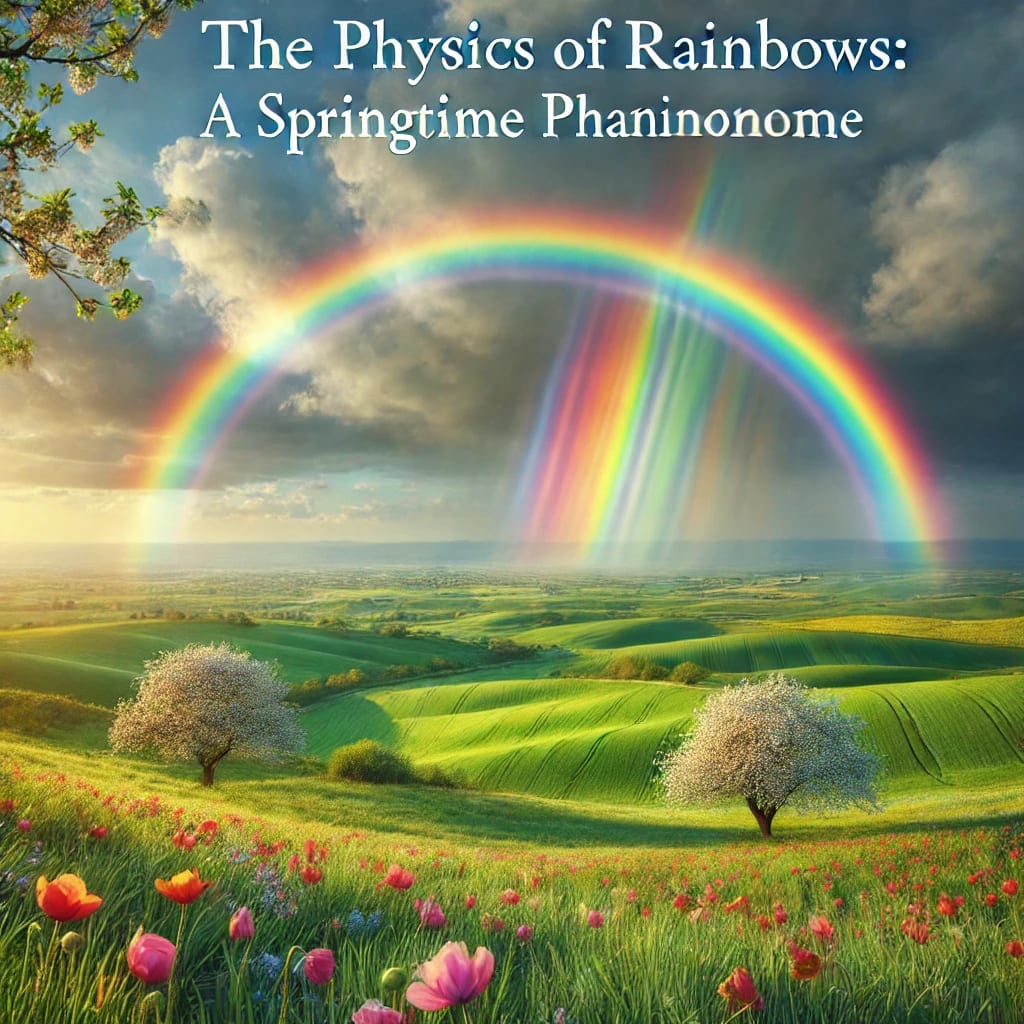
It had just stopped raining. The air smelled fresh, and tiny droplets still clung to the grass. As Emma stepped outside, she caught sight of it—a perfect rainbow stretching across the sky. The colors were vibrant, glowing against the fading storm clouds. She reached for her phone, eager to capture the moment, but she couldn’t help but wonder: How do rainbows form? Why do they appear more often in spring? And why do they always have the same colors?
Rainbows have fascinated humans for centuries, inspiring myths, art, and scientific curiosity. While many of us see them as a beautiful natural spectacle, the science behind rainbows is even more astonishing. In this article, we’ll explore the physics behind rainbows, why they are more common in spring, and what makes their colors so perfectly arranged.
The Science of Rainbows
Rainbows form because of three fundamental physics principles: reflection, refraction, and dispersion of light.
When sunlight hits a raindrop, it doesn’t just pass through—it bends. This bending, called refraction, happens because light travels at different speeds through air and water. As the light enters the raindrop, it slows down and bends. Inside the drop, some of the light reflects off the back of the droplet and exits, bending again as it leaves. But something even more fascinating happens: white sunlight splits into different colors because each color bends at a slightly different angle.
This process, known as dispersion, separates light into the seven distinct colors of the rainbow—red, orange, yellow, green, blue, indigo, and violet (ROYGBIV).
The reason we see a curved arc is that millions of tiny raindrops in the sky are bending and reflecting sunlight at the same time. The result? A perfectly shaped, multi-colored bow across the sky.
Why Do Rainbows Appear More in Spring?
Spring is known for its unpredictable weather—sunshine one moment, rain showers the next. This combination of rain and sunshine is the perfect recipe for rainbow formation.
Unlike winter, when the sun is lower in the sky, or summer, when rain is less frequent, spring provides ideal conditions for rainbows. The higher sun angle and frequent short rain showers create the perfect setup. When sunlight breaks through the clouds while raindrops are still in the air, a rainbow is almost inevitable.
If you’ve ever noticed that rainbows often appear in the morning or late afternoon, it’s because the sun has to be at the right angle—about 42 degrees above the horizon. That’s why you won’t see a rainbow if the sun is directly overhead at noon.
Why Are Rainbow Colors Always in the Same Order?
One of the most magical things about rainbows is their consistency. Whether you see a rainbow in Africa, Europe, or your backyard, the colors always follow the same pattern—red at the top, violet at the bottom.
This happens because different colors of light bend at different angles. Red light bends the least, exiting the raindrop at a wider angle, which is why it appears at the top. Violet light bends the most, appearing at the bottom. The other colors fall in between, always in the same order.
Sometimes, if conditions are just right, you might see a double rainbow. In this case, light reflects twice inside the raindrop before leaving, creating a second, fainter rainbow above the first. Interestingly, the colors in the second rainbow appear reversed, with red on the bottom and violet on top!
Conclusion
Rainbows aren’t just beautiful—they’re a perfect example of the wonders of physics. Thanks to reflection, refraction, and dispersion, we get to witness these breathtaking natural spectacles, especially in the rainy yet sunny days of spring.
The next time you see a rainbow, take a moment to appreciate the science behind it. It’s not just magic—it’s physics in action. And if you ever spot a double rainbow, consider yourself lucky—you’ve just witnessed one of nature’s rarest and most stunning light shows!
“Try to be a rainbow in someone’s cloud.” – Maya Angelou
Have you ever seen a rainbow that left you in awe? Share your experience in the comments below!
About the Creator
Pure Crown
I am a storyteller blending creativity with analytical thinking to craft compelling narratives. I write about personal development, motivation, science, and technology to inspire, educate, and entertain.
Keep reading
More stories from Pure Crown and writers in Earth and other communities.
How Spring Impacts Your Sleep Cycle (and What to Do About It)
It was 5:30 AM, and Sarah found herself wide awake, staring at the ceiling. Just a month ago, she could sleep soundly until her alarm rang at 7 AM. But now, with spring in full swing, the morning sunlight streamed through her blinds earlier than ever, nudging her awake before she was ready. She felt groggy, her sleep interrupted, her body struggling to adjust.
By Pure Crownabout a year ago in Earth




Comments
There are no comments for this story
Be the first to respond and start the conversation.