
The NASA orbiter captures breathtaking images of the Martian horizon.
Authored by NASA.

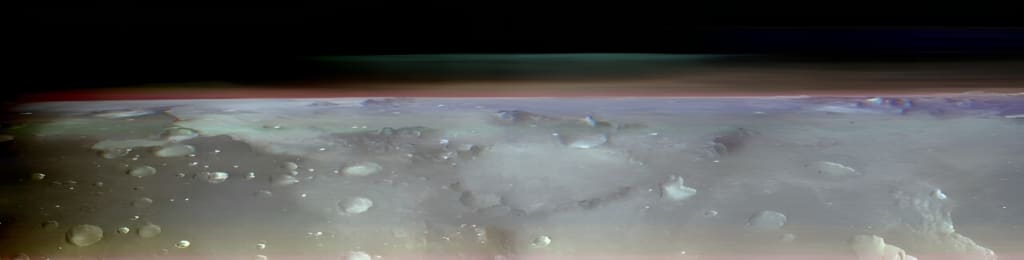
The awe-inspiring reactions that astronauts often have when witnessing the curvature of Earth from the International Space Station are now being mirrored by scientists studying Mars. Thanks to NASA's 2001 Mars Odyssey orbiter, which recently completed its 22nd year at the Red Planet, these scientists are experiencing a similar sensation.
The orbiter has captured a remarkable series of panoramic images that unveil the curved Martian landscape beneath layers of clouds and dust. These images, when stitched together, not only provide a fresh and breathtaking view of Mars but also offer valuable insights into the Martian atmosphere for scientists.
Taken in May from an altitude of approximately 250 miles (400 kilometers), the same altitude at which the space station orbits Earth, these images provide a perspective that would be seen by astronauts if they were in orbit around Mars. This unique viewpoint allows scientists to gain a new understanding of the Red Planet.
Jonathon Hill, the operations lead for Odyssey's camera known as the Thermal Emission Imaging System (THEMIS) at Arizona State University, expressed his excitement, stating, "No Mars spacecraft has ever had this kind of view before." This unprecedented perspective opens up new avenues for scientific exploration and allows researchers to delve deeper into the mysteries of Mars.
# What was the process?
The view is considered uncommon due to the difficulties involved in its creation. The engineers at NASA's Jet Propulsion Laboratory in Southern California, along with Lockheed Martin Space, spent three months meticulously planning the THEMIS observations. By utilizing the infrared camera's ability to detect warmth, they were able to map various elements such as ice, rock, sand, dust, and temperature changes on the planet's surface.
Additionally, the camera can measure the presence of water ice or dust in the atmosphere, but only in a narrow column directly beneath the spacecraft. This limitation arises from THEMIS being fixed in place on the orbiter, typically pointing downwards.
The mission aimed to obtain a broader perspective of the atmosphere. By observing the positioning of water-ice clouds and dust layers in relation to one another, scientists can enhance their understanding of Mars' atmosphere and refine their models.
Jeffrey Plaut, Odyssey's project scientist at JPL, described this approach as viewing a cross-section or a slice through the atmosphere. He emphasized that there are intricate details that cannot be observed from above, which is the usual method employed by THEMIS for measurements.
Due to THEMIS's inability to pivot, adjusting the camera angle necessitates repositioning the entire spacecraft. In this particular case, the team had to rotate the orbiter nearly 90 degrees while ensuring that the solar panels still received sunlight, while sensitive equipment remained shielded from overheating. The most convenient orientation was found to be one where the orbiter's antenna faced away from Earth. Consequently, the team temporarily lost communication with Odyssey for several hours until the operation was successfully completed.
The Odyssey mission aspires to capture similar images in the future, providing a comprehensive understanding of the Martian atmosphere across multiple seasons.
# Over the moon:
In order to maximize their efforts, the mission also obtained images of Phobos, Mars' small moon. This occurrence signifies the seventh occasion in a span of 22 years that the orbiter has directed THEMIS towards the moon to analyze temperature fluctuations across its surface.
According to Hill, "We have captured Phobos from a different perspective and under distinct lighting conditions compared to our usual observations. This adds a unique element to our Phobos dataset."
The newly acquired images offer valuable insights into the moon's composition and physical characteristics. Further examination could potentially resolve the ongoing debate regarding Phobos' origin, whether it is a captured asteroid or a fragment of Mars that was ejected from the surface due to an impact.
NASA is collaborating with JAXA (Japan Aerospace Exploration Agency) on a sample return mission to Phobos and its companion moon, Deimos, known as Mars Moon eXplorer (MMX). The Phobos imagery obtained by Odyssey will prove beneficial to scientists involved in both the Odyssey mission and MMX.
About the Creator
Keep reading
More stories from Afeef Khan and writers in Earth and other communities.
Study suggests dinosaurs' extinction not solely due to asteroid, but multiple factors.
The extinction of dinosaurs 66 million years ago has long been attributed to an asteroid's collision with Earth. However, scientists have been engaged in a heated debate over whether other factors also played a role in this mass extinction event. A recent study has once again ignited this debate by proposing that volcanic eruptions may have already destabilized the ecosystem and posed a threat to non-bird dinosaurs even before the asteroid impact occurred.
By Afeef Khan2 years ago in Earth
At Least 22 Dead as Crane Collapses Onto Train in Thailand
Thailand has been plunged into mourning after a devastating accident in which a construction crane collapsed onto a moving passenger train, killing at least 22 people and injuring dozens more. The incident, described by officials as one of the deadliest infrastructure-related accidents in recent years, has raised urgent questions about construction safety, urban development, and oversight in the country.
By Aarif Lashari6 days ago in Earth


Comments
There are no comments for this story
Be the first to respond and start the conversation.