
The Mighty Crocodile – The Ancient Ruler of Water and Land
A fascinating look at one of Earth’s oldest and most powerful predators — the crocodile that has ruled rivers and lakes for over 200 million years.

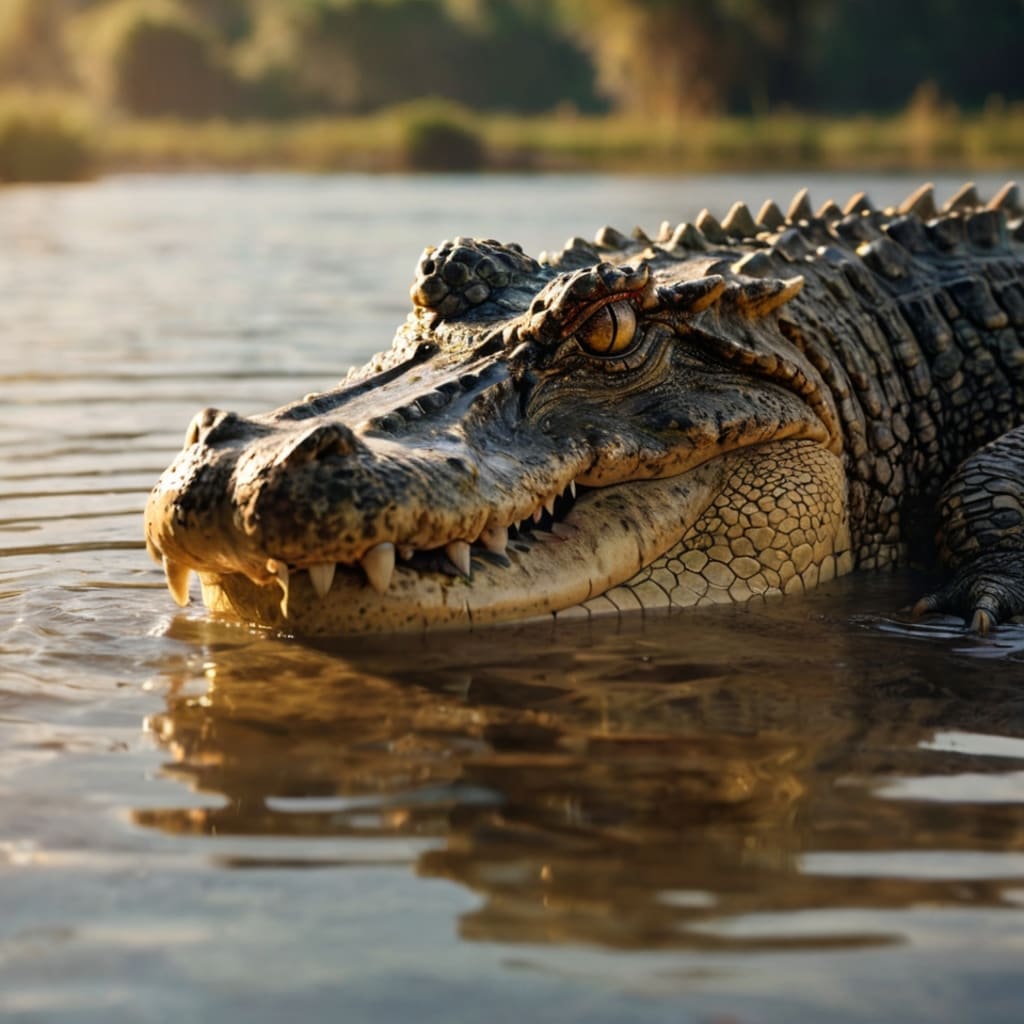
The Mighty Crocodile – The Ancient Ruler of Water and Land
BY: Khan
The very name Crocodile sends a chill down the spine. It is a large reptile that has lived on Earth for millions of years and is known for its fearsome power and stealth. The crocodile is a remarkable creature because it can live both on land and in water — which is why it is often called an amphibian giant. Though it appears clumsy on land, once it slips into the water, it becomes one of nature’s most skilled and powerful swimmers.
Crocodiles are found in the rivers, lakes, and marshes of Asia, Africa, Australia, and the Americas. They thrive both in freshwater and saltwater habitats. These ancient predators usually feed on fish, small animals, and sometimes even large mammals that come near the water’s edge.
It is said that crocodiles have existed on Earth for over 200 million years — long before humans appeared. Their body structure and survival skills have changed very little over time, proving how perfectly they are adapted to their environment. Their tough, scaly skin, sharp teeth, and powerful tails make them one of the most successful hunters in the animal kingdom.
When a crocodile swims, it keeps its legs close to its body, using its strong tail to glide smoothly through the water. The webbing between its toes helps it to paddle in shallow areas or move swiftly when needed. While underwater, a crocodile closes its nostrils tightly to prevent water from entering. Inside its throat is a special flap of skin that seals off the windpipe, allowing the animal to open its mouth underwater without drowning.
Interestingly, a crocodile’s tongue cannot move freely like ours — it is attached to the bottom of its mouth by a thin membrane. Its eyes, ears, and nostrils are located on the top of its head, allowing it to remain almost completely submerged while still being able to see, hear, and breathe. This makes the crocodile an expert ambush hunter.
Crocodiles usually hunt by stealth. They float quietly in the water, waiting for an unsuspecting victim to come close. Then, with lightning speed, they lunge forward, grab the prey, and drag it into the water. Their night vision is excellent, allowing them to hunt effectively even in the dark.
A crocodile’s mouth holds around 74 sharp, conical teeth that can pierce deeply into flesh. Once it bites, there is almost no escape — its jaws can lock with a force unmatched by most animals. In fact, the saltwater crocodile of Australia has a bite three times stronger than that of a lion. However, despite this power, the crocodile’s jaws are also incredibly sensitive.
Scientists were amazed to discover that a crocodile’s jawline is packed with thousands of tiny nerve endings — even more sensitive than the tips of human fingers. Researcher Duncan Leitch once wrote that “all the nerve fibers in a crocodile’s jaw pass through a single opening in the skull, making them both protected and highly responsive.” This sensitivity allows a crocodile to sense the slightest movement in the water — even a single drop touching its skin.
This extraordinary ability is also what helps a mother crocodile handle her eggs and babies so gently. She can carry her newborns in her mouth without crushing them — a rare display of tenderness in such a fierce predator.
Crocodiles do not chew their food; instead, they swallow large chunks of flesh whole. When their stomach is full, they often crawl onto land, open their mouths wide, and bask in the sun. This “mouth gaping” behavior helps regulate their body temperature since crocodiles do not sweat. Sometimes, small birds approach and feed on the leftover meat stuck between their teeth — a strange yet peaceful partnership between predator and scavenger.
Crocodiles have an excellent sense of hearing and can detect even the faintest sounds. While resting, they may keep their mouths open to release body heat. They usually grow between 1 to 5 meters long, and some can weigh over 200 kilograms.
When it comes to reproduction, the female crocodile builds her nest near the water, digging a pit in the sand or mud. She lays her eggs there, covers them carefully with soil, and guards the nest from predators. The eggs are incubated by the warmth of the sun and the mother’s body. After some time, tiny crocodile hatchlings emerge — each only about 8 inches long. The mother gently helps them reach the water, where they begin their perilous journey of survival.
The back of a crocodile is covered with hard, armor-like scales called scutes, which run from its head to the tip of its tail. These tough scales protect it from injuries and attacks, while the belly skin remains soft and smooth. Because of this, crocodile skin has been highly valued by humans for centuries. It is used to make expensive leather goods such as shoes, belts, and handbags — a trade that, sadly, has led to the hunting and endangerment of many crocodile species.
Crocodiles are true survivors of Earth’s ancient past. They are symbols of patience, strength, and adaptability. Despite their terrifying appearance, they play an important role in maintaining the balance of aquatic ecosystems by controlling fish and animal populations. The mighty crocodile, ruler of both water and land, reminds us that every creature — no matter how fearsome — has its own place and purpose in the natural world.
About the Creator
1600 People Reported Dead and 12 Homes Collapsed After a 4.7 Earthquake Struck Israe
**1600 People Reported Dead and 12 Homes Collapsed After a 4.2 Earthquake Struck Israel** Reports circulating after a 4.2-magnitude earthquake struck parts of Israel have caused widespread confusion and alarm, particularly claims stating that 1600 people were killed and 12 homes collapsed as a result of the tremor. The earthquake itself was felt across several regions, especially in the south near the Dead Sea and the Negev, prompting emergency alerts and heightened public concern. However, the scale of the reported casualties has raised serious questions, given the relatively moderate magnitude of the quake.
By America today 4 days ago in Earth




Comments
There are no comments for this story
Be the first to respond and start the conversation.