
The Life Cycle of - Saara Hardwickii
(The Indian Spiny-tailed Lizard)

Introduction
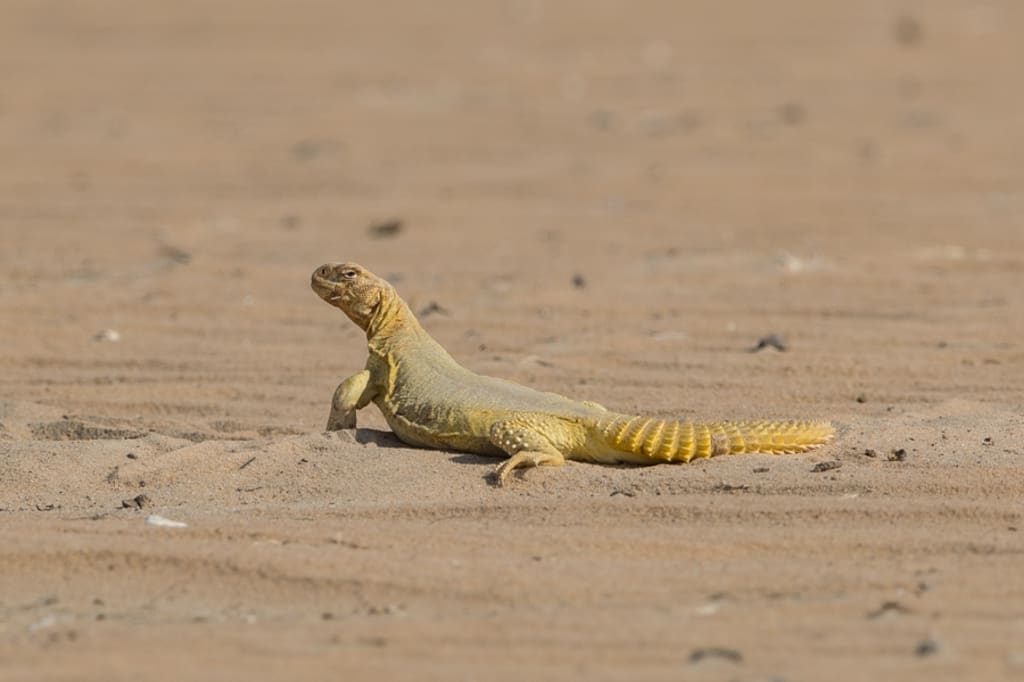
Saara Hardwickii, commonly known as Hardwicke's spiny-tailed lizard or the Indian spiny-tailed lizard, is a unique reptile found in the arid and semi-arid regions of South Asia, particularly in India, Pakistan, and Afghanistan. This species is well-adapted to desert environments and is known for its distinctive spiny tail, which it uses for defense. Understanding its life cycle provides insight into its survival strategies in harsh conditions.
Class: Reptilia
Scientific name: Uromastyx hardwickii
Higher classification: Saara
Rank: Species
Family: Agamidae
Kingdom: Animalia
Order: Squamata
The Egg Stage
The egg stage marks the beginning of "Saara Hardwickii's" life cycle. After mating, the female digs a burrow in sandy or loamy soil to lay her eggs.
Breeding Season
Mating typically occurs in the spring (from March to May).
• Egg Laying: Females lay 6–12 eggs in a single clutch, usually between May and July.
• Incubation: The eggs are left buried, relying on ambient heat for incubation. The incubation period lasts about 60–90 days, depending on temperature and humidity.
Developing Stage
Once the eggs hatch, juvenile lizards emerge, fully independent from birth.
• Appearance: Hatchlings are miniature versions of adults but with brighter coloration.
• Survival Challenges: At this point, birds, snakes, and other reptiles are a significant threat.
• Behavior: They quickly learn to forage and seek shelter in burrows to avoid extreme temperatures.
Juvenile Stage
As the lizards grow, they undergo several developmental changes.
• Growth Rate: They consume insects and plant material to grow rapidly in the first year.
• Burrow Adaptation: Young animals protect themselves by digging small burrows or using abandoned ones. - Social Behavior: They are mostly solitary but may share burrows in high-density populations.
Adult Stage
By 2–3 years of age, “Saara Hardwickii” reaches sexual maturity.
• Size: Adults can grow up to 50–60 cm in length, including the tail.
• Diet: Primarily herbivorous, feeding on leaves, flowers, and fruits, but they may also consume insects.
• Defense Mechanism: Their spiny tail is used to block burrow entrances against predators.
Reproduction and Lifespan
• Mating Rituals: Males engage in territorial displays and combat to attract females.
• Lifespan: In the wild, they can live up to 10–15 years if they avoid predation and harsh environmental conditions.
Conservation Status
Saara Hardwickii is currently listed as “Least Concern” by the IUCN(International Union for Conservation of Nature), but habitat destruction and illegal pet trade pose threats to its population. Conservation efforts focus on protecting its natural desert habitats.
Conclusion
The Indian spiny-tailed lizard (Saara Hardwickii) is a fascinating example of evolutionary adaptation to arid environments. Its life cycle, which includes egg-laying in carefully dug burrows, independent hatchlings, and long-lived adults, shows that it can survive in the harsh desert. The species’ herbivorous diet, burrowing behavior, and unique spiny tail defense mechanism highlight its specialized ecological niche.
Studying Saara Hardwickii provides valuable insights into desert ecosystems, where reptiles play crucial roles in soil aeration, seed dispersal, and food web dynamics. Their burrows also offer shelter for other small animals, contributing to biodiversity. However, despite their adaptability, these lizards face growing threats from human activities. Protecting Saara Hardwickii is not just about conserving a single species but also about preserving the delicate balance of arid and semi-arid ecosystems.
About the Creator
Imtiaz Mahmud (Ratul)
Writer of thoughts, stories, and moments that matter. I share real experiences, reflections, and ideas that connect. Here to inspire, express, and explore through words. Let’s connect through honest writing and meaningful reads.
Welcome
Keep reading
More stories from Imtiaz Mahmud (Ratul) and writers in Earth and other communities.


Comments
There are no comments for this story
Be the first to respond and start the conversation.